When selecting a benchtop conductivity meter, it’s essential to balance accuracy, ease of use, and durability. The Apera Instruments EC700 stands out as the best overall due to its reliable performance and intuitive interface. For those seeking a more budget-friendly option, the Bante 510 offers solid features within a lower price point. Meanwhile, the Apera Instruments EC800 provides a comprehensive kit suited for advanced lab work. Readers should be aware that tradeoffs often involve balancing precision against cost and complexity. Continue reading for a detailed breakdown of each model and how they compare to meet different needs.

Prime made for students and young adults
- Fast, free delivery for dorm and study essentials
- Prime Video and Amazon Music included
- Member-only deals
Key Takeaways
- Top-performing models like the EC700 and EC800 provide high accuracy but come at a premium price.
- Electrode quality and durability significantly influence long-term reliability and maintenance costs.
- Multi-parameter options, such as pH and TDS integration, add versatility but may complicate calibration procedures.
- Budget-friendly meters like the Bante 510 deliver good value for basic testing without advanced features.
- Ease of calibration and auto-recognition features are common differentiators that improve user experience.
| Apera Instruments EC700 Benchtop Conductivity/Temperature Meter |  | Best Overall for Laboratory Precision and Data Management | Range: 0-200.0 mS/cm | Accuracy: 1% F.S | Calibration: Auto with guide and self-diagnosis | VIEW ON AMAZON | See Our Full Breakdown |
| Bante 510 Benchtop Conductivity Meter with Platinum Electrodes, 0-200 mS/cm Range |  | Best for Research and Educational Settings Requiring Reliable Calibration | Measurement Range: 0 to 200 mS/cm | Electrodes: 2 Platinum Electrodes | Calibration Points: 1 to 3 points | VIEW ON AMAZON | See Our Full Breakdown |
| EC200EM Conductivity Meter 0.00–200 mS/cm Range ±1.0% FS Accuracy Data Storage Auto-Read IP54 Lab Benchtop |  | Best for Water Quality Testing with Waterproof Durability | Range: 0.00 μS/cm to 200 mS/cm | Accuracy: ±1.0% FS | Data Storage: Up to 50 results | VIEW ON AMAZON | See Our Full Breakdown |
| Benchtop Conductivity Meter |  | Best for Large Display and Custom Settings in Laboratory Settings | Display: 6.0 inch LCD | Range: 0.00 S/cm to 100.0 mS/cm | Accuracy: 1.5% FS | VIEW ON AMAZON | See Our Full Breakdown |
| Apera Instruments EC800 Laboratory Benchtop Conductivity Meter Kit |  | Best for Scientific Research and Data Management | Range: 0-200 MS/cm | Accuracy: 1% F.S | Temperature Range: 0–50°C | VIEW ON AMAZON | See Our Full Breakdown |
| Oakton CON 550 Benchtop Conductivity Meter Kit |  | Best Overall for Reliable Laboratory Use | Measurement Range: 0 to 200 mS/cm | Calibration: Four-point conductivity calibration, automatic solution recognition | Temperature Compensation: Yes, automatic | VIEW ON AMAZON | See Our Full Breakdown |
| Apera Instruments PC910 Benchtop Dual-Channel pH/Conductivity Meter Kit with LabSen 211 Refillable Glass pH Electrode | 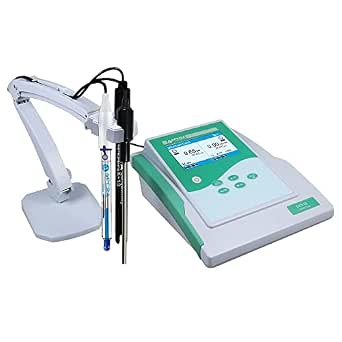 | Best for Multi-Parameter Water Analysis with User-Friendly Interface | Product Dimensions: 13.03 x 10.24 x 6.61 inches | Item Weight: 6.82 pounds | Calibration: Automatic, smart guidance, self-diagnosis | VIEW ON AMAZON | See Our Full Breakdown |
| Sper Scientific Benchtop Water Quality Meter 860033 – Multi-Parameter pH, ORP, Conductivity, TDS, Salinity & Temperature Analyzer |  | Best for Multi-Parameter, Industrial-Grade Water Testing | Measurement Parameters: pH, ORP, mV, conductivity, TDS, salinity, temperature | pH Range: 0 to 14 | Conductivity Range: 0 to 19.9 uS/cm, 0.1 to 19.99 mS/cm | VIEW ON AMAZON | See Our Full Breakdown |
| Apera Instruments EC820 Benchtop Conductivity Meter Kit with Auto-Calibration |  | Best for High-Precision Conductivity with Data Management | Accuracy: ±0.5% F.S | Calibration: Auto 1-4 points | Display: Backlit LCD | VIEW ON AMAZON | See Our Full Breakdown |
| Apera Instruments PC800 Benchtop pH/Conductivity/TDS/Salinity/Resistivity/Temp. Multiparameter Meter Kit, 0.01 pH/1% F.S Accuracy AI523 |  | Best for Scientific Research and Quality Control | Measurement Range pH: -2.00 to 19.99 | Conductivity Range: 0 to 200.0 mS | Temperature Range: 0 to 100°C | VIEW ON AMAZON | See Our Full Breakdown |
| High-Precision Conductivity Meter EC400F |  | Best for Laboratory and Industrial Precision | Measurement Range: 0.000 μS/cm–1000 mS/cm | Accuracy: ±0.5% FS | Parameters Supported: Conductivity, TDS, salinity, resistivity, temperature | VIEW ON AMAZON | See Our Full Breakdown |
| benchtop conductivity meter | Accuracy | Calibration |
|---|---|---|
| Apera Instruments EC700 Bencht | 1% F.S | Auto with guide and self-diagnosis |
| Bante 510 Benchtop Conductivit | ±1% F.S. | — |
| EC200EM Conductivity Meter 0.0 | ±1.0% FS | — |
| Benchtop Conductivity Meter | 1.5% FS | — |
| Apera Instruments EC800 Labora | 1% F.S | 1 to 4 points auto calibration |
| Oakton CON 550 Benchtop Conduc | — | Four-point conductivity calibration, automatic solution recognition |
| Apera Instruments PC910 Bencht | — | Automatic, smart guidance, self-diagnosis |
| Sper Scientific Benchtop Water | — | — |
| Apera Instruments EC820 Bencht | ±0.5% F.S | Auto 1-4 points |
| Apera Instruments PC800 Bencht | 0.01 pH / 1% F.S | — |
| High-Precision Conductivity Me | ±0.5% FS | Up to 3-point with automatic standard recognition |
More Details on Our Top Picks
Apera Instruments EC700 Benchtop Conductivity/Temperature Meter
This model stands out for its high accuracy and advanced auto-calibration, making it ideal for precise laboratory measurements. Unlike the Bante 510, which emphasizes research-grade durability, the EC700 integrates digital processing and data storage seamlessly, supporting detailed record-keeping. Its spill-proof design adds to reliability in busy lab settings, but it’s limited to benchtop use and requires calibration solutions, which could be a hassle. If you need a dependable, feature-rich instrument with integrated data management, the EC700 delivers. However, for those seeking portability or quick, on-the-fly testing, this might be too bulky and calibration-dependent.Pros:- High accuracy with 1% F.S precision
- Auto calibration with self-diagnosis and guidance
- Includes calibration solutions and data storage capabilities
- Durable, spill-proof, IP54 design
Cons:- Limited to benchtop use; no portable features
- Requires calibration solutions for maintenance
Best for: Research laboratories and quality control labs needing high accuracy and data tracking
Not ideal for: Field technicians or casual users who prioritize portability over detailed data management
- Range:0-200.0 mS/cm
- Accuracy:1% F.S
- Calibration:Auto with guide and self-diagnosis
- Electrode:2301T-s platinum black ATC
- Data Storage:50 groups
- Protection:IP54 spill-proof and dust-proof
Our verdict“This is best suited for dedicated laboratory environments requiring consistent precision and data handling.”
Bante 510 Benchtop Conductivity Meter with Platinum Electrodes, 0-200 mS/cm Range
The Bante 510 is tailored for research and classroom environments, offering precise measurements with ±1% F.S. accuracy. It’s more straightforward than the EC800, focusing on automatic calibration, temperature compensation, and multiple calibration points, which are ideal for users needing consistent, accurate results. Its larger size and higher price point make it less suitable for portable use or quick field testing, but it compensates with durability and ease of calibration. If your priority is educational or research-grade testing with reliable standards, this model performs well, but casual or mobile users may find it too bulky and costly.Pros:- Accurate ±1% F.S. calibration
- Automatic temperature compensation
- Multiple calibration points with automatic recognition
- Durable build suitable for research
Cons:- Bulkier size limits portability
- Higher price may be prohibitive for casual use
Best for: Researchers and educators who need reliable, calibrated measurements in a stable lab setting
Not ideal for: Mobile technicians or casual hobbyists needing lightweight, portable units
- Measurement Range:0 to 200 mS/cm
- Electrodes:2 Platinum Electrodes
- Calibration Points:1 to 3 points
- Accuracy:±1% F.S.
- Dimensions:8.2 x 8 x 2.9 inches
- Weight:3.3 pounds
Our verdict“Ideal for research and educational environments that demand consistent accuracy and calibration ease.”
EC200EM Conductivity Meter 0.00–200 mS/cm Range ±1.0% FS Accuracy Data Storage Auto-Read IP54 Lab Benchtop
The EC200EM offers a wide measurement range with high accuracy, making it suitable for detailed water quality assessments. Its IP54 waterproof housing and data storage capabilities make it stand out for laboratory use, especially where water exposure is a concern. Unlike the EC700, which emphasizes advanced auto-calibration and data handling, the EC200EM leans toward durability and simplicity, but it requires manual calibration, adding a step for consistent results. It’s less suited for portable testing and more for controlled lab environments. If waterproofing and data traceability matter most, this model fits the bill, though it may be less flexible for quick field testing.Pros:- High measurement accuracy with ±1.0% FS
- Waterproof IP54 housing for durability
- Data storage for traceability
- Wide measurement range
Cons:- Manual calibration needed for accuracy
- Limited to laboratory environments
Best for: Laboratory water testing where waterproofing and data storage are priorities
Not ideal for: Mobile field operators or users needing quick, on-the-go measurements
- Range:0.00 μS/cm to 200 mS/cm
- Accuracy:±1.0% FS
- Data Storage:Up to 50 results
- Housing:IP54 waterproof
- Display Size:6.0 inches
Our verdict“This model excels in water testing labs emphasizing waterproof design and data management but isn’t suited for portable field use.”
Benchtop Conductivity Meter
This benchtop meter emphasizes usability with its large 6.0-inch LCD, which is a clear advantage over smaller displays like on the EC200EM. Its wide measurement range up to 100.0 mS/cm makes it versatile, while the customizable settings and manual temperature compensation appeal to users needing tailored experiments. Compared to the EC700, it offers fewer advanced features like data storage, but its intuitive display and high durability make it ideal for routine lab work. However, its lack of portability and somewhat limited accuracy (1.5% FS) could be drawbacks for precision-dependent applications.Pros:- Large, easy-to-read 6.0-inch LCD
- Wide measurement range
- Durable waterproof and dust-proof design
- Customizable calibration settings
Cons:- No portable design for field use
- Less precise than models with 1% accuracy
Best for: Laboratory users needing a large display and flexible settings for routine testing
Not ideal for: Field technicians or users requiring detailed data management or portability
- Display:6.0 inch LCD
- Range:0.00 S/cm to 100.0 mS/cm
- Accuracy:1.5% FS
- Protection:IP54 waterproof, spill-proof
- Features:Factory reset, manual temperature compensation
Our verdict“This is a solid choice for lab environments prioritizing display clarity and adjustable settings over portability or highest accuracy.”
Apera Instruments EC800 Laboratory Benchtop Conductivity Meter Kit
The EC800 offers comprehensive measurement options, including conductivity, TDS, salinity, resistivity, and temperature, making it the most versatile in this lineup. Its intelligent calibration and GLP-compliant data management via USB and PC-Link software set it apart from simpler models like the EC200EM, especially for labs needing detailed records. Its robust IP54 water resistance and inclusion of a full test kit make it suitable for intensive scientific work. The setup complexity and need for additional calibration solutions could be hurdles for less experienced users. This pick is ideal for those who require multi-parameter analysis and extensive data capabilities, but it might be overkill for basic testing needs.Pros:- High accuracy with 1% F.S.
- Multi-parameter measurements including TDS and salinity
- Auto calibration with multiple points and reminders
- Large backlit LCD with extensive data storage and USB output
Cons:- Complex setup and operation for beginners
- Additional calibration solutions may be needed
Best for: Advanced laboratories and quality assurance teams requiring multi-parameter testing and detailed data management
Not ideal for: Casual hobbyists or users looking for a simple conductivity meter without software integration
- Range:0-200 MS/cm
- Accuracy:1% F.S
- Temperature Range:0–50°C
- Calibration:1 to 4 points auto calibration
- Data Storage:500 groups
- Connectivity:USB, PC-Link software
- Water Resistance:IP54
- Included Accessories:Electrode, arm, holder, software, calibration solutions
Our verdict“This model fits advanced scientific applications demanding multi-parameter analysis and robust data handling, at the cost of increased complexity.”
Oakton CON 550 Benchtop Conductivity Meter Kit
The Oakton CON 550 stands out for its combination of automatic calibration, temperature compensation, and data storage, making it highly suitable for precise laboratory environments. Compared with the Apera PC800, it offers more straightforward operation with a focus solely on conductivity, while the PC800 covers multiple parameters. Its spillproof and dustproof design adds durability but results in a bulkier form, which might be less ideal for limited workspace. The four-point calibration ensures accurate readings without complex procedures, though it requires calibration solutions for optimal performance. This makes it an excellent choice for labs prioritizing accuracy and robustness over portability or multi-parameter versatility.
Pros:- Automatic calibration and temperature compensation ensure precise results
- Robust, spillproof, and dustproof design enhances durability in demanding environments
- Data storage capability simplifies record keeping and analysis
Cons:- Limited to measurements up to 200 mS/cm, restricting use in high-conductivity samples
- Bulkier design reduces portability for on-the-go testing
Best for: Laboratories and technicians needing dependable, accurate conductivity measurements with durable construction
Not ideal for: Field technicians or users requiring portable, multi-parameter testing without heavy equipment
- Measurement Range:0 to 200 mS/cm
- Calibration:Four-point conductivity calibration, automatic solution recognition
- Temperature Compensation:Yes, automatic
- Display:Max/Min readings, stable reading icon
- Connectivity:Connectors protected by silicone seal caps
- Ingress Protection:IP54 dustproof and spillproof
Our verdict“This meter is ideal for lab settings where accuracy and durability take precedence over portability.”
Apera Instruments PC910 Benchtop Dual-Channel pH/Conductivity Meter Kit with LabSen 211 Refillable Glass pH Electrode
The Apera PC910 excels at providing lab-grade pH and conductivity readings with its dual-channel design, large HD display, and automatic calibration. Unlike the Sper Scientific 860033, which offers multiple parameters including ORP, this model specializes in pH and conductivity, making it more streamlined for routine water testing. Its refillable glass electrodes and temperature probe support consistent, accurate results, though its weight and size can be cumbersome for users needing portability. The user interface, with multi-language support, simplifies operation, but beginners without training might find the multitude of features overwhelming. This makes it a top choice for labs that prioritize ease of use and reliable dual measurements over portability or multi-parameter complexity.
Pros:- Accurate, fast pH and conductivity measurements with automatic calibration
- Includes a refillable glass pH electrode and temperature probe for consistent results
- Large, HD color display with multi-language support enhances usability
Cons:- Relatively heavy and bulky, less suited for on-site testing
- May require training to navigate advanced features effectively
Best for: Water testing laboratories and educational labs requiring straightforward, dual-parameter measurements
Not ideal for: Field operators or technicians needing portable devices or multi-parameter analysis beyond pH and conductivity
- Product Dimensions:13.03 x 10.24 x 6.61 inches
- Item Weight:6.82 pounds
- Calibration:Automatic, smart guidance, self-diagnosis
- Display:HD TFT color screen
- Includes:Refillable glass pH electrode, temperature probe
- Best Sellers Rank:#740,780 in Industrial & Scientific
Our verdict“This meter makes the most sense for labs requiring reliable dual-parameter analysis with ease of operation.”
Sper Scientific Benchtop Water Quality Meter 860033 – Multi-Parameter pH, ORP, Conductivity, TDS, Salinity & Temperature Analyzer
The Sper Scientific 860033 offers comprehensive water analysis across multiple parameters, including pH, ORP, conductivity, TDS, salinity, and temperature. When compared with the Apera PC800, it provides broader parameter coverage, suitable for industrial or research environments. The large LCD display and included software support detailed data analysis, but its reliance on AC power and bulkier size make it less practical for field use. Its complex setup and multi-parameter focus mean it might be overwhelming for beginners or those needing quick, simple measurements. This model is best suited for detailed water quality monitoring where multiple parameters are required concurrently.
Pros:- Measures a wide range of water parameters with high accuracy
- Large backlit LCD simplifies reading complex data
- Includes electrodes, probes, and software for comprehensive analysis
Cons:- Requires AC power, no battery option for portability
- Setup can be complex, requiring training for optimal use
Best for: Industrial labs or environmental testing facilities requiring extensive water quality profiling
Not ideal for: Mobile field technicians or small-scale labs needing quick, single-parameter checks
- Measurement Parameters:pH, ORP, mV, conductivity, TDS, salinity, temperature
- pH Range:0 to 14
- Conductivity Range:0 to 19.9 uS/cm, 0.1 to 19.99 mS/cm
- Temperature Range:-5 to 176°F
- Display:Large LCD
- Includes:Electrodes, software
Our verdict“This multi-parameter analyzer is best for detailed water quality assessments in stationary lab environments.”
Apera Instruments EC820 Benchtop Conductivity Meter Kit with Auto-Calibration
The Apera EC820 provides high-accuracy conductivity measurements with its glass-body platinum electrode and auto-calibration, making it a flexible choice for research and manufacturing. Compared to the Oakton CON 550, the EC820 emphasizes precision with ±0.5% F.S accuracy and robust data management features, including USB export. However, it offers only three calibration solutions in the kit, which may limit calibration flexibility for some users. Its easy auto calibration and large backlit LCD support efficient workflow, yet the need for additional solutions can be a hurdle for new users. This pick makes the most sense for professionals prioritizing measurement accuracy and data handling over kit completeness or multi-parameter testing.
Pros:- High measurement accuracy of ±0.5% F.S
- Auto 1-4 point calibration with guidance
- Large backlit LCD and USB data export facilitate analysis
Cons:- Limited to three standard calibration solutions in the kit
- Requires additional solutions for extended calibration
Best for: Research labs or quality control teams requiring precise, high-accuracy conductivity measurements
Not ideal for: Users seeking a multi-parameter device or those on a tight budget for calibration solutions
- Accuracy:±0.5% F.S
- Calibration:Auto 1-4 points
- Display:Backlit LCD
- Electrode:Glass-body platinum
- Data Storage:500 groups
- Power:USB/AC
Our verdict“This meter is ideal for users who need high-precision conductivity data with straightforward calibration and data management features.”
Apera Instruments PC800 Benchtop pH/Conductivity/TDS/Salinity/Resistivity/Temp. Multiparameter Meter Kit, 0.01 pH/1% F.S Accuracy AI523
The Apera PC800 offers robust, multi-parameter water analysis with high accuracy—perfect for scientific research or quality control labs. Its comprehensive feature set, including pH, conductivity, TDS, salinity, resistivity, and temperature, surpasses simpler models like the Sper Scientific 860033 in versatility. The auto-calibration and GLP data management, along with a large backlit LCD, make it suitable for detailed analysis, though the setup can be complex for beginners. Its IP54 rated design adds durability, yet it requires an AC power source and additional electrodes for full functionality. This device suits those needing precise, multi-parameter data in a stable, laboratory setting rather than field use.
Pros:- High accuracy with 0.01 pH and 1% F.S for multiple parameters
- Auto calibration with reminders and GLP data management
- Durable, IP54 rated for laboratory environments
Cons:- Requires separate electrodes, which may increase cost and setup complexity
- Some users might find the extensive features overwhelming without proper training
Best for: Research institutions and quality assurance labs demanding precise, multi-parameter analysis
Not ideal for: Mobile operators or small labs with limited space and no need for extensive parameter testing
- Measurement Range pH:-2.00 to 19.99
- Conductivity Range:0 to 200.0 mS
- Temperature Range:0 to 100°C
- Accuracy:0.01 pH / 1% F.S
- Calibration Points:1 to 4 points
- Waterproof Rating:IP54
Our verdict“This multiparameter meter excels in detailed, accurate water testing suitable for professional labs and research environments.”
High-Precision Conductivity Meter EC400F
The EC400F Conductivity Meter stands out for its exceptional accuracy and wide measurement range, making it ideal for laboratory research and industrial quality control. Compared to the Apera EC700, which offers good performance but less parameter versatility, the EC400F supports multiple parameters including conductivity, TDS, salinity, resistivity, and temperature, providing comprehensive testing capabilities. Its automatic calibration simplifies setup, but the complex interface may challenge users without technical experience. The rugged IP54 protection ensures durability in demanding environments, yet its bulkier size reduces portability for field work. This model is best suited for professionals needing precise, multi-parameter data in a stable setting, rather than those requiring a lightweight, portable device.Pros:- High accuracy of ±0.5% FS across a broad measurement range
- Supports multiple parameters including conductivity, TDS, salinity, resistivity, and temperature
- Automatic calibration with standard recognition simplifies user setup
- Robust IP54 protection ensures durability in challenging environments
Cons:- Setup can be complex, requiring some technical understanding
- Bulkier design may hinder portability and quick deployment
Best for: Analytical laboratories and industrial quality assurance teams needing high accuracy and multi-parameter support
Not ideal for: Field technicians or educators seeking a lightweight, easy-to-use meter for quick testing or demonstration purposes
- Measurement Range:0.000 μS/cm–1000 mS/cm
- Accuracy:±0.5% FS
- Parameters Supported:Conductivity, TDS, salinity, resistivity, temperature
- Calibration:Up to 3-point with automatic standard recognition
- Data Storage:500 data points
- Protection Class:IP54
Our verdict“This pick makes the most sense for professionals who prioritize precision and multi-parameter testing in stable, laboratory or industrial settings.”

How We Picked
These products were evaluated based on a combination of accuracy, build quality, ease of calibration, feature set, and overall value. Preference was given to models that balanced professional-grade performance with user-friendly operation. We also considered the breadth of features, such as automatic calibration, data storage, and multi-parameter capabilities, to ensure options suit different levels of expertise. The ranking reflects a mix of high-end precision tools and more accessible options, helping buyers identify models that best match their specific needs and budgets.Factors to Consider When Choosing Benchtop Conductivity Meter
Choosing the right benchtop conductivity meter involves several key factors that impact performance, durability, and ease of use. Beyond basic features, understanding the broader tradeoffs can prevent costly mistakes and ensure your investment aligns with your application. Here are the main considerations to keep in mind:Accuracy and Range
Look for a model with a measurement range that covers your typical testing parameters. Higher accuracy and a broader range are crucial for lab-quality results, but they usually come at a higher cost. Consider whether you need precision for research or if a mid-range model suffices for routine testing. Keep in mind that some meters specify ±1% FS accuracy, which is suitable for most applications, while others offer higher precision.
Calibration and Maintenance
Auto-calibration features streamline daily use and reduce user error, but some models still require manual calibration with standard solutions. Electrode durability is another critical factor—cheaper electrodes may need frequent replacement, driving up long-term costs. It’s important to select a meter with easy access to calibration and replacement parts to minimize downtime and expense.
Build Quality and Durability
Benchtop meters are often used in demanding environments, so robust construction matters. IP ratings, such as IP54, indicate resistance to dust and splashes, extending device lifespan. Consider whether you need a portable, lightweight model or a more rugged unit designed for intensive lab use. A well-built device reduces the risk of damage and costly repairs over time.
Feature Set and Expandability
Multi-parameter meters that include pH, TDS, or salinity readings add versatility but can complicate calibration routines. Decide whether you need a dedicated conductivity meter or a multi-parameter device. Additional features like data logging, USB connectivity, or touchscreen interfaces can improve workflow but often increase price and complexity.
Cost and Value
Pricing varies widely—from basic models suitable for hobbyists to premium units for professional labs. Consider your frequency of use, required accuracy, and whether advanced features justify the higher investment. Sometimes, spending more upfront on a durable, precise device saves money over time by reducing calibration and replacement costs.
Frequently Asked Questions
How often should I calibrate my benchtop conductivity meter?
Calibration frequency depends on usage and the environment, but a common recommendation is to calibrate before each use or at least daily if used frequently. Regular calibration ensures accuracy, especially when measuring critical samples. Using fresh calibration standards and following the manufacturer’s instructions helps maintain reliable readings over time. For high-precision work, more frequent calibration may be necessary to account for electrode drift.
What is the typical lifespan of electrodes in benchtop conductivity meters?
Electrode lifespan varies based on usage, maintenance, and storage conditions. Generally, electrodes last between 6 months to 2 years with proper care. Regular cleaning and storage in recommended solutions can extend their service life. Investing in high-quality electrodes might cost more initially but often results in better durability and consistent performance over time.
Can I use a general-purpose benchtop conductivity meter for field testing?
Most benchtop models are designed for laboratory use and may not be suitable for field conditions due to their size and sensitivity. However, some rugged models with IP ratings and battery operation are portable enough for on-site testing. If fieldwork is a priority, consider a specialized portable conductivity meter instead, as it will better withstand environmental challenges while providing adequate accuracy.
What additional features should I consider in a benchtop conductivity meter?
Features like automatic temperature compensation (ATC) are essential, as conductivity varies with temperature. Data logging and connectivity options, such as USB or Bluetooth, facilitate record-keeping and analysis. Multi-parameter capabilities add versatility if your testing encompasses various water quality metrics. However, weigh these extras against cost and complexity to ensure they align with your actual needs.
Is a higher price always worth it for a benchtop conductivity meter?
Not necessarily; higher-priced models often offer better accuracy, durability, and advanced features, which are valuable for professional or research applications. For casual or periodic testing, a mid-range or budget model may suffice. Carefully evaluate your specific requirements—such as measurement precision, environmental conditions, and long-term costs—to determine if a premium device provides meaningful benefits for your situation.
Conclusion
For most users, the Apera Instruments EC700 delivers the best overall balance of accuracy, ease of use, and durability. If you’re seeking value and simplicity, the Bante 510 offers reliable performance at an accessible price point. Professionals needing advanced features and multi-parameter measurements should consider the Apera EC800 or the EC400F. Beginners or casual testers will appreciate models with auto-calibration and straightforward interfaces, while labs requiring high precision should invest in premium options. Match your choice to your specific testing needs and budget to get the best results.
Halloween Picks
halloween
As an affiliate, we earn on qualifying purchases.