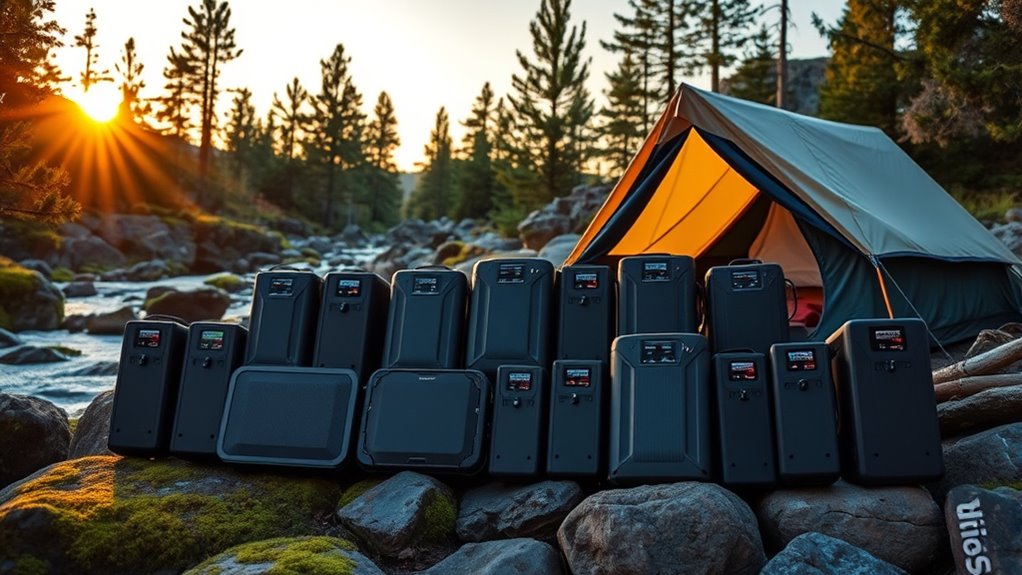

When choosing portable power stations for camping, the key factors are power capacity, portability, and versatility. The Jackery Explorer 1000 v2 stands out as the best overall due to its high capacity and reliable performance. For those seeking a more budget-friendly option, the ZeroKor 120W offers compact size with decent power. Meanwhile, the EnginStar 300W provides a good balance of features for mid-range needs. Each option involves tradeoffs: larger capacities mean more weight, while smaller units may lack enough juice for extended trips. Keep reading to see how these and other picks compare to help you find the best fit for your camping adventures.

Prime made for students and young adults
- Fast, free delivery for dorm and study essentials
- Prime Video and Amazon Music included
- Member-only deals
Complete the kit


Key Takeaways
- Higher capacity units like the Jackery Explorer 1000 deliver longer usage but are heavier and bulkier.
- Compact models such as ZeroKor 120W excel for short trips and minimal gear but fall short for high-demand appliances.
- Battery chemistry impacts longevity; LiFePO4 batteries last longer and are safer than standard lithium-ion options.
- Solar compatibility varies; some models include solar panels or support portable solar input, enhancing off-grid usability.
- Price ranges widely; budget options work for basic needs, but investing in a higher-capacity unit pays off for extended camping or emergencies.
| HOWEASY Portable Power Station 120W (240W Peak) Solar Generator |  | Best Compact Power for Light Devices | Capacity: 88Wh | AC Output: 2 x 110V sockets, 120W (240W peak) | USB-C: 18W | VIEW ON AMAZON | See Our Full Breakdown |
| EnginStar Portable Power Station 300W 296Wh Solar Generator |  | Best for Moderate Power Needs and Fast Charging | Capacity: 296Wh | AC Output: 300W | Dimensions: 9 x 5.5 x 7.5 inches | VIEW ON AMAZON | See Our Full Breakdown |
| Jackery Explorer 1000 v2 Portable Power Station, 1070Wh, 1500W |  | Best for Heavy-Duty Camping Power | Capacity: 1070Wh | AC Output: 1500W | Surge: 3000W | VIEW ON AMAZON | See Our Full Breakdown |
| DaranEner Portable Power Station 192Wh LiFePO4 Solar Generator with 2×300W AC Outlets & 60W USB-C PD |  | Best for Lightweight, Long-Cycle Camping Power | Capacity: 192Wh | AC Outlets: 2× 300W pure sine wave | USB-C: 60W PD | VIEW ON AMAZON | See Our Full Breakdown |
| LIBRIDS Portable Power Station 640Wh, 600W Output with 1200W Surge, Solar Generator with 4 AC Outlets |  | Best for Extended Power and Emergency Backup | Capacity: 640Wh | Running Wattage: 600W | Surge Wattage: 1200W | VIEW ON AMAZON | See Our Full Breakdown |
| Anker SOLIX C300 Portable Power Station, 288Wh LiFePO4 Solar Generator for Camping |  | Best Overall for Reliability and Versatility | Capacity: 288Wh | Output Wattage: 300W (600W surge) | Ports: 8 total: 3x AC, 1x car socket, 2x USB-C (140W each), 1x USB-C (15W), 1x USB-A (12W) | VIEW ON AMAZON | See Our Full Breakdown |
| Jackery Explorer 300 Portable Power Station, 292Wh |  | Best for Lightweight Portability and Long Battery Life | Capacity: 292Wh | Rated Output: 300W (600W peak) | Weight: 7.5 lbs | VIEW ON AMAZON | See Our Full Breakdown |
| ZeroKor 300W Portable Power Station with 60W Solar Panel |  | Best for Complete Solar Independence and Emergency Use | Wattage: 300W | Solar Panel: 60W monocrystalline | AC Outlets: 2 x 300W Max | VIEW ON AMAZON | See Our Full Breakdown |
| EnginStar 300W Portable Solar Generator, 296Wh Lithium Battery Backup with Dual 110V Pure Sine Wave Outlets |  | Best for Robust Power and Versatility on the Road | Watt-hours: 296Wh | Rated Power: 300W | Output Type: Dual 110V pure sine wave | VIEW ON AMAZON | See Our Full Breakdown |
| ZeroKor 120W Portable Power Station with AC Outlet, 97.6Wh/26400mAh Battery |  | Best for Light, Compact Power on Demand | Capacity: 97.6Wh / 26400mAh | Rated Power: 120W | AC Outlets: 2 x 120W MAX | VIEW ON AMAZON | See Our Full Breakdown |
| Daran Portable Power Station 89.6Wh LiFePO4 Battery, 100W (200W Peak) Solar Power Bank with AC Outlets & PD Fast Charging |  | Best Compact Power Bank for Lightweight Camping | Capacity: 89.6Wh | Battery Type: LiFePO4 | Output Power: 100W (200W peak) | VIEW ON AMAZON | See Our Full Breakdown |
| Core 300W Portable Power Station, 192Wh LiFePO4 Solar Generator with 600W Surge |  | Best Long-Lasting Power Station for Extended Camping | Rated Output: 300W | Surge Output: 600W | Battery Capacity: 192Wh | VIEW ON AMAZON | See Our Full Breakdown |
| ALLWEI Portable Power Station 300W, 256Wh Solar Generator with LiFePO4 Battery |  | Best Versatile Power Station with Long Cycle Life | Capacity: 256Wh | Continuous Output: 300W | Peak Surge: 600W | VIEW ON AMAZON | See Our Full Breakdown |
| Jackery Solar Generator 300 with 40W Solar Panel |  | Best for Lightweight, Solar-Powered Camping | Capacity: 292Wh | Rated Output: 300W (600W peak) | Weight: 7.5 lbs | VIEW ON AMAZON | See Our Full Breakdown |
| MARBERO Portable Power Station M82, 88Wh Solar Generator with 120W Surge, AC/DC/USB Outputs |  | Best Ultra-Compact Power Station for Short Trips | Capacity: 88Wh | Surge Power: 120W | Item Weight: 3.2 lbs | VIEW ON AMAZON | See Our Full Breakdown |
| portable power stations for camping | Weight | Capacity |
|---|---|---|
| HOWEASY Portable Power Station | 2.3 lbs | 88Wh |
| EnginStar Portable Power Stati | 6.5 lbs | 296Wh |
| Jackery Explorer 1000 v2 Porta | 23.8 lbs | 1070Wh |
| DaranEner Portable Power Stati | 5.73 lbs | 192Wh |
| LIBRIDS Portable Power Station | 8.3"L x 6.9"W x 8.2"H | 640Wh |
| Anker SOLIX C300 Portable Powe | 4.13 kg (9.1 lbs) | 288Wh |
| Jackery Explorer 300 Portable | 7.5 lbs | 292Wh |
| ZeroKor 300W Portable Power St | Approx. 4 lbs | — |
| EnginStar 300W Portable Solar | 6.5 lbs | — |
| ZeroKor 120W Portable Power St | 2.2 lbs | 97.6Wh / 26400mAh |
| Daran Portable Power Station 8 | 2.54 lbs | 89.6Wh |
| Core 300W Portable Power Stati | 8.8 lbs | — |
| ALLWEI Portable Power Station | 6.4 lbs | 256Wh |
| Jackery Solar Generator 300 wi | 7.5 lbs | 292Wh |
| MARBERO Portable Power Station | — | 88Wh |
More Details on Our Top Picks
HOWEASY Portable Power Station 120W (240W Peak) Solar Generator
This lightweight, 88Wh power station stands out for its portability and versatility, making it ideal for quick power needs during camping or emergencies. Compared to the larger Jackery Explorer 1000, it’s far more convenient to carry, though its 120W output limits its use to smaller devices like phones and cameras. Its 8 output ports—including USB-C, Quick Charge USB, and dual AC sockets—cover a broad range of small electronics. The built-in LED and SOS mode add emergency utility, while three recharging options enhance flexibility. The main tradeoff is its limited capacity, which won’t support high-wattage appliances for long. This pick makes the most sense for campers needing a light, portable power source for phones, lights, and small gadgets, but not for powering larger appliances.
Pros:- Extremely lightweight at just 2.3 pounds with a hidden handle
- Multiple output ports for diverse device charging
- Supports solar, car, and AC recharging for versatile power options
Cons:- Solar panel not included, adding to overall cost
- Limited 120W power output restricts use to small devices
Best for: Casual campers or outdoor enthusiasts needing a lightweight backup for phones and small devices.
Not ideal for: Users who want to run appliances like mini-fridges or hair dryers, as its 120W limit is insufficient.
- Capacity:88Wh
- AC Output:2 x 110V sockets, 120W (240W peak)
- USB-C:18W
- USB:2 x QC 3.0, 5V 2.4A
- DC Output:2 x 12V/10A
- Weight:2.3 lbs
Our verdict“This compact power station is best suited for campers needing lightweight, emergency power for small electronics.”
EnginStar Portable Power Station 300W 296Wh Solar Generator
The EnginStar 296Wh power station offers a compelling balance between capacity and portability, making it suitable for camping trips that require more sustained power. Its 300W AC output can support devices like small refrigerators or microwave ovens, unlike the smaller Howeasy model. It’s lighter than the Jackery Explorer 1000 at 6.5 pounds, with eight output ports including two pure sine wave AC outlets, USB, and regulated DC. It recharges quickly—up to 80% in about 2 hours—and supports solar, wall, and car charging, though the solar panel is not included. Compared to the Jackery Explorer 1000, it’s easier to handle but offers less capacity for large appliances. It’s ideal for campers who want more power without the bulk of larger units, but those needing to run high-wattage equipment should look elsewhere.
Pros:- Lightweight and portable at 6.5 pounds
- Quick recharge in about 2 hours to 80%
- 8 versatile output ports including pure sine wave AC
Cons:- Solar panel not included, increasing total setup cost
- 300W output limits high-power appliances
Best for: Campers needing more power for small appliances and fast recharge capabilities with moderate portability.
Not ideal for: Users planning to run high-wattage appliances like full-sized refrigerators or power tools continuously.
- Capacity:296Wh
- AC Output:300W
- Dimensions:9 x 5.5 x 7.5 inches
- Weight:6.5 lbs
- Charge Cycles:1000+
- Warranty:12 months
Our verdict“This unit suits campers who need more wattage and faster charging without carrying a bulky generator.”
Jackery Explorer 1000 v2 Portable Power Station, 1070Wh, 1500W
The Jackery Explorer 1000 v2 offers a high capacity of 1,070Wh and 1,500W continuous power, making it suitable for running larger appliances like mini-fridges and small AC units. Its long lifespan—over 4,000 charge cycles—outperforms most lithium-ion options, and the fast full recharge in just under 2 hours via emergency mode is impressive. Compared to the EnginStar, it’s bulkier at nearly 24 pounds, but it compensates with a significantly higher capacity and more robust output. Its multiple outlets—including three pure sine wave AC ports and USB-C—cover diverse needs. The drawback is the need for a Jackery-specific solar panel for recharging, which adds to the overall cost. It’s a strong choice for campers who prioritize capacity and durability, but less so for those seeking ultra-lightweight gear.
Pros:- Large capacity of 1070Wh supports extended use
- Fast recharge time in emergency mode
- Long-lasting battery with 10+ years lifespan
Cons:- Heavy at nearly 24 pounds, less portable
- Requires Jackery panels for compatible solar charging
Best for: Campers needing reliable, high-capacity power for extended trips or larger devices.
Not ideal for: Backpackers or minimalist campers who prioritize lightweight, small power sources.
- Capacity:1070Wh
- AC Output:1500W
- Surge:3000W
- Weight:23.8 lbs
- Full Charge Time:1.7 hours
- Battery Type:LFP
Our verdict“This power station is best for campers who need substantial, durable power for multiple days or larger electronics.”
DaranEner Portable Power Station 192Wh LiFePO4 Solar Generator with 2×300W AC Outlets & 60W USB-C PD
The DaranEner 192Wh LiFePO4 power station excels in longevity and portability, making it a prime choice for campers who prioritize sustainability and weight savings. Its 3500+ charge cycles significantly outlast lithium-ion competitors like the Jackery Explorer 1000, while its 300W pure sine wave output supports multiple small devices simultaneously. At just over 5.7 pounds, it’s easy to carry in a backpack or glove box. The inclusion of a 60W USB-C PD port and MPPT solar charging makes it flexible for recharging in remote locations. Compared to the larger Jackery Explorer 1000, it’s less capable for high-power appliances but perfect for charging phones, tablets, and small gadgets repeatedly. Its main limitation is the 192Wh capacity, which restricts use to lighter loads and shorter trips.
Pros:- LiFePO4 battery with over 3500 charge cycles
- Very lightweight and compact for portability
- Supports solar charging with MPPT for remote recharging
Cons:- Limited 192Wh capacity restricts high-power use
- Not suitable for appliances requiring more than 300W
Best for: Backpackers or ultralight campers needing a long-lasting, portable power source for small electronics.
Not ideal for: Campers hoping to power larger appliances or run multiple devices continuously for extended periods.
- Capacity:192Wh
- AC Outlets:2× 300W pure sine wave
- USB-C:60W PD
- Charge Cycles:3500+
- Weight:5.73 lbs
- Recharge Options:AC, solar, car
Our verdict“This model is ideal for campers who value long battery life and portability over high wattage capacity.”
LIBRIDS Portable Power Station 640Wh, 600W Output with 1200W Surge, Solar Generator with 4 AC Outlets
The LIBRIDS 640Wh power station offers a substantial capacity with 600W continuous output and 4 AC outlets, making it suitable for longer camping stays or backup power at home. Its 10ms UPS feature ensures seamless transition during outages, and the 4 AC outlets support multiple appliances simultaneously. The pure sine wave inverter provides clean power, safe for sensitive electronics like CPAP machines. Compared with the smaller DaranEner, it provides nearly triple the capacity, though it’s noticeably larger and heavier. Its fast 1.5-hour recharge time with AC input is a major plus, but its size makes it less portable for backpackers. Best suited for campers with a need for higher wattage support and longer durations, but less ideal for those seeking lightweight gear.
Pros:- High capacity supports multiple devices for extended periods
- Fast recharge in 1.5 hours
- Built-in UPS ensures seamless power during outages
Cons:- Bulkier and heavier than smaller units
- Limited mobility for backpacking or hiking
Best for: Campers or small households needing reliable, extended power backup during trips or outages.
Not ideal for: Lightweight backpackers or minimalist campers who prioritize portability over capacity.
- Capacity:640Wh
- Running Wattage:600W
- Surge Wattage:1200W
- Weight:8.3″L x 6.9″W x 8.2″H
- Charge Time:1.5 hours
- Battery Type:LiFePO4
Our verdict“This generator is best for users requiring dependable, extended, multi-device power in camping or emergency scenarios.”
Anker SOLIX C300 Portable Power Station, 288Wh LiFePO4 Solar Generator for Camping
The Anker SOLIX C300 stands out as a comprehensive choice for campers who need reliable, long-lasting power. Its 288Wh capacity and 8 ports—including multiple AC outlets and fast-charging USB-C—offer flexibility for a variety of devices. Compared with the Jackery Explorer 300, the C300’s LiFePO4 battery promises over 3,000 cycles, translating into a decade of dependable use, though its 300W output limits high-wattage appliances. Its quick recharge to 80% in just 50 minutes and ultra-quiet operation at 25dB make it ideal for outdoor settings. The main tradeoff is that solar panels are sold separately, and the AC output might not support larger appliances. This pick makes the most sense for campers seeking durability and quiet operation without sacrificing port versatility.
Pros:- Fast 140W two-way USB-C charging with quick recharge to 80% in 50 minutes
- 8 versatile ports, including 3 AC outlets for multiple device types
- LiFePO4 battery rated for 3,000 cycles, ensuring a decade of use
- Ultra-quiet at 25dB, ideal for peaceful outdoor environments
Cons:- Shoulder strap sold separately, adding to overall cost
- Solar panel compatibility is optional and sold separately
- Limited 300W AC output may not power high-wattage appliances
Best for: Campers who prioritize long-term durability, quiet operation, and multiple device charging options
Not ideal for: Users needing to run high-wattage appliances like microwaves or power tools during camping trips
- Capacity:288Wh
- Output Wattage:300W (600W surge)
- Ports:8 total: 3x AC, 1x car socket, 2x USB-C (140W each), 1x USB-C (15W), 1x USB-A (12W)
- Battery Type:LiFePO4
- Battery Lifespan:3,000 cycles / 10 years
- Recharge Time:80% in 50 minutes
- Noise Level:25dB
- Weight:4.13 kg (9.1 lbs)
- Warranty:5 years
Our verdict“This station suits campers seeking a reliable, durable power source with versatile charging options and quiet operation.”
Jackery Explorer 300 Portable Power Station, 292Wh
The Jackery Explorer 300 offers a compelling balance between weight and power, making it ideal for backpackers and light campers. Weighing only 7.5 lbs, it’s significantly lighter than the Anker SOLIX C300, while providing a slightly higher capacity at 292Wh. Its lithium iron phosphate battery supports over 4,000 charge cycles, promising more than a decade of reliable service, even with frequent use. The inclusion of a 100W USB-C PD port enhances charging speed for laptops and other devices. However, the solar charging support requires a separate panel, and its 300W maximum output may restrict use with high-power appliances like coffee makers. Compared to larger stations, this model excels in portability but sacrifices some wattage capacity.
Pros:- Ultra-lightweight at just 7.5 lbs with an integrated carry handle
- Long-lasting LiFePO4 battery with over 4,000 charge cycles
- Versatile charging including a fast 100W USB-C PD port
- Supports solar charging for off-grid adventures
Cons:- Solar panel not included, requiring additional purchase
- Limited 300W output restricts use with high-power devices
- Cannot be shipped to PO Box addresses
Best for: Hikers and minimalists who need lightweight power for essential devices
Not ideal for: Campers who want to run high-wattage appliances or need large capacity for extended stays
- Capacity:292Wh
- Rated Output:300W (600W peak)
- Weight:7.5 lbs
- Battery Chemistry:LiFePO4
- Charge Cycles:4,000+
- Ports:2 AC, 1x 100W USB-C PD, 2 USB-A, 1x 120W car port
- Solar Charging Time:80% in ~2.8 hrs with 100W panel
- Included:Power station, AC adapter, car charger cable
Our verdict“Ideal for lightweight users needing portable, long-lasting power without high wattage demands.”
ZeroKor 300W Portable Power Station with 60W Solar Panel
The ZeroKor 300W bundle combines a reliable power station with a quality solar panel, making it a strong contender for off-grid camping and emergency preparedness. The 60W monocrystalline solar panel boasts high efficiency, enabling recharging in fair sunlight. Its multiple output options—including AC, DC, and USB—support a variety of devices, complemented by safety features like BMS and automatic cooling fan. Compared with larger stations like the EnginStar 300W, its smaller form factor and direct solar input make it highly portable and self-sufficient. The main limitation is that the 300W output can’t handle high-wattage appliances, and the solar panel isn’t waterproof. This option suits those seeking a compact, solar-ready system for basic power needs and emergency use.
Pros:- Includes a 60W high-efficiency monocrystalline solar panel
- Multiple charging outputs including AC, DC, and USB
- Built-in safety features with BMS and automatic fan cooling
- Compact and lightweight design for easy transport
Cons:- Limited 300W output restricts high-power devices
- Solar panel junction box is not waterproof, requiring careful setup
- Requires consistent sunlight to maintain charge; performance varies with weather
Best for: Campers looking for a portable, solar-powered backup for small devices and emergencies
Not ideal for: Users needing to power high-wattage appliances or run multiple heavy devices simultaneously
- Wattage:300W
- Solar Panel:60W monocrystalline
- AC Outlets:2 x 300W Max
- DC Port:Yes
- USB Ports:Multiple including quick charge
- Recharge Methods:AC, solar, 12V car
- Safety Features:BMS, auto cooling
- Weight:Approx. 4 lbs
Our verdict“Perfect for campers wanting a portable, solar-charged power solution for small devices and emergencies.”
EnginStar 300W Portable Solar Generator, 296Wh Lithium Battery Backup with Dual 110V Pure Sine Wave Outlets
The EnginStar 300W provides a solid power capacity of 296Wh, making it suited for camping, road trips, and emergency backup. Its dual 110V pure sine wave outlets ensure clean power for sensitive electronics like laptops and cameras. Compared to the ZeroKor 300W with its bundled solar panel, the EnginStar offers a more versatile power source that can run a wider range of devices. Its safety features, including overload and overheating protections, add peace of mind in outdoor environments. The main drawback is its limited ability to support high-capacity appliances such as refrigerators. Its 6.5-pound weight balances portability with capacity, but it’s best suited for users who need dependable power for electronics rather than heavy-duty appliances.
Pros:- Dual 110V pure sine wave outlets for sensitive electronics
- Compact and portable at 6.5 lbs
- Reliable 296Wh capacity suitable for a variety of devices
- Includes overload, short circuit, and overheating protections
Cons:- Limited support for high-capacity appliances like refrigerators
- Solar panel sold separately, adding to total cost
- Maximum wattage of 300W may restrict some devices
Best for: Road trippers and campers who need reliable, clean power for electronics and small appliances
Not ideal for: People wanting to run large appliances or needing very high wattage capacity
- Watt-hours:296Wh
- Rated Power:300W
- Output Type:Dual 110V pure sine wave
- Weight:6.5 lbs
- Additional Protections:Overload, overheat, short circuit
- Dimensions:9″L x 5.5″W x 7.5″H
Our verdict“A dependable choice for travelers needing safe, clean power for electronics on the go.”
ZeroKor 120W Portable Power Station with AC Outlet, 97.6Wh/26400mAh Battery
The ZeroKor 120W is a lightweight, pocket-sized power bank designed for quick, on-the-go charging of small devices. Weighing just 2.2 lbs, it’s perfect for short camping trips where minimal power is needed. Its 97.6Wh capacity supports basic charging for smartphones, tablets, and small USB devices, with dual AC outlets capable of handling up to 120W. Compared with larger units like the Anker SOLIX C300, it’s less versatile but excels in portability. The built-in display, LED flashlight, and SOS mode add practical features. However, its limited wattage prevents use with larger appliances, and solar charging requires an external panel, which is not included. This makes it best suited for emergency kits or light device charging during outdoor adventures.
Pros:- Extremely lightweight and portable at just 2.2 lbs
- Multiple ports including USB-C, Quick Charge, and dual AC outlets
- Built-in LED flashlight with SOS mode
- Includes safety protections with BMS
Cons:- Limited 120W power output restricts high-drain devices
- Solar panel not included, requiring extra purchase
- Small capacity limits usage to basic gadgets
Best for: Hikers and emergency preparedness enthusiasts needing a compact power source for small gadgets
Not ideal for: Campers who want to power or run larger devices or appliances
- Capacity:97.6Wh / 26400mAh
- Rated Power:120W
- AC Outlets:2 x 120W MAX
- Weight:2.2 lbs
- Safety Features:BMS, short circuit, over-voltage
- Additional Features:LED flashlight, SOS mode
Our verdict“Great for quick, small device charging and emergencies, but not suitable for larger appliances or extended power needs.”
Daran Portable Power Station 89.6Wh LiFePO4 Battery, 100W (200W Peak) Solar Power Bank with AC Outlets & PD Fast Charging
The Daran Portable Power Station stands out for its ultra-lightweight, pocket-sized design, making it ideal for minimalists or backpackers who prioritize portability. Compared to larger options like the Core 300W, it offers significantly less capacity but excels in weight and size, fitting easily into a backpack. Its 89.6Wh LiFePO4 battery provides enough juice for charging smartphones, small cameras, or LED lights, but not high-demand appliances. The fast charging (0-80% in 1.5 hours) and quiet, fanless operation make it convenient for quick top-ups without noise disturbance. However, it’s limited to 100W output, making it unsuitable for laptops or devices requiring more power, and solar charging accessories are sold separately. This pick is perfect for solo campers or emergency kit use who need a lightweight, reliable power source for small electronics.
Pros:- Extremely lightweight and compact, fitting in a backpack
- Long-lasting LiFePO4 battery with over 3500 charge cycles
- Fast charging options with multiple methods including solar (panel not included)
- Fanless, quiet operation with built-in flashlight and SOS mode
Cons:- Limited 100W output restricts use to small electronics
- Solar panel and charging cable sold separately
Best for: Solo campers or emergency preparedness enthusiasts who need a compact, lightweight power backup for small devices
Not ideal for: Groups or users needing to power higher-wattage appliances like laptops or portable refrigerators
- Capacity:89.6Wh
- Battery Type:LiFePO4
- Output Power:100W (200W peak)
- Output Ports:2 AC, USB-C, USB-A, DC5521
- Dimensions:6.5 x 3.3 x 4 inches
- Weight:2.54 lbs
Our verdict“Ideal for ultralight campers or emergency kits where portability outweighs high capacity.”
Core 300W Portable Power Station, 192Wh LiFePO4 Solar Generator with 600W Surge
The Core 300W offers a solid combination of capacity and longevity, making it a strong choice for campers who need reliable power for longer trips. Its 192Wh LiFePO4 battery supports over 4000 charge cycles, ensuring a decade of use. Its 300W continuous output can run essential devices like laptops, small refrigerators, and lights, outperforming the Daran 89.6Wh in capacity and power. The built-in UPS with a ≤10ms switch makes it suitable for critical electronics like CPAP machines. While it’s heavier at 8.8 lbs, it remains portable enough for car camping or RV use. The recharge time of 1 hour to 80% is quick, but solar panel options are sold separately, and it’s not suitable for high-wattage appliances like hair dryers. This model is best suited for campers needing dependable, extended power for multiple devices.
Pros:- Exceptional battery lifespan with over 4000 charge cycles
- High surge capacity for demanding devices
- Built-in UPS for seamless power switching
- Multiple output options including USB-C PD and AC outlets
Cons:- Relatively heavy at 8.8 lbs
- Solar panel sold separately, adding to total cost
- Limited to 300W, not suitable for high-wattage appliances
Best for: Campers or RV travelers seeking durable, long-term power for multiple devices and critical electronics
Not ideal for: Lightweight backpackers or those needing ultra-portable devices with minimal capacity
- Rated Output:300W
- Surge Output:600W
- Battery Capacity:192Wh
- Battery Type:LiFePO4
- Charge Cycles:4000+
- Weight:8.8 lbs
Our verdict“Best for campers who prioritize reliability and long-term use over ultra-lightweight portability.”
ALLWEI Portable Power Station 300W, 256Wh Solar Generator with LiFePO4 Battery
The ALLWEI 300W strikes a balance between capacity and portability, making it appealing for varied camping needs. Its 256Wh LiFePO4 battery supports 300W continuous output, suitable for charging laptops, small appliances, and lights. Compared to the Jackery Explorer 300, it offers similar capacity but with a slightly higher wattage support and more output ports, including a car outlet. Its 5-year warranty and built-in MPPT controller provide reassurance for off-grid use. Weighing just 6.4 lbs, it’s easy to carry, but solar panels are sold separately. The 300W output limits use to smaller appliances, and the charging times are around 3.5–4 hours from AC or solar. This unit is ideal for campers needing a versatile power source with a long lifespan.
Pros:- Long-lasting LiFePO4 battery with over 3000 cycles
- Multiple charging options including solar with built-in MPPT
- Lightweight and compact design
- Safe for sensitive electronics with pure sine wave output
Cons:- Solar panel not included, adding to overall cost
- Limited to 300W, not for high-power appliances
- Charging time from solar around 4 hours
Best for: Campers and small off-grid users who want a reliable, multi-device capacity for extended trips
Not ideal for: Those needing to power high-wattage devices or large appliances
- Capacity:256Wh
- Continuous Output:300W
- Peak Surge:600W
- Charge Cycles:3000
- Weight:6.4 lbs
- Dimensions:9.25 x 5 x 6.81 inches
Our verdict“A versatile, dependable option for campers who need long-term power for multiple small devices.”
Jackery Solar Generator 300 with 40W Solar Panel
The Jackery Explorer 300 paired with its 40W solar panel offers a portable, eco-friendly power solution, especially suited for casual campers. At 7.5 lbs, it’s one of the lightest options with a built-in handle, ideal for backpackers or car campers who value solar recharging. Its 292Wh capacity and 300W rated output can power smartphones, small laptops, and lights, but not high-demand appliances like hair dryers. The included solar panel takes about 7.5 hours to reach 80%, which is on the slower side, but it’s a reliable and durable choice with over 4,000 charge cycles. The solar panel and power station are shipped separately, which can be a minor inconvenience. This setup is perfect for those seeking a lightweight, sustainable power source for low to moderate energy needs.
Pros:- Very portable at 7.5 lbs with an ergonomic handle
- Durable LiFePO4 battery with over 4,000 cycles
- Versatile device charging for multiple devices simultaneously
- Eco-friendly solar charging option
Cons:- Slow solar recharge rate (~7.5 hours to 80%)
- Capacity may be insufficient for larger appliances
- Power station and solar panel shipped separately
Best for: Casual campers or hikers who want a lightweight, solar-rechargeable power station for small devices
Not ideal for: Users needing rapid solar charging or to power high-wattage appliances
- Capacity:292Wh
- Rated Output:300W (600W peak)
- Weight:7.5 lbs
- Battery Chemistry:LiFePO4
- Charge Cycles:4,000+
- Solar Charging Time:~7.5 hours
Our verdict“An excellent lightweight, solar-compatible choice for low-demand, eco-conscious campers.”
MARBERO Portable Power Station M82, 88Wh Solar Generator with 120W Surge, AC/DC/USB Outputs
The MARBERO M82 emphasizes portability above all, weighing just 3.2 lbs and roughly the size of a DSLR camera. Its 88Wh capacity supports modest electronic needs, such as phones, small tablets, or LED lights, with a 120W surge capacity enough for small appliances. It boasts 8 ports, including AC, USB-C, USB, and car DC, making it highly versatile for its size. The built-in BMS offers comprehensive safety protections, and the 3-level LED flashlight with SOS mode extends usability in emergencies. However, with such a small capacity, it’s not suitable for extended use of larger devices or high-power appliances, and solar panels are sold separately. This device fits best for short outings or emergency kits where ultra-lightweight power is essential.
Pros:- Incredibly lightweight and portable for its capacity
- Multiple output ports for versatile device charging
- Built-in safety protections and SOS mode
- Pass-through charging for simultaneous use and recharge
Cons:- Limited capacity means short usage periods
- Solar panel must be purchased separately
- Not suitable for high-wattage appliances
Best for: Short-term trips, emergency kits, or everyday small electronic needs
Not ideal for: Long camping trips or powering larger appliances and laptops
- Capacity:88Wh
- Surge Power:120W
- Item Weight:3.2 lbs
- Dimensions:6.5 x 4.6 x 3.1 inches
- Safety Features:BMS, UL drop tested
- LED Runtime:Up to 68 hours
Our verdict“Perfect for quick trips or emergency backups where minimal weight and size are priorities.”
How We Picked
To evaluate these portable power stations, I focused on practical factors that influence outdoor use—power capacity, weight, size, and recharging options. Performance reliability and build quality also played key roles, especially for rugged camping conditions. I prioritized models with versatile outputs (AC, USB, DC) to cover varied device needs, and I considered price-to-value ratios to recommend options suitable for different budgets. The ranking reflects a balance between capacity, portability, and features, aiming to help campers choose a reliable, efficient solution tailored to their typical needs and trip durations.Factors to Consider When Choosing Portable Power Stations For Camping
Choosing the right portable power station for camping involves understanding several key factors. Size and weight are critical, as you want a unit that’s easy to carry but still provides enough power. Battery capacity directly impacts how long your devices can run, so consider your typical energy needs. Compatibility with solar panels can extend your off-grid capabilities, especially for longer trips. Price and build quality are also important, with higher-end models offering more durability and longevity. Knowing these tradeoffs helps ensure you select a station that matches your camping style and power demands.Capacity and Power Output
Power capacity, measured in watt-hours (Wh), determines how long your devices can run. For camping, a unit with at least 300Wh is generally recommended for powering phones, lights, and small appliances, whereas larger capacities around 1000Wh suit extended trips or larger devices. Pay attention to surge wattage for appliances with motors, like mini-fridges or blenders. Balancing capacity with your portability needs is essential—more power often means more weight, so choose based on your typical usage and travel weight constraints.
Portability and Size
Size and weight are critical considerations—larger units tend to house more power but can be cumbersome to carry. For backpacking or lightweight camping, ultra-compact models like ZeroKor 120W make sense, though they offer limited runtime. On the other hand, wheeled or backpack-friendly designs with handles can ease transport for car camping. Think about how much gear you’ll carry and whether you prefer a lightweight option or are willing to handle extra bulk for increased capacity.
Recharging Options
Flexibility in recharging is a big advantage for outdoor use. Many models support solar input, which extends off-grid capabilities—an important feature for longer trips. Fast recharging via AC outlets is useful when plugged into mains, but solar compatibility is often more relevant for camping. Consider the input wattage and whether the station supports fast charging or has multiple input ports. This can significantly reduce downtime between outings.
Battery Chemistry and Durability
The type of battery impacts longevity and safety. LiFePO4 batteries last longer—often 2000+ charge cycles—and are more stable under high temperatures, making them ideal for outdoor use. Standard lithium-ion batteries are lighter but degrade faster over time. Investing in a station with durable battery chemistry can be worthwhile if you plan frequent trips or long-term outdoor use. Keep in mind that higher-quality batteries tend to come with higher upfront costs but offer better reliability over time.
Price and Value
Budget constraints influence your choice, but it’s important to evaluate value rather than just price. Cheaper units may lack capacity or durability, leading to higher replacement costs. Conversely, premium models often provide longer-lasting batteries, faster recharging, and better build quality. Assess your typical power needs and how often you’ll use the station; an investment in a higher-quality unit can pay off through greater reliability and longer lifespan. Don’t forget to factor in the cost of compatible solar panels if off-grid recharging is a priority.
Frequently Asked Questions
How long can a portable power station run my camping devices?
The runtime depends on the capacity of the power station and the power draw of your devices. For example, a 300Wh unit can typically power a smartphone for 20-30 charges or run small LED lights for over 50 hours. Larger units like 1000Wh can support mini-fridges and multiple devices for days. To estimate your needs, list your devices’ wattages and usage time, then match that with the station’s capacity to determine how long your gear will stay powered during your trip.
Is solar charging reliable for camping trips?
Solar charging can be highly effective if you have good sunlight and a compatible solar panel. Many power stations support solar input, enabling you to recharge during the day and extend your trip. However, efficiency depends on panel wattage, weather conditions, and angle placement. For reliable off-grid power, choose a station with a high solar input rating and consider investing in a quality solar panel. This setup can significantly reduce dependence on grid power or replace it altogether during extended camping periods.
Should I prioritize capacity over portability?
It depends on your typical camping style. If you mostly go on short trips with minimal devices, a smaller, lighter station may suffice. For longer excursions or if you plan to power larger appliances, investing in a higher-capacity model makes sense, even if it adds weight. The key is balancing your power needs with ease of transport—consider how much gear you’ll carry and whether the extra capacity justifies the added bulk.
Are higher-priced models worth the extra investment?
Higher-priced units often feature better build quality, longer-lasting batteries, faster recharging, and more versatile outputs. If you rely heavily on your power station or plan multiple trips per year, investing in a premium model can save money and hassle in the long run. Cheaper options might be suitable for occasional, light use, but they may require replacement sooner or lack features like solar input or fast charging. Weigh your expected usage against the upfront costs to decide if the extra investment aligns with your camping habits.
How durable are these power stations for outdoor use?
Most portable power stations designed for camping feature rugged casings and are built to withstand typical outdoor conditions, including dust and minor impacts. However, their durability varies—higher-end models often have better seals and more robust construction. Always check the IP rating (Ingress Protection) if you expect exposure to water or dust. Proper handling and storage will also extend their lifespan. For frequent or harsh outdoor use, prioritize units with proven durability and good warranty support.
Conclusion
For most campers, the Jackery Explorer 1000 v2 offers the best mix of capacity, portability, and reliability, making it ideal for extended trips or powering multiple devices. Budget-conscious users or short-term campers will find the ZeroKor 120W a practical choice for light use. Those seeking a premium, durable solution with longer battery life should consider higher-end models like the LIBRIDS 640Wh or Jackery Explorer 1500. Beginners or casual campers benefit from starting with compact, easy-to-use units, whereas seasoned adventurers should invest in larger, more capable stations with solar compatibility for true off-grid independence. Carefully matching your camping style and power needs ensures a satisfying experience with your portable energy source.
Halloween Picks
halloween
As an affiliate, we earn on qualifying purchases.