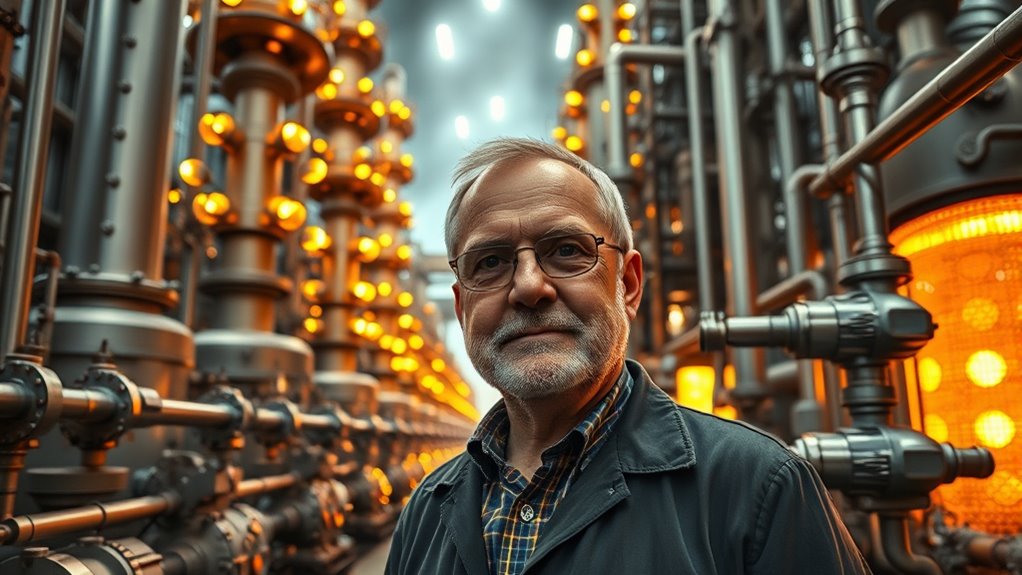

Carl Bosch transformed agriculture by scaling the Haber-Bosch process, enabling the industrial production of ammonia with catalysts. This breakthrough made large-scale fertilizer synthesis possible, helping you feed a growing world population. His work led to higher crop yields and reduced hunger worldwide. If you’re curious, you’ll discover how Bosch’s innovations continue to impact food security and sustainable chemistry today.
Prime for Young Adults — start your free trial
Fast free delivery, streaming and member deals for eligible 18–24 year olds.
As an affiliate, we earn on qualifying purchases.
Key Takeaways
- Carl Bosch developed the industrial Haber-Bosch process, enabling large-scale ammonia production for fertilizers.
- This innovation revolutionized agriculture, increasing crop yields and supporting global food security.
- Industrial catalysts, especially iron-based ones, were crucial for efficient ammonia synthesis.
- Bosch’s work demonstrated how catalytic chemistry can scale processes to meet societal needs.
- His contributions laid the foundation for sustainable, scalable fertilizer manufacturing and modern agriculture.

Carl Bosch revolutionized chemistry by developing innovative methods to produce fertilizers at an unprecedented scale, helping to feed a growing global population. His work in fertilizer innovation transformed agriculture, making it possible to cultivate crops on a massive scale and support billions of people. Before Bosch’s breakthroughs, traditional farming relied heavily on natural fertilizers, which limited crop yields and hampered food security. Bosch’s advancements, however, enabled the mass production of synthetic fertilizers, fundamentally changing the way we nourish plants.
Central to this achievement was Bosch’s mastery of industrial catalysts. These catalysts are substances that speed up chemical reactions without being consumed in the process, making large-scale chemical production feasible and cost-effective. Bosch’s collaboration with Fritz Haber led to the development of the Haber-Bosch process, which synthesizes ammonia from nitrogen and hydrogen gases. This process relies heavily on industrial catalysts, such as iron-based catalysts, to facilitate the reaction at high temperatures and pressures. Without these catalysts, producing ammonia at an industrial scale would be impossible or prohibitively expensive.
Industrial catalysts like iron enable large-scale, cost-effective ammonia synthesis.
By optimizing these catalysts, Bosch dramatically increased the efficiency of ammonia synthesis. This advancement meant that fertilizer production could be scaled up to meet the demands of agriculture worldwide. The Haber-Bosch process became the backbone of fertilizer manufacturing, directly contributing to the Green Revolution and enabling farmers to grow more food than ever before. You can see how this innovation impacts everyday life—by ensuring an abundant food supply, it helps reduce hunger and stabilize economies dependent on agriculture.
Bosch’s work didn’t just improve fertilizer production; it also demonstrated how industrial catalysts could revolutionize chemical manufacturing. The process he helped perfect is a prime example of how catalytic chemistry can solve complex industrial problems. Your understanding of this can inspire further innovations in sustainable chemistry and energy, as catalysts are essential in many environmentally friendly technologies. Bosch’s legacy proves that combining scientific insight with engineering prowess can lead to solutions that benefit millions.
In essence, Bosch’s contributions to fertilizer innovation, powered by advanced industrial catalysts, set the stage for modern agriculture’s success. His work exemplifies how scaling chemistry through technological advances can address some of humanity’s most pressing needs—feeding a growing world population efficiently and sustainably. You can appreciate that behind every bushel of food and every meal, there’s a story of scientific ingenuity, driven by pioneers like Carl Bosch who dared to rethink what chemistry can achieve. Understanding catalysts is key to advancing sustainable industrial processes and environmental solutions.
As an affiliate, we earn on qualifying purchases.
Frequently Asked Questions
How Did Carl Bosch’s Innovations Impact Global Food Security?
Your understanding of Carl Bosch’s innovations shows how he fueled the agricultural revolution by improving the food supply. His development of industrial nitrogen fixation allowed farmers to produce more fertilizer, boosting crop yields worldwide. This advancement helped prevent food shortages and supported a growing population. By scaling chemistry, Bosch transformed agriculture into a more efficient and reliable system, ensuring that more people had access to sufficient, nutritious food.
What Challenges Did Bosch Face in Industrializing Ammonia Production?
You’re stepping into Bosch’s shoes, facing the storm of scaling challenges and technical hurdles. He struggled to turn laboratory breakthroughs into industrial processes, battling high pressures and temperatures that threatened to blow the project apart. Equipment corrosion and energy demands added to the chaos, demanding relentless innovation. Bosch’s perseverance turned these obstacles into stepping stones, ultimately revolutionizing ammonia production and transforming global agriculture.
How Did Bosch’s Work Influence Modern Chemical Engineering Practices?
Your work revolutionized modern chemical engineering by developing efficient catalytic processes for ammonia synthesis at an industrial scale. You made it possible to produce fertilizers affordably, supporting global food supplies. This breakthrough set standards for scaling chemical reactions and optimizing industrial processes, influencing countless other fields. Your innovations continue to shape practices today, emphasizing the importance of catalysis, process control, and engineering design in transforming chemistry into practical, large-scale applications.
Were There Environmental Concerns Linked to Bosch’s Processes?
Yes, there were environmental concerns linked to Bosch’s processes. You should know that his method of synthesizing ammonia involved high pressures and temperatures, which raised environmental impact worries. These sustainability challenges included energy consumption and emissions. While revolutionary for agriculture, modern practices now aim to reduce these effects, emphasizing cleaner, more sustainable methods. Bosch’s innovations paved the way, but they also highlight the need for ongoing environmental responsibility in chemical engineering.
What Awards or Recognitions Did Bosch Receive for His Contributions?
Imagine the world recognizing a chemist as brightly as stars in the night sky. Carl Bosch received the Nobel Prize in Chemistry in 1931 for his groundbreaking work. His contributions to chemical engineering revolutionized fertilizer production and earned him prestigious accolades, cementing his legacy. These honors highlight how his innovations transformed agriculture and industry, showcasing the profound impact one individual can have through scientific achievement.
Conclusion
You now see how Carl Bosch’s groundbreaking work transformed agriculture forever. By scaling chemistry, he turned a tiny idea into a global force capable of feeding billions—truly a feat of human ingenuity that’s almost beyond belief. His innovations didn’t just change farming; they reshaped the entire world. So next time you enjoy a meal, remember that Bosch’s brilliant mind made it all possible, proving that bold ideas can change the course of history.
NFL season / tailgating Picks
team gear
As an affiliate, we earn on qualifying purchases.