
Cyclic voltammetry is a key electrochemical method where you sweep the voltage at an electrode immersed in solution and measure the resulting current. This technique helps you understand how molecules undergo redox reactions, revealing whether they transfer electrons easily or face barriers. Faster electrode kinetics produce sharp peaks, while sluggish reactions broaden them. By analyzing the voltammogram, you can uncover details about reaction mechanisms and improve your electrochemical applications. Keep exploring to see how these basics connect to real-world systems.
Key Takeaways
- Cyclic voltammetry applies a voltage sweep to an electrode to observe oxidation and reduction currents, revealing electrochemical behavior.
- The shape and peak features of voltammograms depend on electrode kinetics and experimental parameters.
- Peak currents and potentials help identify electroactive species and their reaction mechanisms.
- Data analysis techniques like peak analysis and models such as Tafel plots provide insights into reaction kinetics.
- Understanding voltammetric responses aids in designing sensors, batteries, and catalytic systems.
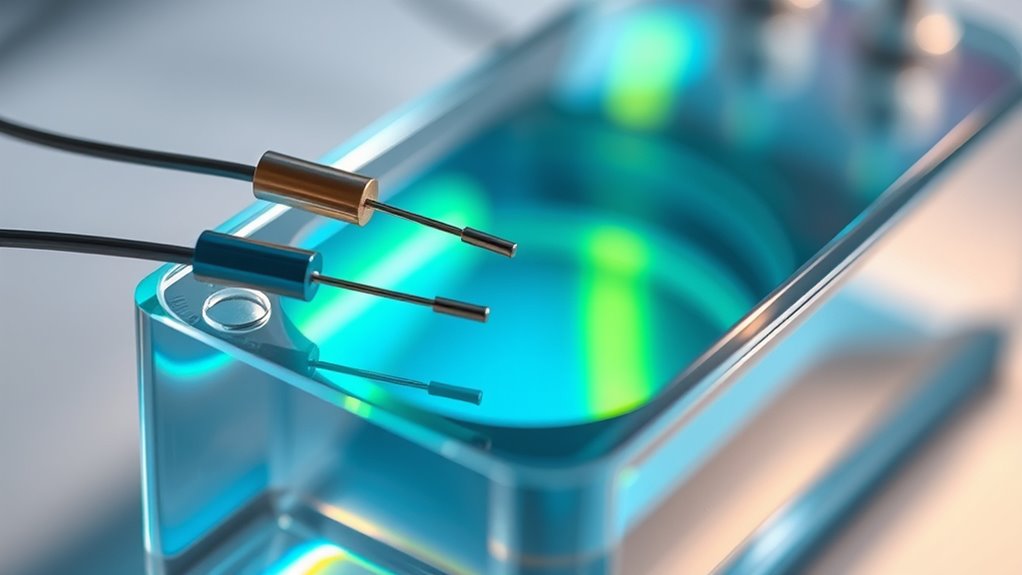
Have you ever wondered how scientists analyze the chemical composition of substances or monitor electronic processes? One powerful method they use is cyclic voltammetry, a technique that provides insights into the electrochemical behavior of molecules. When you perform cyclic voltammetry, you’re essentially applying a voltage sweep to an electrode immersed in a solution, observing how current responds as molecules undergo oxidation and reduction. This process reveals critical details about the electrochemical system, including reaction mechanisms and the stability of different species. The resolution of the voltammogram**** can also be affected by experimental parameters, influencing how clearly you can interpret the data.
Understanding electrode kinetics plays a fundamental role in interpreting the results of cyclic voltammetry. Electrode kinetics refers to the speed at which electrochemical reactions occur at the electrode surface, influencing how quickly current responds to changes in applied voltage. Fast electrode kinetics typically produce sharp, well-defined peaks on the voltammogram, indicating rapid electron transfer. Conversely, sluggish kinetics lead to broader, less distinct peaks. By analyzing these features, you can gauge the ease or difficulty of electron transfer processes, which is indispensable for designing better sensors, batteries, or catalytic systems.
Electrode kinetics dictate reaction speed, shaping voltammetric peaks and revealing electron transfer efficiency.
Data analysis techniques are essential for extracting meaningful information from voltammetric data. When you look at a voltammogram, you’re presented with peaks that correspond to oxidation and reduction events. To interpret these, you might apply methods like peak current analysis, peak potential evaluation, or more advanced models such as Tafel plots or Nicholson’s method. These techniques help determine parameters like diffusion coefficients, concentration of analytes, and reaction mechanisms. They also enable you to distinguish between different electroactive species and assess their interactions at the electrode surface.
Moreover, the integration of data analysis techniques allows you to quantify the number of electrons transferred during a redox process, identify reversible or irreversible reactions, and monitor changes over multiple cycles. This quantitative insight is key for developing reliable electrochemical sensors or optimizing processes like energy storage. As you refine your understanding of electrode kinetics through these analysis methods, you’ll gain a clearer picture of how molecules behave under electrochemical conditions.
Top picks for "electrochemical method cyclic"
Open Amazon search results for this keyword.
As an affiliate, we earn on qualifying purchases.
Frequently Asked Questions
How Does Temperature Affect Cyclic Voltammetry Results?
Temperature affects cyclic voltammetry results through temperature dependence and thermal effects. As temperature increases, reaction kinetics accelerate, leading to higher peak currents and shifted potentials. Conversely, lower temperatures slow down electron transfer, reducing current and causing peak separation to widen. These thermal effects can influence the shape and position of voltammetric peaks, so controlling temperature is essential for consistent, accurate measurements.
What Are Common Errors in Cyclic Voltammetry Experiments?
You should watch out for common errors like electrode fouling, which can distort your results, and setting an incorrect potential window, possibly damaging the electrode or missing relevant data. Regularly clean your electrode and verify the potential range before starting. Avoid over-scanning and ensure your solution is well-degassed. These steps help prevent fouling and keep your cyclic voltammetry experiments accurate and reproducible.
Can Cyclic Voltammetry Detect Trace Levels of Analytes?
Yes, cyclic voltammetry can detect trace levels of analytes, especially when you use sensitivity enhancement techniques. By optimizing parameters like electrode surface area, scan rate, and supporting electrolyte, you can improve detection limits. Advanced methods, such as using modified electrodes, further boost sensitivity. These adjustments allow you to identify low-concentration analytes effectively, making cyclic voltammetry a powerful tool for trace analysis in various fields.
How Do Electrode Surface Modifications Influence Measurements?
Modifying the electrode surface can considerably influence your measurements by altering surface roughness, which enhances the electrode’s active area and sensitivity. Stable modifications ensure consistent results over multiple scans, improving reproducibility. However, if the surface roughness isn’t well-controlled or the modification isn’t stable, it can lead to inconsistent signals or signal degradation. Consequently, carefully optimizing surface modifications is essential for reliable, high-quality cyclic voltammetry data.
What Are the Limitations of Cyclic Voltammetry in Complex Samples?
Did you know that cyclic voltammetry struggles with over 50% accuracy in complex samples? You’ll find that sample matrix effects and interfering species can distort results, making quantification unreliable. These limitations mean you need careful sample preparation and sometimes alternative methods. Complex biological or environmental samples, in particular, introduce noise and false signals, so be cautious when interpreting voltammetric data in such contexts.
Conclusion
You now understand the basics of cyclic voltammetry, a powerful electrochemical technique. Like a window into the redox world, it reveals how substances gain and lose electrons. By mastering these methods, you can analyze materials with precision and confidence. Think of cyclic voltammetry as a conversation with molecules, where each peak tells a story. With this knowledge, you’re well-equipped to explore the electrochemical landscape and uncover new insights.