
If you want cleaner, surface-specific FTIR spectra with minimal sample prep, ATR is your best choice. It provides quick, reliable results focused on surface interactions and avoids issues caused by uneven thickness or complex sample handling. Transmission, on the other hand, offers a more complete picture of bulk properties but involves more preparation and potential artifacts. To discover which method suits your needs best and get detailed insights, explore further.
Key Takeaways
- Transmission FTIR provides bulk, comprehensive spectra, reducing surface-related artifacts and offering a more representative “truth” of the entire sample.
- ATR FTIR offers surface-sensitive spectra, which may highlight surface contaminants or heterogeneities, potentially skewing the overall sample representation.
- For the cleanest, most accurate bulk information, transmission mode generally yields a more reliable “truth” than surface-focused ATR.
- ATR is faster and easier but may compromise the accuracy of bulk properties due to its limited penetration depth.
- The choice depends on whether surface or bulk information is more critical; transmission often provides a clearer, more complete spectral “truth.”

When choosing a method for FTIR sampling, understanding the differences between Attenuated Total Reflectance (ATR) and transmission techniques is vital. Both approaches have unique advantages and limitations that influence your spectral resolution and sample preparation process. Your decision depends on what you aim to analyze and the nature of your samples.
ATR is widely favored for its simplicity and minimal sample preparation. With ATR, you place your sample directly onto a crystal—commonly diamond or zinc selenide—and apply slight pressure. This contact allows the infrared light to penetrate only a few micrometers into your sample, producing spectra that are generally easy to interpret. Since the light interacts with the sample surface, you often get high-quality spectral resolution without needing extensive preparation. This makes ATR especially suitable for solids, powders, or even liquids with rough surfaces. You don’t have to thin or dilute your sample, saving time and reducing the risk of introducing artifacts. However, because ATR relies on surface contact, it might not fully represent the bulk properties of heterogeneous samples, potentially affecting the spectral accuracy if the surface isn’t uniform.
ATR offers quick, surface-focused spectra with minimal prep, ideal for solids, powders, and rough liquids.
In contrast, transmission FTIR involves preparing your sample in a way that allows the infrared light to pass completely through it. This typically requires thin-sectioning or creating pellets with potassium bromide (KBr) for solids, or using specialized cells for liquids. Proper sample preparation is essential here—thinning or diluting the sample ensures the IR beam isn’t overly absorbed, which could distort the spectra. The benefit of transmission is that it often provides higher spectral resolution, capturing the entire absorption profile of your sample’s bulk properties. It allows for more precise quantitative analysis and detailed spectral interpretation. But this method can be more time-consuming, especially when preparing thin films or pellets, and it demands careful handling to avoid artifacts caused by improper sample thickness or uneven distribution.
Additionally, advancements in instrumentation have enhanced the capabilities of both methods, allowing for better data quality and easier sample analysis. Ultimately, your choice hinges on balancing ease of sample preparation with the level of spectral detail you need. ATR offers rapid, surface-focused analysis with excellent spectral resolution suited for quick assessments and rough samples. Transmission provides a comprehensive view of the bulk material, with higher spectral resolution, but requires meticulous sample prep. Both methods can give you reliable, “clean” spectra—if you understand their nuances and select the right approach based on your sample type and analytical goals.
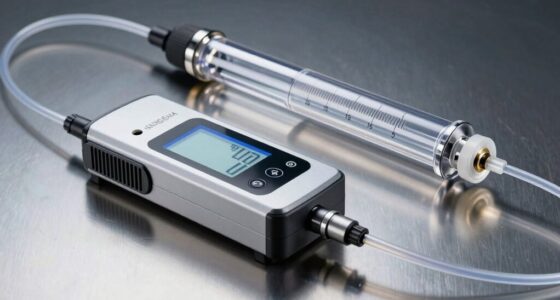
FTIR ATR sampling accessory
As an affiliate, we earn on qualifying purchases.
As an affiliate, we earn on qualifying purchases.
Frequently Asked Questions
How Does Sample Preparation Differ Between ATR and Transmission FTIR?
You prepare samples differently for ATR and transmission FTIR. For ATR, you need a clean, flat sample surface, often pressing or placing it directly onto the crystal, and no specific thickness is required. In contrast, transmission FTIR requires the sample to be thin enough—usually a few micrometers—to allow IR light to pass through without excessive absorption. Proper preparation guarantees accurate, clean spectra for both methods.
Can ATR Analyze Thick or Opaque Samples Effectively?
Yes, ATR can analyze thick or opaque samples effectively because it offers good spectral accuracy and limited sample penetration. Unlike transmission, ATR doesn’t require thin, transparent samples, making it ideal for challenging materials. You’ll find that ATR minimizes sample preparation, providing reliable, high-quality spectra even with difficult samples. This method’s ability to penetrate only surface layers ensures you get accurate insights without the need for extensive sample thinning or clearing.
What Are the Cost Differences Between ATR and Transmission Accessories?
Is it a surprise that costs vary like the tides? You’ll find ATR accessories generally cost more upfront due to specialized components, impacting your instrument cost. Transmission accessories, often simpler, save you money initially. However, consider long-term expenses—maintenance and replacement parts can tip the scales. So, weigh the accessory expense against your budget and analytical needs to choose what’s truly cost-effective for your lab.
How Do Environmental Factors Affect ATR Versus Transmission FTIR Results?
Environmental factors like humidity interference and surface contamination can impact ATR and transmission FTIR results differently. Humidity interference may introduce water bands that obscure spectra, especially in ATR due to its surface contact. Surface contamination can also affect ATR measurements more, as it interacts directly with the probe. To get cleaner results, control humidity levels and keep samples free of surface contaminants, regardless of the method you choose.
Which Method Offers Better Reproducibility for Quantitative Analysis?
Ever wondered which method guarantees more consistent results? You’ll find that ATR offers better reproducibility because it provides higher measurement precision and consistency across samples. Its contact-based approach minimizes sample preparation variability, leading to more reliable quantitative analysis. While transmission can be affected by sample thickness and heterogeneity, ATR’s stable contact ensures your measurements stay precise, making it the superior choice for reproducibility and consistent quantification.

J-8763-B Universal Transmission Holding Fixture with Base for GM & Transmissions 180C, 3L30, 200, 200C, 200-4R, 250, 250-C, 350, 350-C, 375, 400, 425, 475, 700-R4, 4L80E, Transmission Holder Stand
【Universal Compatibility】 J-8763-B Transmission Holding Fixture Tool is designed for a wide range of transmissions including 180C (3L30),…
As an affiliate, we earn on qualifying purchases.
As an affiliate, we earn on qualifying purchases.
Conclusion
Think of ATR and transmission as two different lenses through which you view the universe of your sample. While ATR offers a clearer, more direct glimpse—like peering through a pristine window—transmission can sometimes be clouded by interference. Ultimately, choosing the cleaner truth depends on your sample’s nature. Like a detective peeling back layers of mystery, select the method that reveals the clearest story, uncovering the hidden details as if lifting a veil to see the true face behind the mask.

BioMEMS: Science and Engineering Perspectives
As an affiliate, we earn on qualifying purchases.
As an affiliate, we earn on qualifying purchases.
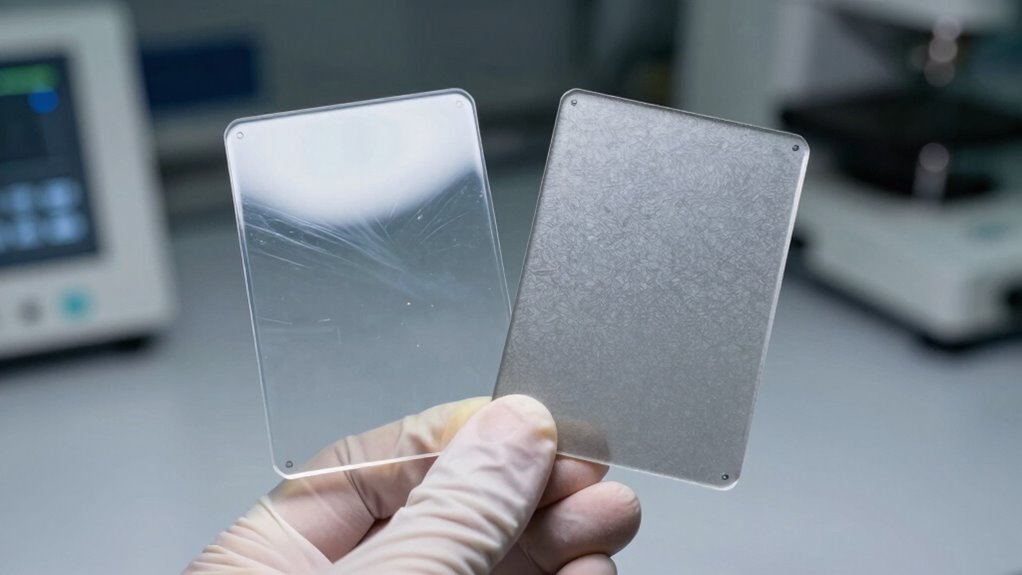
KBr pellet press for FTIR
As an affiliate, we earn on qualifying purchases.
As an affiliate, we earn on qualifying purchases.