
To rescue Raman spectra obscured by fluorescence, you can use simple tricks like shifting to near-infrared lasers, which reduces background interference. Applying baseline correction algorithms helps subtract fluorescence without losing spectral details. Combining wavelength selection with advanced correction techniques makes your spectra clearer and more accurate. These straightforward strategies are effective, but to discover even more ways to improve your results, keep exploring the solutions that follow.

Get school and study supplies delivered free — and shop member deals
- Fast, free delivery on millions of items
- Access to Prime Big Deal Days deals on October 6–7
- Prime Video, Amazon Music and more included
Key Takeaways
- Use baseline correction algorithms to effectively subtract fluorescence background from Raman spectra.
- Shift excitation wavelengths to near-infrared regions to minimize fluorescence interference.
- Apply adaptive spectral fitting techniques to isolate and remove fluorescence without distorting signals.
- Combine wavelength tuning with spectral correction methods for clearer, more accurate spectra.
- Proper data processing transforms cluttered spectra into reliable information for analysis.
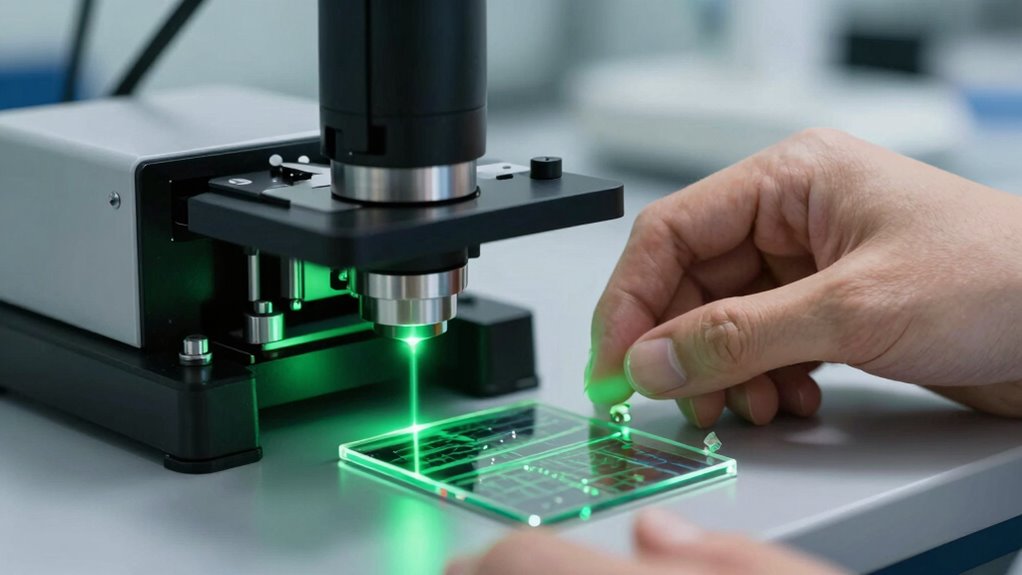
Have you ever wondered how scientists identify and analyze tiny molecules with remarkable precision? It’s a fascinating process, especially when dealing with Raman spectroscopy, where fluorescence interference often complicates measurements. Fluorescence can overshadow the Raman signals, making it challenging to interpret spectra accurately. But don’t worry — there are simple tricks to rescue these spectra, and spectral correction techniques play a crucial role in this process.
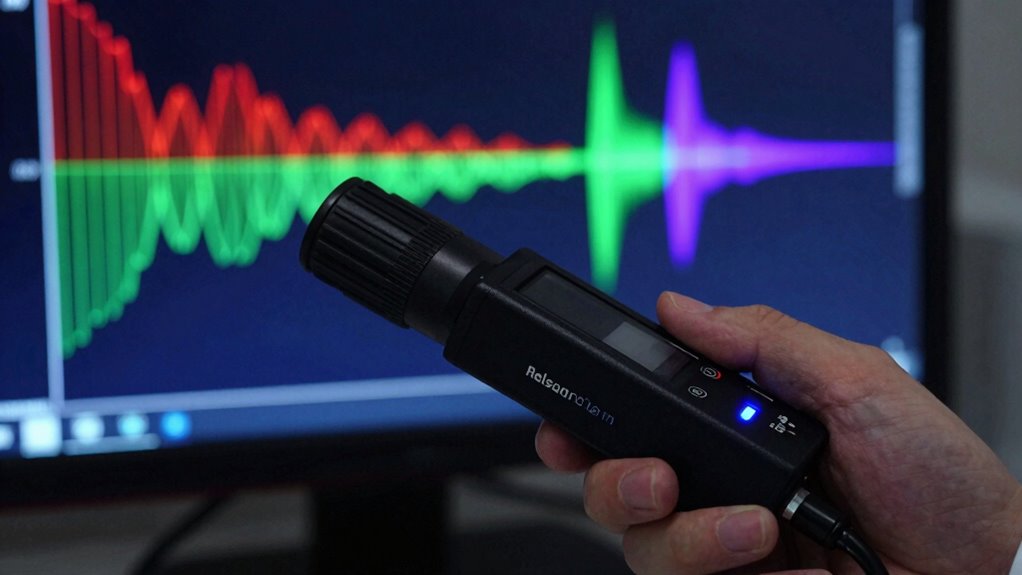
When fluorescence interference occurs, it creates a broad, intense background that masks the subtle Raman peaks. This background isn’t just an annoyance; it can lead to misinterpretations or missed details about the molecular structure. To combat this, spectral correction methods are employed. These techniques help subtract or minimize the fluorescence background, revealing the true Raman signals beneath. For example, baseline correction algorithms are commonly used to fit and subtract the fluorescence background, allowing sharper focus on the Raman peaks. This correction isn’t just a technical step; it’s indispensable for accurate analysis, especially when working with complex biological samples or organic compounds prone to fluorescence.
Another effective approach involves choosing excitation wavelengths carefully. Shorter wavelengths tend to excite more fluorescence, so shifting to near-infrared lasers can markedly reduce fluorescence interference. By doing this, you’re practically tuning the system to minimize the problem at its source. Additionally, advanced spectral correction algorithms can adaptively fit and remove the fluorescence background, even in challenging samples. These algorithms analyze the spectrum’s shape and subtract the fluorescence component without distorting the Raman peaks, ensuring you preserve the integrity of the data.
The combination of appropriate wavelength selection and spectral correction techniques transforms problematic spectra into clear, interpretable data. With these tricks, what once seemed like an insurmountable obstacle becomes manageable. You can analyze biological tissues, organic molecules, or complex samples with greater confidence, knowing that fluorescence interference won’t obscure critical details. These methods are simple yet powerful, enabling you to extract meaningful insights from spectra that initially appear compromised.
In essence, mastering fluorescence interference and spectral correction is key to opening the full potential of Raman spectroscopy. By applying these straightforward tricks, you guarantee your spectra are clean and accurate, paving the way for precise molecular identification and analysis. It’s a game-changer, turning noisy, cluttered data into clear, reliable information that advances your research and understanding of the microscopic world. Recognizing the importance of spectral correction techniques helps ensure you can effectively address fluorescence issues and improve your spectral analysis outcomes.
Raman spectroscopy baseline correction software
As an affiliate, we earn on qualifying purchases.
As an affiliate, we earn on qualifying purchases.
Frequently Asked Questions
How Does Temperature Affect Raman Fluorescence Signals?
Temperature effects can substantially influence Raman fluorescence signals. As you increase the temperature, fluorescence quenching often occurs, reducing the intensity of the signals. Higher temperatures can cause non-radiative energy loss, diminishing fluorescence efficiency. Conversely, lowering the temperature may enhance fluorescence signals by minimizing quenching. You should control temperature carefully during measurements to guarantee accurate, reliable spectra, especially when dealing with sensitive samples where fluorescence quenching impacts data quality.
Can Raman Fluorescence Be Used for Real-Time Monitoring?
Sure, Raman fluorescence can be used for real-time monitoring—who would’ve thought? You just need to guarantee proper spectral calibration and signal enhancement techniques are in place. While it’s challenging due to background interference, with the right setup, you can get quick, reliable data. This makes it ideal for continuous monitoring in processes, environmental sensing, or medical diagnostics, turning complex spectral data into real-time insights.
What Are Common Sources of Artifacts in Spectra?
You should watch out for common sources of artifacts in spectra, like spectral distortions caused by sample movement or environmental factors. Instrument calibration errors can also introduce inaccuracies, so regularly calibrate your equipment to guarantee reliable results. Additionally, fluorescence interference and improper sample preparation may cause artifacts, leading to misleading data. Addressing these issues helps you obtain clearer, more accurate spectra for your analysis.
How Do Sample Preparation Methods Influence Results?
Sample preparation methods critically influence your results by affecting spectral clarity. When you dry your samples thoroughly, it minimizes solvent effects and reduces fluorescence interference. Proper drying ensures the sample’s consistency, preventing artifacts from residual solvents or moisture. Additionally, choosing appropriate solvents that don’t fluoresce or interfere with Raman signals is essential. These steps help you obtain cleaner spectra, making data interpretation more accurate and reliable.
Are There Limitations for Biological Sample Analysis?
You might think biological samples are easy to analyze, but spectral interference and issues with instrument calibration often limit accuracy. These factors can cause overlapping signals or distortions, making it hard to get clear spectra. While advanced techniques help, you must be cautious about these limitations. Proper calibration and managing spectral interference are essential for reliable results, but some biological complexities still pose challenges, especially with heterogeneous or low-concentration samples.
Conclusion
Think of Raman fluorescence as a tricky puzzle; with the right tricks, you can reveal its secrets. By applying simple strategies like baseline correction and careful data collection, you’ll turn confusing spectra into clear insights. It’s like finding a hidden treasure map—once you know the tricks, the path becomes obvious. Keep experimenting, stay patient, and soon you’ll rescue those spectra just like a detective solving a mystery. Your Raman journey is just getting started!
Halloween Picks
halloween
As an affiliate, we earn on qualifying purchases.