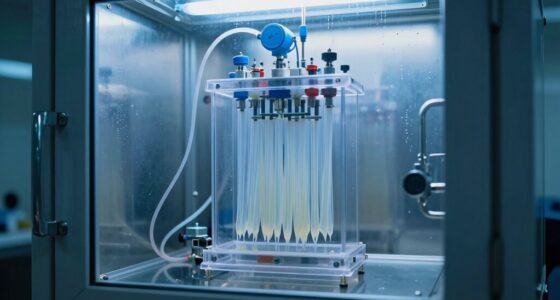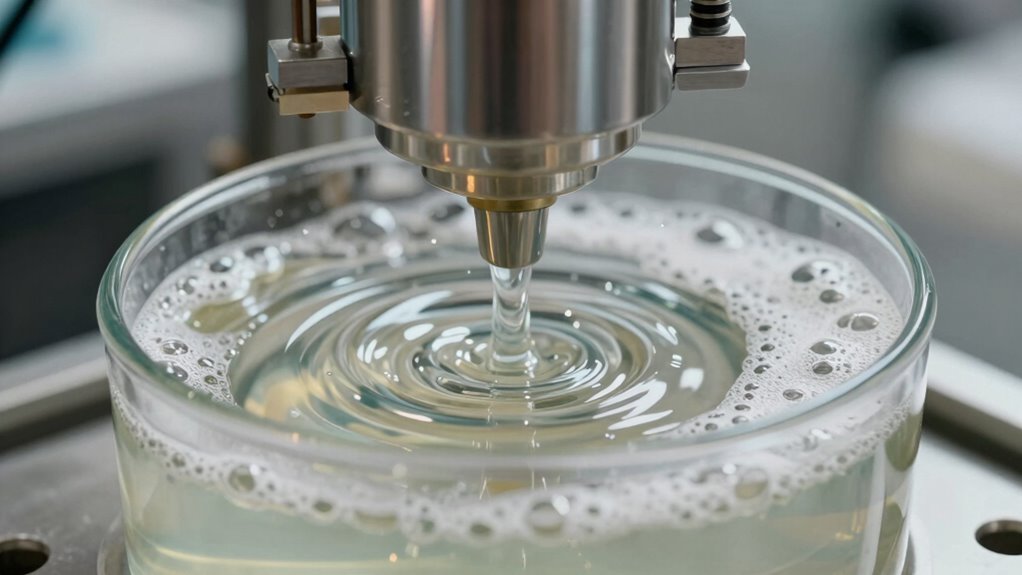

Vacuum degassing is a vital step in resin casting that helps eliminate trapped air and volatile impurities, preventing bubbles and foam-like imperfections. By applying vacuum, you release air pockets that could weaken or mar your final piece, resulting in clearer, denser, and stronger castings. Proper degassing combined with careful pouring guarantees professional results with minimal finishing work. Keep going, and you’ll discover how to master this foaming trick for perfect castings every time.
Key Takeaways
- Vacuum degassing removes trapped air and volatile impurities, preventing foam formation and ensuring bubble-free resin casts.
- Applying vacuum causes bubbles to expand and escape, resulting in clearer, denser resin with improved surface quality.
- Proper degassing reduces surface defects and weak spots caused by trapped air during curing.
- Combining vacuum degassing with careful pouring minimizes reintroduction of bubbles, enhancing final product strength and appearance.
- Integrating vacuum degassing into your workflow leads to smoother, more professional castings with less finishing work needed.
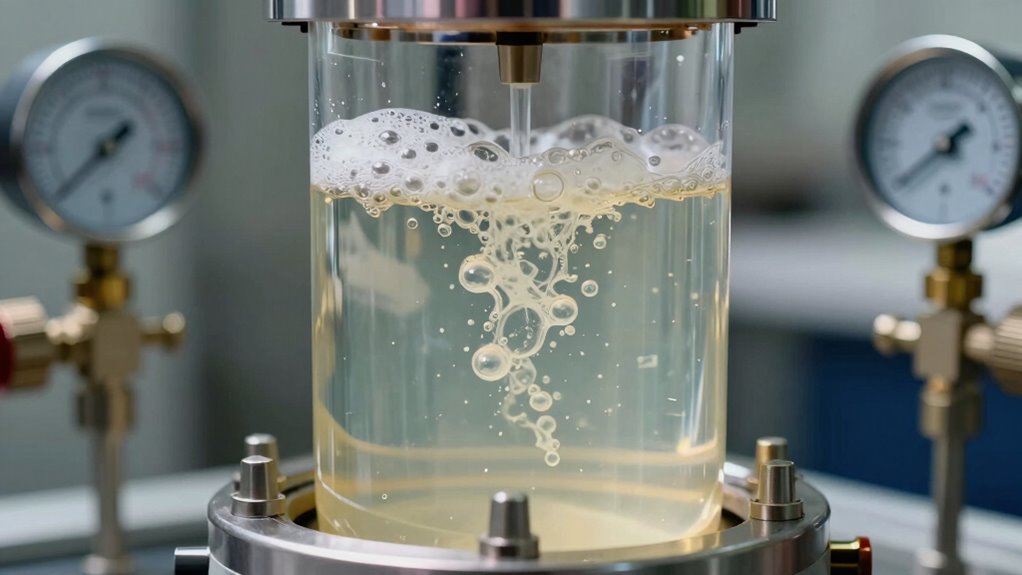
Vacuum degassing resins is an essential process that removes trapped air and volatile impurities, guaranteeing the material’s purity and performance. When working with resins, especially in casting applications, the presence of bubbles can compromise the final product’s integrity. That’s why understanding how vacuum degassing fits into your casting techniques is fundamental. By applying a vacuum, you effectively eliminate air pockets that may have been introduced during mixing or handling, giving you a smoother, denser casting.
In resin curing, the quality of your mixture directly impacts the strength and appearance of your castings. If you neglect proper degassing, trapped air can expand during curing, leading to foam-like imperfections or weak spots. Using vacuum degassing before pouring helps you achieve a more uniform resin flow, ensuring that the resin fills every crevice of your mold. This step not only enhances the aesthetic quality but also improves structural integrity, especially in detailed or complex castings. You’ll find that casting techniques that incorporate vacuum degassing often result in clearer, more professional-looking pieces, since bubbles tend to cause cloudiness or surface defects.
Proper degassing ensures stronger, clearer castings with fewer surface defects and bubbles.
To effectively integrate vacuum degassing into your process, you should start by mixing your resin thoroughly but gently to minimize introduced air. Once mixed, place the resin in a suitable container and apply a vacuum using a degassing chamber or a vacuum pump. As the pressure drops, you’ll notice the resin begin to bubble and expand — this is a sign that trapped air is escaping. Keep the vacuum until the bubbling subsides and the resin appears clear and free of foam. This step is essential because it prevents bubbles from forming during resin curing, which could otherwise weaken the final product or ruin its appearance.
Additionally, it’s beneficial to understand the physical properties of resins, as these influence how easily gases are released during degassing. After degassing, pour the resin into your mold carefully, minimizing any disturbance that might reintroduce air. The combined effect of degassing and proper pouring technique ensures a high-quality cast. Remember, the effectiveness of your casting techniques depends heavily on how well you prepare your resin beforehand. Skipping vacuum degassing may save time upfront, but it often leads to more finishing work later, such as sanding or repairing surface defects caused by bubbles. By making vacuum degassing a standard part of your workflow, you’ll consistently produce cleaner, stronger, and more visually appealing castings, elevating your craftsmanship and results.
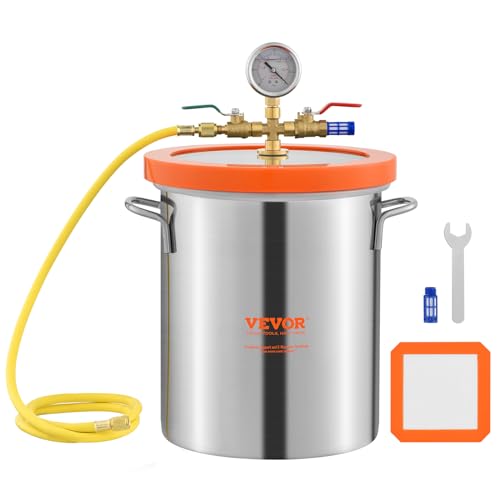
VEVOR 3 Gallon Vacuum Chamber, Upgraded Tempered Glass Lid Vacuum Degassing Chamber, 304 Stainless Steel Chamber, for Stabilizing Wood, Resin Degassing, Silicone Degassing and Plaster Degassing
- Large 3-Gallon Capacity: Ideal for bubble-free crafts and experiments
- Corrosion-Resistant Glass Lid: Suitable for stabilizing wood and handling volatile materials
- 304 Stainless Steel Chamber: Durable and corrosion-resistant for degassing tasks
As an affiliate, we earn on qualifying purchases.
As an affiliate, we earn on qualifying purchases.
Frequently Asked Questions
Can Vacuum Degassing Be Used With All Resin Types?
Vacuum degassing isn’t suitable for all resin types, as resin compatibility varies. You need to check your resin’s specifications to guarantee it can handle vacuum processes without adverse effects. Additionally, proper equipment requirements, like a vacuum chamber and appropriate safety measures, are essential. Some resins might foam excessively or degrade under vacuum, so always verify compatibility and use the right equipment to achieve the best results.
How Long Does the Degassing Process Typically Take?
The degassing process usually takes about 5 to 15 minutes, depending on resin viscosity and bubbling behavior. Think of it as a gentle dance where you let the bubbles rise to the surface naturally. You’ll see the bubbling slow down as the resin becomes clearer. Keep an eye on it, and don’t rush—patience guarantees all trapped air escapes, resulting in a flawless cast.
Are There Safety Precautions During Vacuum Degassing?
Yes, you should always wear safety equipment like gloves and goggles during vacuum degassing to protect yourself from resin fumes and splashes. Make certain proper ventilation precautions are in place, such as working in a well-ventilated area or using exhaust systems, to prevent inhaling harmful vapors. Follow the manufacturer’s safety guidelines carefully, and never bypass safety features, to keep yourself safe throughout the degassing process.
Does Degassing Affect the Resin’s Curing Time?
Think of degassing as a gentle whisper to your resin, subtly influencing its curing speed. Yes, it can affect resin viscosity, making it flow smoother, which in turn may speed up or slow down curing. When you remove trapped air, the resin’s curing process becomes more uniform, avoiding bubbles. So, by vacuum degassing, you’re fine-tuning your casting’s final quality, ensuring a flawless finish without sacrificing your desired curing time.
Can Vacuum Degassing Remove All Types of Impurities?
Vacuum degassing effectively removes most air bubbles and some impurities, but it doesn’t eliminate all types of impurities. For impurity removal, especially contaminants like dust or chemical residues, additional filtering or cleaning methods are necessary. While it enhances resin purity by reducing trapped air, vacuum degassing alone can’t guarantee complete impurity removal. To ensure the highest resin purity, combine vacuum degassing with other purification techniques tailored to specific impurities.
Conclusion
By mastering vacuum degassing, you’ll reveal flawless castings that defy even the wildest expectations. This simple foaming trick transforms your resin process, saving you from countless imperfections and endless frustration. It’s like giving your project a magic wand—turning cloudy, bubbly messes into crystal-clear masterpieces in seconds. So, don’t underestimate this powerful technique; it’s the game-changer that’ll elevate your casting skills to legendary status. Get ready to amaze yourself with perfect results every single time!