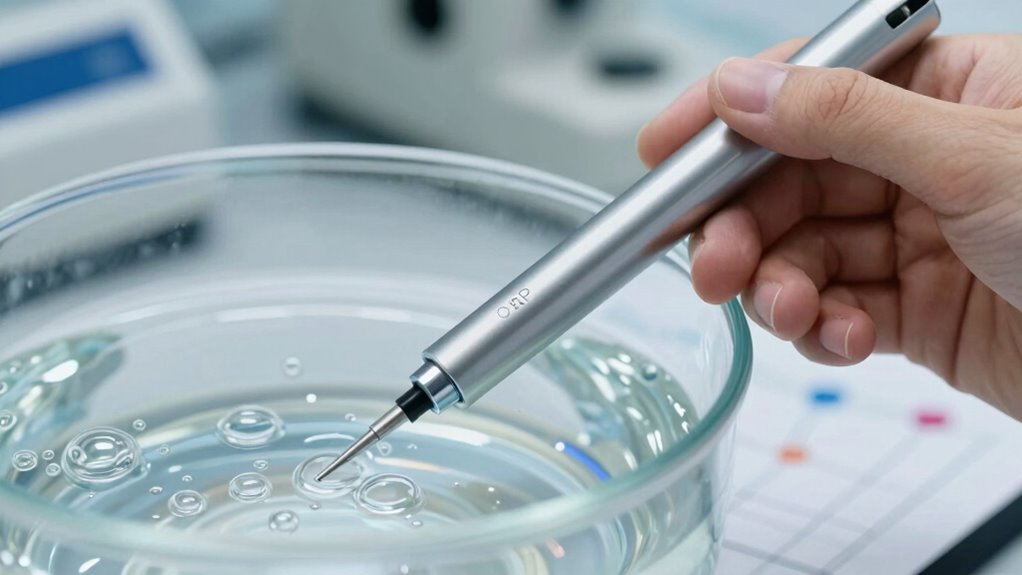

ORP confuses many because it’s an electrochemical measurement that’s often mistaken for a direct indicator of water purity. It actually reflects the solution’s redox balance—how easily molecules gain or lose electrons—not how “clean” the water is. High ORP might mean strong oxidants are present, but not necessarily safe or pure water. To truly understand what ORP tells you, you need to grasp its basic electrochemical principles and limitations. Keep exploring to see how it all fits together.
Key Takeaways
- ORP measures electrical potential from electron transfer, not overall water quality or safety.
- High ORP can result from oxidants like chlorine, not necessarily indicating pure or safe water.
- Low ORP may be due to reducing agents like organic matter, not inherently unsafe water.
- ORP is a momentary electrochemical snapshot, not a comprehensive assessment of water conditions.
- Proper interpretation requires understanding the presence of oxidants and reducers, avoiding hand-waving assumptions.
Have you ever looked at ORP readings and wondered what they really mean? If so, you’re not alone. ORP, or oxidation reduction potential, is often misunderstood because it’s presented as a single number that supposedly indicates how “clean” or “dirty” water is. But the truth is, ORP measures something much more specific: it’s an electrical measurement of a solution’s tendency to gain or lose electrons during oxidation reduction reactions. This can be confusing because many people assume ORP directly correlates with water quality, which isn’t always accurate. Instead, ORP reflects the potential of a solution to participate in chemical reactions involving electron transfer, not necessarily its overall purity.
Understanding how ORP relates to oxidation reduction processes helps clear up some of the confusion. These processes are fundamental in chemistry because they describe how substances either donate or accept electrons. When you measure ORP, you’re fundamentally measuring the electrical potential created by these electron exchanges. A high ORP value indicates a greater tendency for oxidation, meaning the water has a strong ability to accept electrons from other substances. Conversely, a low ORP suggests a reducing environment, where the water tends to donate electrons. This electrical measurement isn’t just a number; it’s a reflection of the balance between oxidizing and reducing agents present in the water at that moment.
ORP measures the electrical potential from electron exchanges, indicating the water’s redox balance at that moment.
Many people get caught up in thinking ORP is a direct indicator of sanitization or cleanliness, but it’s more nuanced. For example, water with a high ORP might contain oxidants like chlorine or ozone, which are often added to disinfect water. However, a high ORP doesn’t guarantee the water is free of contaminants or safe to drink. It simply shows that the solution has a strong oxidation potential at that time. Similarly, low ORP values don’t necessarily mean the water is unsafe; they could result from the presence of reducing agents, like organic matter, that skew the reading without indicating poor quality. Recognizing the electrochemical nature of ORP helps avoid misconceptions and interpret readings more accurately.

ORP Meter, ORP Redox Meter Tester -1999~1999mV, 1-Point Calibration, Oxidation Reduction Potential, Aquariums, Swimming Pools, Water Treatment Systems, Aquaculture, Spa
- Easy-to-Read Display: Large, clear screen for quick readings
- Simple Calibration: Includes screwdriver for 1-point calibration
- Automatic Temperature Compensation: Adjusts readings from 0–50°C
As an affiliate, we earn on qualifying purchases.
As an affiliate, we earn on qualifying purchases.
Frequently Asked Questions
How Is ORP Measured in Real-Time?
You measure ORP in real-time using a specialized ORP sensor with a reference electrode, which you connect to a meter or data logger. Regular sensor calibration guarantees accuracy, so you should calibrate it with standard solutions. Also, maintain the electrode by cleaning and storing it properly, as this keeps measurements reliable and consistent over time. This process helps you monitor redox potential effectively without confusion.
What Factors Can Distort ORP Readings?
Think of ORP readings as delicate plants that need careful tending. pH sensitivity can throw off your results, and electrode calibration is essential to keep readings accurate. Contaminants or deposits on the electrode surface also distort measurements. If you don’t regularly calibrate your sensor, the data drifts, giving a false picture. Keep these factors in check, and your ORP readings will stay true to life.
Is ORP Applicable to All Water Types?
You’ll find ORP applies to many water types, but water chemistry varies, so measurements can differ. Factors like pH, dissolved substances, and contamination influence ORP readings, making it less consistent across different waters. Use proper measurement techniques to get accurate results, and remember that ORP is most useful when combined with other water quality tests. Always consider water chemistry for reliable ORP application in various water sources.
How Does Temperature Influence ORP Measurements?
Temperature effects can substantially influence ORP measurements, making them less accurate if not properly adjusted. As temperature rises, the redox reactions speed up, often leading to higher ORP readings, and vice versa. You should always consider temperature corrections to guarantee measurement accuracy. Using a temperature-compensated ORP meter or calibrating your device regularly helps account for these effects, ensuring reliable and consistent results across different water temperatures.
Can ORP Predict Water Quality Reliably?
Did you know ORP measurements can vary by up to 200 millivolts depending on water chemistry? While oxidation potential provides quick insights, it isn’t entirely reliable for predicting water quality. Factors like contaminants and pH influence ORP, making it a helpful indicator but not a definitive test. You should combine ORP with other analyses to get a clearer picture of water quality’s true state.
Conclusion
So, next time you look at ORP readings, picture a swirling storm of electrons dancing unpredictably. Don’t let the confusing numbers drown you in a fog of uncertainty. Instead, see the redox potential as a guiding lighthouse, illuminating the path through the chaos. With a clearer understanding, you can navigate this complex world with confidence, turning the confusing storm into a steady breeze—making sense of what once seemed impossible.