
Stroboscopes in maintenance let you visualize moving parts as if they’re frozen, helping you identify issues without stopping equipment. When you use them for laser alignment, vibration analysis, or troubleshooting, you can catch problems early and prevent costly downtime. This non-invasive approach saves time, reduces wear, and extends machinery life. If you want to discover how this technology can keep your operations running smoothly, there’s more to explore.
Key Takeaways
- Stroboscopes make moving machinery appear stationary, enabling quick inspections without halting operations.
- They facilitate real-time detection of misalignments and irregularities, preventing costly downtime.
- Using stroboscopes for laser alignment ensures precise adjustments without disassembly.
- They allow ongoing vibration monitoring, identifying issues early to avoid unexpected failures.
- Stroboscopes enhance maintenance efficiency by enabling non-invasive, immediate troubleshooting during equipment operation.

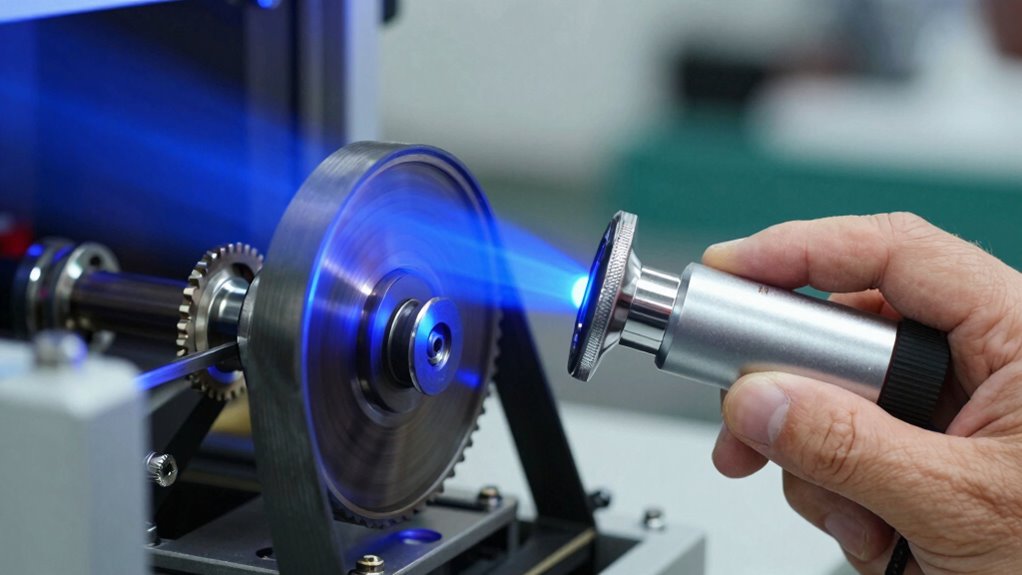
Have you ever wondered how maintenance teams diagnose fast-moving machinery without stopping it? It’s a critical question because halting equipment can lead to costly downtime and production delays. That’s where stroboscopes come into play. These tools allow you to observe the motion of machinery as if it’s frozen in time, giving you the ability to analyze and troubleshoot while everything is still running. By flashing light at precisely the right frequency, a stroboscope makes moving parts appear stationary, revealing any irregularities or misalignments that might otherwise be hidden.
Using a stroboscope is a game-changer when it comes to performing tasks like laser alignment and vibration analysis. With laser alignment, you need pinpoint accuracy to ensure shafts and pulleys are perfectly aligned, reducing wear and energy consumption. Instead of disassembling equipment or relying solely on manual measurements, you shine the stroboscope’s light and observe the alignment in real time. If the laser points or pulleys seem to be out of sync, you can make immediate adjustments, saving time and avoiding potential damage. In vibration analysis, the stroboscope enables you to identify abnormal vibrations that could indicate bearing issues, misalignment, or imbalance. By observing the machinery under normal operating conditions without stopping it, you get a clear picture of how the equipment performs over time.
Stroboscopes enable real-time laser alignment and vibration analysis without shutting down machinery.
This approach not only enhances accuracy but also markedly reduces downtime. You don’t have to shut down a machine to perform inspections, which means production keeps flowing. Plus, the immediate insights gained from stroboscopic observations can help you catch problems early, preventing catastrophic failures and extending equipment life. It’s a proactive approach that combines visual clarity with real-time data, allowing you to troubleshoot more effectively. Implementing non-invasive inspection methods like stroboscopes can significantly improve maintenance efficiency and safety. Additionally, understanding the principles of motion analysis can help you better interpret the observations and make informed decisions. Incorporating advanced diagnostic techniques enhances your ability to maintain complex machinery efficiently.
Integrating stroboscopes with vibration analysis and laser alignment tools creates an all-encompassing maintenance strategy. You can quickly identify issues, verify repairs, and optimize machinery performance without interrupting daily operations. This synergy improves overall efficiency and saves money by avoiding unnecessary repairs and replacements. When combined with preventive maintenance practices, the effectiveness of using stroboscopes is further amplified. In the end, a well-utilized stroboscope acts as your eyes during operation, providing the critical information needed to keep machinery running smoothly, reliably, and safely. It’s a powerful, non-invasive way to maintain complex machinery, ensuring that “frozen motion” isn’t just a visual effect but a practical tool for operational excellence. Understanding the importance of non-invasive inspection methods can significantly elevate your maintenance practices.

Accurate Digital Handheld Stroboscope with Wide Measurement Range, 50~12,000 FPM, for Equipment Fault Detection and Maintenance
- Measurement Range: 50 to 12,000 FPM
- Versatile Measurement: Detects rotation speed and surface defects
- No Reflective Marks Needed: Inspects without surface preparation
As an affiliate, we earn on qualifying purchases.
As an affiliate, we earn on qualifying purchases.
Frequently Asked Questions
How Do Stroboscopes Compare to Other Motion Analysis Tools?
Stroboscopes excel in motion resolution and quick device calibration, making them ideal for real-time analysis. Unlike other tools, they freeze motion precisely, allowing you to identify issues without stopping machinery. While high-speed cameras provide detailed visuals, they often require extensive setup. Stroboscopes are portable, easy to calibrate, and deliver instant insights, helping you reduce downtime effectively. They’re a practical choice for efficient, on-the-spot motion analysis.
What Are the Safety Considerations When Using Stroboscopes?
Safety with stroboscopes is vital; don’t let their flickering be a trap. You should always wear personal protective equipment, like safety glasses, to shield your eyes from intense flashes. Follow electrical safety procedures to prevent shocks or short circuits, especially when working near energized equipment. Remember, a vigilant approach guarantees you don’t just analyze motion but also keep yourself safe from harm.
Can Stroboscopes Be Used Outdoors or in Bright Environments?
Yes, you can use stroboscopes outdoors or in bright environments, but you need to take into account outdoor lighting and ambient brightness. Bright environments can diminish the strobe’s effectiveness, so it’s best to use models with high-intensity flash capabilities. Position the stroboscope away from direct sunlight and ensure the flash intensity overcomes outdoor lighting conditions. Proper setup guarantees you get clear, frozen motion images even in challenging bright environments.
What Maintenance Is Required for Long-Term Stroboscope Accuracy?
Think of your stroboscope as a vintage camera needing regular focus adjustments. To maintain long-term accuracy, you should perform calibration procedures periodically, ensuring the device’s timing remains precise. Also, consider environmental factors like temperature, humidity, and vibration, which can affect accuracy. Regularly inspecting and cleaning the optics, verifying power sources, and recalibrating as needed will keep your stroboscope reliable over time.
Are There Any Industry-Specific Standards for Stroboscope Use?
Yes, industry-specific standards for stroboscope use do exist. You should follow calibration procedures regularly to guarantee accurate measurements, especially in critical environments like manufacturing or power plants. Operator training is equally important, as it helps you understand proper handling and positioning to avoid errors. Adhering to these standards ensures safety, precision, and efficiency, reducing downtime and maintaining equipment reliability across different industries.
Conclusion
Imagine a stroboscope as a vigilant lighthouse keeper, freezing chaos in its tracks so you can see every flicker and flaw. When you harness its power, downtime becomes a thing of the past—like catching lightning in a bottle. With this tool, maintenance transforms from a frantic scramble into a choreographed dance, where “frozen motion” reveals hidden secrets. Embrace it, and turn your maintenance routine into a symphony of precision and efficiency.