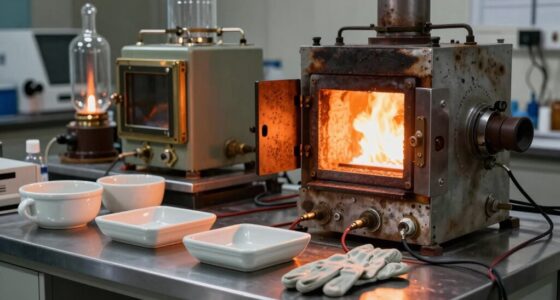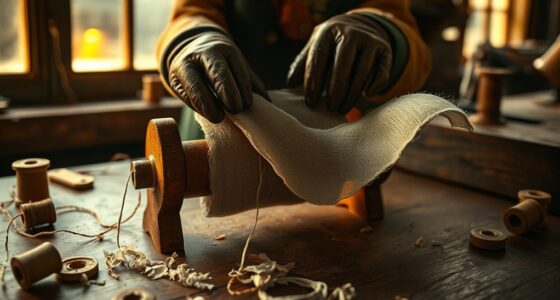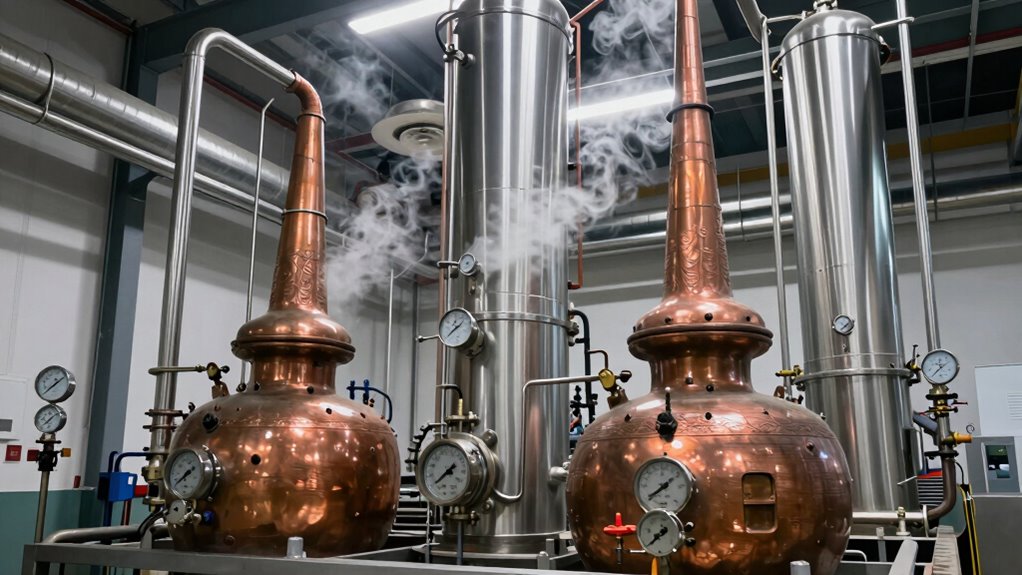
You see, distillation started as a simple craft using clay or metal vessels for heating and cooling, driven by early needs in alchemy and medicine. Over time, Islamic scholars improved the apparatus, making the process more efficient and scientific. During the Industrial Revolution, large-scale equipment and automation transformed distillation into a cornerstone of industries like petrochemicals and pharmaceuticals. Today, it’s a highly sophisticated science that keeps evolving, and exploring further reveals just how integral it’s become.

Get school and study supplies delivered free — and shop member deals
- Fast, free delivery on millions of items
- Access to Prime Big Deal Days deals on October 6–7
- Prime Video, Amazon Music and more included
Key Takeaways
- Early distillation relied on simple heating and cooling techniques driven by primitive observation and manual methods.
- Islamic scholars improved apparatus design, notably the alembic, merging practical craft with emerging scientific principles.
- Advances in chemistry and thermodynamics enabled precise control, optimization, and understanding of distillation processes.
- The Industrial Revolution scaled up distillation with steam-powered equipment, enabling mass production across industries.
- Modern distillation employs sophisticated technology, integrating scientific research to maximize efficiency, purity, and industrial applications.
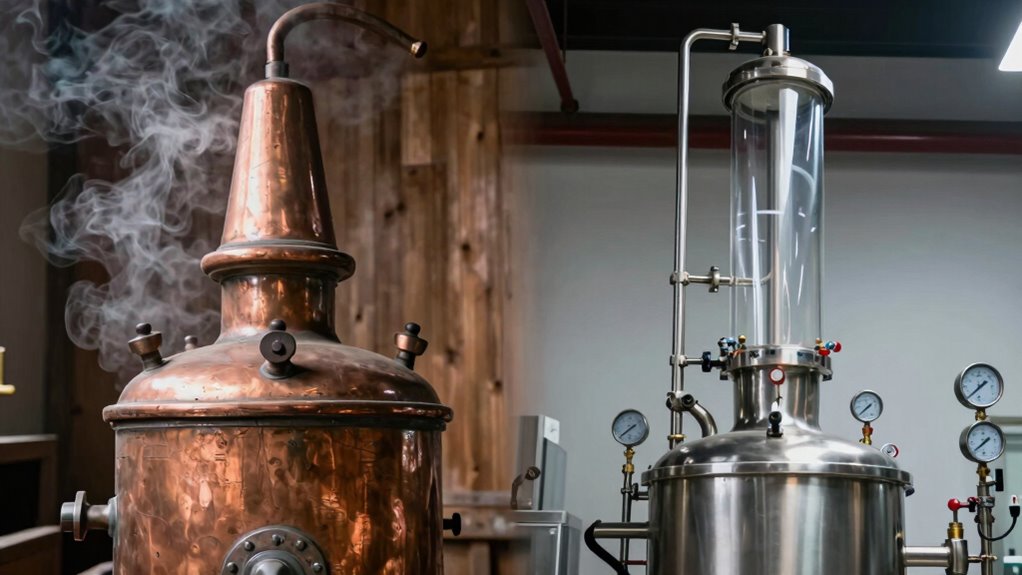
Have you ever wondered how the process of distillation has transformed over time? It’s a fascinating journey from simple, manual techniques to complex industrial systems. Originally, early civilizations relied on basic methods to separate liquids, primarily driven by the needs of alchemy, medicine, and early chemistry. These ancient peoples observed natural phenomena and experimented with primitive setups, often using clay or metal vessels to heat mixtures and collect vapors. The core chemical processes involved in these early methods were straightforward: heating a mixture to vaporize the more volatile component and then cooling the vapor back into liquid form to obtain a purified substance. Over centuries, these basic principles laid the groundwork for more sophisticated techniques, marking key historical developments in distillation.
As societies advanced, so did their understanding of the chemical processes involved. During the Islamic Golden Age, scholars like Jabir ibn Hayyan refined distillation apparatuses, introducing innovations such as the alembic—a device that improved the efficiency of vaporization and condensation. These developments weren’t just incremental; they marked a shift toward a more scientific approach, blending empirical knowledge with emerging principles of chemistry. This period also saw the first systematic experimentation with different materials, temperatures, and designs, which substantially increased the purity and yield of distilled products. These historical developments helped shift distillation from an art to an essential scientific process, fueling advancements in medicine, alchemy, and eventually, chemistry as a whole. Additionally, the understanding of chemical principles allowed for more precise control and innovation in distillation techniques. The integration of scientific methods into distillation processes further accelerated progress and reliability. Moreover, the development of thermodynamics contributed significantly to optimizing distillation processes and energy efficiency. The application of mathematical modeling further enhanced the ability to design more effective distillation equipment.
Fast forward to the Industrial Revolution, and distillation becomes a cornerstone of modern industry. Technological innovations allowed for the scaling up of processes, transforming distillation from small-scale lab setups into large, continuous operations. The introduction of steam-powered stills and automated systems meant that industries could produce alcohol, essential oils, fuels, and chemicals more efficiently and reliably. These advancements directly stemmed from a deeper understanding of chemical processes and thermodynamics, enabling engineers to optimize energy consumption and maximize output. The development of industrial distillation techniques further enabled the creation of complex chemical compounds essential in various sectors. Today, industrial distillation is integral to sectors like petrochemicals, pharmaceuticals, and food processing, making it a backbone of modern manufacturing.
In essence, the evolution of distillation reflects mankind’s growing mastery over chemical processes, from rudimentary experiments to high-tech industrial feats. Each historical development built on prior knowledge, pushing the boundaries of what’s possible and shaping the way industries operate today. What started as a craft rooted in curiosity and necessity has become a sophisticated science that continues to evolve, driven by ongoing innovations and a deeper understanding of chemical phenomena.
As an affiliate, we earn on qualifying purchases.
Frequently Asked Questions
What Were the Earliest Materials Used for Distillation Apparatus?
You’d find that the earliest distillation apparatus used materials like clay, copper, and glass. Ancient artifacts reveal that early inventors experimented with these substances, leading to material innovations that improved distillation techniques. Clay was used for simple stills, while copper allowed better heat conduction. Glass enabled more precise control and observation. These foundational materials set the stage for evolving distillation technology, transforming it from an ancient craft into an essential industrial process.
How Did Distillation Techniques Spread Across Different Ancient Civilizations?
Imagine whispers of ancient trade winds carrying secret distillation knowledge across lands, igniting a spark of innovation. You see how cultural exchange fueled this journey, as artisans shared techniques, blending ideas like vibrant paints on a canvas. From Persia to China, distillation spread like wildfire, transforming from a sacred craft into a essential industry. Through trade routes and storytelling, these methods wove themselves into the fabric of diverse civilizations, shaping history’s liquid tapestry.
Who Were the Key Historical Figures Influencing Distillation Development?
You learn that key figures like Jabir ibn Hayyan advanced distillation through his work on alchemy, blending ancient alchemical practices with early chemistry. During medieval times, herbal distillation gained prominence, thanks to alchemists and herbalists refining techniques for medicinal and aromatic purposes. These pioneers laid the groundwork for modern industrial distillation, transforming a craft into an essential process used in pharmaceuticals, fuels, and beverages today.
What Role Did Alchemy Play in Refining Distillation Methods?
Alchemy influence played a significant role in refining distillation methods. You see, alchemists experimented with early techniques to purify and extract substances, which led to improved refinement techniques. Their quest to transform base metals into gold pushed them to develop more precise distillation processes. These innovations laid the groundwork for modern distillation, transforming it from a mystical art into a systematic science, essential for industries like perfumery, medicine, and fuel production.
How Did Societal Changes Impact the Growth of Industrial Distillation?
Societal reforms and technological innovations greatly propelled industrial distillation’s growth. As societies embraced reforms, they demanded higher quality products, pushing distillation techniques forward. Technological innovations, like improved still designs and automation, made large-scale production efficient and consistent. You see, these changes allowed industries to meet increasing demand for spirits, fuels, and chemicals, transforming distillation from a craft into an essential industrial process that fuels modern economies.
Conclusion
You’ve seen how distillation transformed from a humble, ancient craft into the unstoppable, world-shaping force behind industries. It’s no exaggeration to say that without it, our modern lives would crumble—no spirits, no fuels, no perfumes. This incredible evolution proves that with innovation and ingenuity, what once seemed simple can become the backbone of entire civilizations. So next time you enjoy a drink or fuel your car, remember: distillation’s journey is nothing short of legendary.
Halloween Picks
halloween
As an affiliate, we earn on qualifying purchases.