If you’re looking to understand complex flow behavior, rheometers are the better choice since they provide all-encompassing insights into a material’s response to shear, stress, and deformation. Unlike viscometers, which mainly measure viscosity under specific conditions, rheometers explore a wider range of flow behaviors and properties like shear thinning, thickening, and viscoelasticity. To discover how these advanced tools can enhance your analysis, explore further details below.
Key Takeaways
- Rheometers provide comprehensive flow behavior data, making them ideal for complex material analysis, unlike viscometers with limited scope.
- Rheometers simulate real-world stresses, offering detailed insights into material responses, whereas viscometers measure viscosity under specific conditions.
- For predicting performance and understanding complex formulations, rheometers are more effective due to their advanced testing capabilities.
- Rheometers generate flow curves and viscoelastic data, answering broader questions about material behavior than the single-point viscosity data from viscometers.
- If the goal is thorough rheological characterization, rheometers answer the better question; for simple viscosity measurement, viscometers suffice.
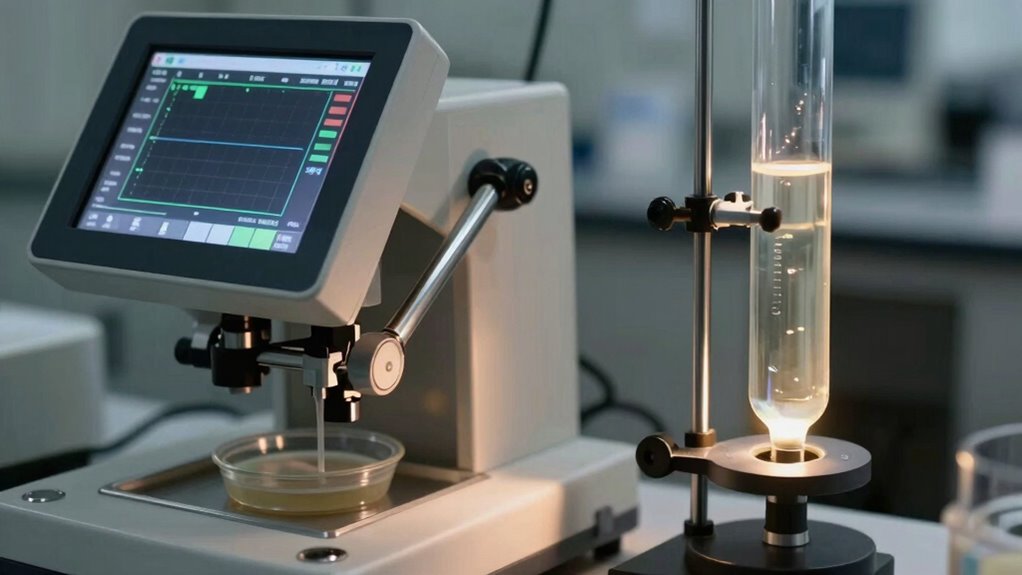
Rheometers, on the other hand, are more advanced instruments that explore a material’s flow behavior across a wider range of conditions. They measure not just viscosity but also how a material responds to varying shear rates, temperatures, or stresses. This means you can understand whether your material exhibits shear thinning, shear thickening, or viscoelastic properties—traits critical in many industrial processes. Rheometers allow you to produce detailed flow curves, revealing how a material’s viscosity changes with flow conditions, which is invaluable for complex formulations or quality control. Because they can simulate real-world stresses and deformations, rheometers provide a more holistic picture of your material’s behavior, delivering measurement precision across multiple parameters and ranges. Additionally, rheometers often incorporate advanced testing capabilities that expand their usefulness in research and development settings. Incorporating flow behavior analysis can be crucial for understanding complex materials, which rheometers are better equipped to provide. Understanding the rheological properties of materials helps in predicting their performance during manufacturing and end-use, making rheometers essential for comprehensive material characterization.
rheometer for complex flow analysis
As an affiliate, we earn on qualifying purchases.
As an affiliate, we earn on qualifying purchases.
Frequently Asked Questions
What Maintenance Is Required for Rheometers and Viscometers?
You need to regularly calibrate rheometers and viscometers, ideally before each use or weekly, to guarantee accuracy. Keep the instruments clean by wiping them with appropriate solvents and avoid contamination. Proper sample preparation is essential—use consistent methods and temperatures. Check for wear or damage, and replace parts as needed. Regular maintenance guarantees reliable readings and extends your instrument’s lifespan, ensuring precise measurements every time.
How Do Temperature Variations Affect Measurements?
Temperature variations are like shifting sands beneath your measurements, disrupting accuracy. When temperature isn’t stable, it impacts your readings, making them unreliable. To guarantee calibration accuracy, maintain temperature stability in your testing environment. Fluctuating temperatures can skew results, so control and monitor conditions carefully. This way, your rheometer or viscometer provides precise data, allowing you to confidently interpret material properties without interference from temperature shifts.
Are These Instruments Suitable for Non-Newtonian Fluids?
Yes, both rheometers and viscometers are suitable for testing non-Newtonian fluids. Rheometers excel at measuring non-Newtonian properties like shear thinning or thickening, providing detailed flow behavior. Viscometers are useful for simpler viscosity measurements but may need proper instrument calibration for accuracy with non-Newtonian samples. You should guarantee calibration is precise, as non-Newtonian fluids can vary considerably under different shear conditions.
What Is the Typical Lifespan of Each Device?
Back in the day, you’d expect a trusty rheometer or viscometer to last a good while with proper calibration standards. Typically, a rheometer’s lifespan ranges from 5 to 10 years, while viscometers often last around 3 to 8 years. Ensuring instrument accuracy through regular calibration and maintenance extends their longevity, so you get reliable measurements over time. Proper care keeps these devices performing well for years to come.
Can These Instruments Measure Viscosity in Complex Mixtures?
Yes, both rheometers and viscometers can measure viscosity in complex mixtures, but rheometers excel in complex mixture analysis due to their ability to assess shear-dependent behavior. You need to verify proper instrument calibration for accurate results, especially with complex samples. Viscometers are suitable for simpler fluids, but if your mixture has varying properties, a rheometer provides more detailed insights into its flow characteristics.
Conclusion
When choosing between rheometers and viscometers, picture yourself as an explorer steering a river’s twists and turns. A viscometer gives you a quick glimpse of the surface’s ripple, while a rheometer dives deeper, revealing the river’s true flow beneath. Decide what question you need answered—the surface or the depths. With the right instrument, you’ll soon have a clearer map of your material’s secrets, turning complex flows into simple stories you can confidently tell.