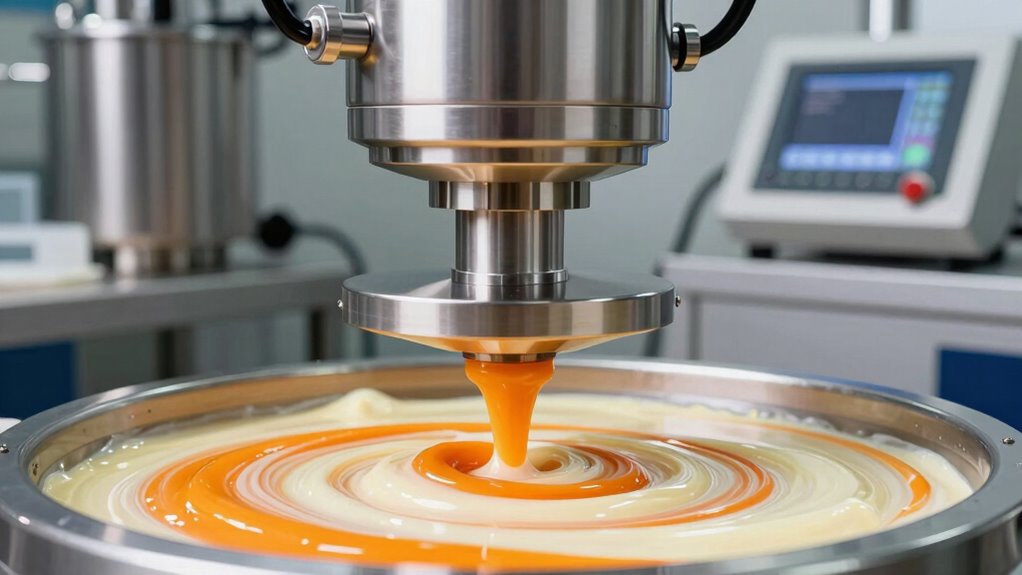

To control emulsion quality with a high-shear homogenizer, you must set the right gap. This controls the flow dynamics and shear forces that break particles for a uniform, stable mix. Too wide a gap weakens shear, creating larger particles, while too narrow risks over-shearing and heat build-up. Proper gap adjustment ensures consistent particle size and emulsion stability. Mastering this balance is vital, and if you keep exploring, you’ll discover how fine-tuning your setup enhances overall product quality.

Get school and study supplies delivered free — and shop member deals
- Fast, free delivery on millions of items
- Access to Prime Big Deal Days deals on October 6–7
- Prime Video, Amazon Music and more included
Key Takeaways
- Proper gap settings ensure optimal shear forces for uniform particle size and stable emulsions.
- Incorrect gaps can cause over-shearing or insufficient mixing, compromising emulsion quality.
- Balancing flow dynamics with the right gap promotes thorough mixing and reduces phase separation.
- Regular monitoring and adjustments of the gap improve process consistency and product stability.
- Mastering gap control enhances homogenizer performance, leading to high-quality, uniform emulsions.

Homogenizers play a crucial role in producing stable emulsions by guaranteeing consistent particle size distribution. When you’re working with high-shear homogenizers, the gap between the rotor and stator is a critical factor that directly influences your results. This gap controls the flow dynamics within the machine, dictating how the mixture is subjected to intense shear forces. A properly set gap ensures that the particles are broken down to the desired size, creating a uniform and stable emulsion.
Proper gap settings in high-shear homogenizers are key to achieving uniform, stable emulsions through optimal flow and shear force control.
If the gap is too wide, the shear forces weaken, leading to larger particle sizes that may settle or separate over time. Conversely, if the gap is too narrow, you risk over-shearing the mixture, which can cause unwanted heat build-up or damage to sensitive ingredients. The goal is to find that ideal gap where flow dynamics are balanced—providing enough force to reduce particle size without compromising the integrity of your product. This balance ensures a consistent particle size distribution, which is essential for product stability, appearance, and texture.
Adjusting the gap impacts not just particle size but also the flow dynamics within the homogenizer. You want a flow pattern that promotes thorough mixing and efficient shear action, so your ingredients blend uniformly. When flow is optimized, you get a steady, high-velocity circulation that minimizes dead zones and ensures that all parts of the mixture experience the same shear intensity. This uniform flow prevents inconsistencies, such as larger droplets or phase separation, enhancing the emulsion’s stability. Additionally, understanding the flow dynamics helps you fine-tune your process for better results. Proper control over the particle size ensures you meet product specifications and quality standards consistently.
Understanding the relationship between particle size and flow dynamics helps you fine-tune your process. Smaller particles contribute to a smoother, more stable emulsion, but achieving this requires precise control over the homogenizer’s gap. Regular monitoring and adjustments allow you to maintain the right gap, ensuring your emulsions stay uniform and stable throughout production. Moreover, awareness of how flow patterns influence particle breakage can help prevent inconsistencies and improve overall efficiency. Flow optimization is essential for maximizing homogenizer performance and achieving high-quality results. Optimizing the gap setting is essential for maximizing homogenizer performance and achieving high-quality results.
In essence, the right gap setting isn’t just about reaching a specific measurement; it’s about optimizing flow dynamics to control particle size effectively. When you master this balance, you’ll produce emulsions that are consistent, stable, and of high quality. Properly managing the gap means you’re not just turning the machine on and letting it run—you’re actively shaping the outcome of your process, achieving the perfect emulsion every time.
high shear homogenizer with adjustable gap
As an affiliate, we earn on qualifying purchases.
As an affiliate, we earn on qualifying purchases.
Frequently Asked Questions
How Does Temperature Affect Homogenizer Performance?
Temperature affects your homogenizer performance by influencing viscosity stability. As temperature rises, viscosity decreases, making it easier for the homogenizer to create fine emulsions. Conversely, cooler temperatures increase viscosity, which can strain the equipment and reduce efficiency. You need to monitor temperature closely, ensuring ideal conditions for consistent emulsion quality and reliable operation. Proper temperature control helps maintain steady viscosity, leading to better homogenization results.
What Maintenance Is Required for High-Shear Homogenizers?
You need to follow a strict lubrication schedule to keep your high-shear homogenizer running smoothly. Regularly check for wear and tear through wear monitoring, especially on seals and rotor-stator gaps. Clean the equipment after each use to prevent buildup. Replace worn parts promptly to avoid costly breakdowns. Proper maintenance guarantees peak performance, extends equipment lifespan, and maintains consistent emulsion quality.
Can Homogenizer Settings Be Automated for Different Products?
You can absolutely automate homogenizer settings for different products, making your process as smooth as silk. With automated calibration, you guarantee consistent quality despite product variability, saving time and reducing errors. Modern systems adapt in real-time, adjusting parameters seamlessly for each batch. This automation transforms your operation into a powerhouse of efficiency, where precision meets flexibility, and you stay ahead of the competition with minimal manual intervention.
How Do Viscosity Changes Impact Emulsion Stability?
Viscosity changes directly impact emulsion stability because they influence emulsion rheology. When you perform viscosity measurement, you’ll notice that higher viscosity often stabilizes droplets, preventing coalescence. Conversely, lower viscosity can lead to phase separation. Variations in viscosity affect how the emulsion flows and resists separation, so maintaining consistent viscosity is key to stable emulsions. Adjusting processing parameters based on viscosity measurements ensures ideal emulsion stability.
What Are the Energy Considerations for Continuous Operation?
You should focus on optimizing energy efficiency and minimizing power consumption during continuous operation. By adjusting the gap properly, you reduce unnecessary energy use, ensuring the homogenizer runs smoothly without overloading. Regular maintenance and monitoring help maintain consistent power consumption, preventing energy waste. This approach not only saves costs but also enhances process stability, making your emulsification process more sustainable and efficient over time.
Conclusion
By paying close attention to the gap settings in your high-shear homogenizer, you’re subtly guiding your emulsion towards perfection. Think of it as fine-tuning a delicate instrument; small adjustments can lead to remarkable improvements. When you master the art of gap control, you’re not just optimizing processes—you’re revealing the full potential of your formulations. Embrace the nuances, and watch your product’s quality elevate in ways you might not have imagined.
Fall Picks
fall essentials
As an affiliate, we earn on qualifying purchases.

![Sean Carroll Explains The Biggest Ideas In The Universe – Full Interview [Video] (2025)](https://chemicalceo.com/wp-content/uploads/2026/09/sean-carroll-explains-the-biggest-ideas-in-the-universe-full-interview-video-202-featured-560x300.jpg)