
Next-generation DNA sequencing relies on advanced chemistry and powerful enzymes to decode entire genomes quickly and accurately. DNA polymerases synthesize new strands while fluorescent tags attached to nucleotides emit specific colors to detect each base in real time. Innovations like reversible terminators and sensitive dyes boost speed and precision. These chemistry-driven methods make genome analysis faster and more reliable. Keep exploring to discover how these breakthroughs are shaping the future of genetics.
Key Takeaways
- Fluorescently labeled nucleotides and DNA polymerase enable real-time, high-speed DNA synthesis detection.
- Advances include reversible terminator nucleotides allowing controlled, rapid sequencing cycles.
- Improved fluorescent dyes increase sensitivity and accuracy during sequencing reactions.
- Enhanced polymerases boost speed and fidelity for faster genome decoding.
- Integrated chemistry innovations significantly reduce sequencing time, enabling lightning-fast results.
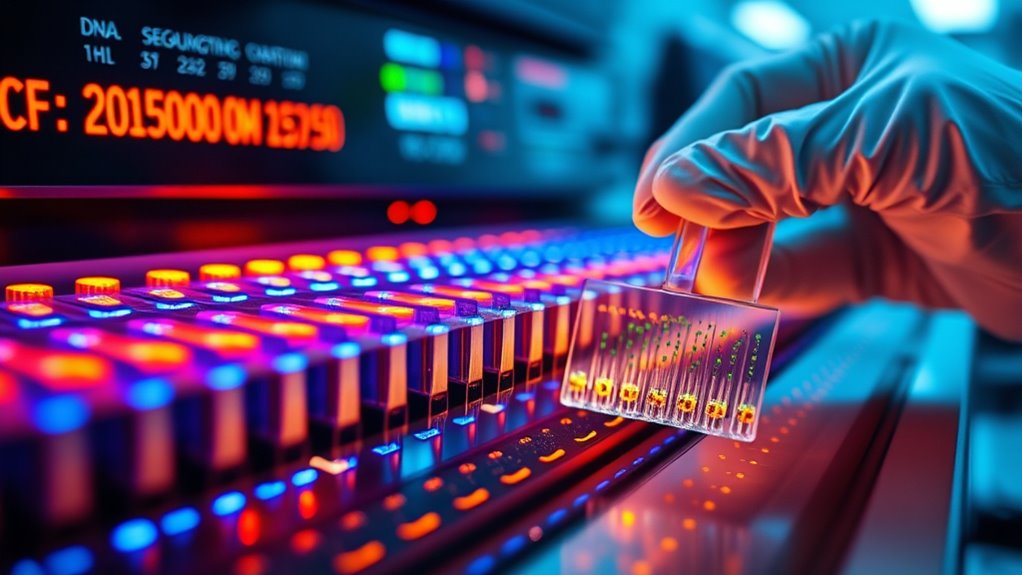
Have you ever wondered how scientists decode the human genome faster and more accurately than ever before? The answer lies in the revolutionary advancements in next-generation DNA sequencing, which leverage innovative chemistry and cutting-edge technology. Central to this process is the use of DNA polymerase, an enzyme that synthesizes new DNA strands by adding nucleotides to a template strand.
Discover how next-generation sequencing uses innovative chemistry and DNA polymerase to decode the genome faster and more accurately.
In modern sequencing methods, DNA polymerase works in tandem with fluorescent tags—small molecules attached to nucleotides that emit specific colors when illuminated. These fluorescent labels enable real-time detection of nucleotide incorporation, allowing scientists to read entire genomes quickly and with high precision.
The process begins by preparing the DNA sample, which is then broken into smaller fragments. These fragments are attached to a surface, forming a dense grid that allows simultaneous sequencing of millions of DNA strands. When DNA polymerase incorporates a nucleotide, the fluorescent tag attached to that nucleotide emits a distinct signal, which is captured by sophisticated imaging systems. fluorescent detection plays a crucial role in enabling the high-throughput and real-time capabilities of these sequencing technologies.
This real-time detection means you can follow the sequence as it develops, rather than waiting until the entire process is complete. Because each nucleotide emits a unique color, the sequencing machine can determine the exact order of bases with remarkable accuracy.
One of the key benefits of this chemistry-driven approach is speed. Traditional sequencing methods often took weeks or even months to produce results. Now, with the combined power of DNA polymerase and fluorescent tags, you can sequence entire genomes in a matter of days or hours. This rapid turnaround has profound implications for medicine, agriculture, and research, enabling personalized treatments, faster disease diagnosis, and deeper understanding of genetic variations.
Plus, the use of fluorescent tags minimizes errors, as each incorporation is visually confirmed, reducing the likelihood of misreads.
Moreover, the chemistry behind next-gen sequencing continues to improve. Researchers are developing more sensitive fluorescent dyes and more efficient DNA polymerases that work faster and with greater fidelity. These innovations mean you’ll get even more accurate data, even from challenging samples.
The integration of advanced chemistry, such as reversible terminator nucleotides, allows the sequencing process to pause after each addition, ensuring precise control over the reaction and further enhancing accuracy. Chemistry advancements have been instrumental in increasing the reliability and throughput of sequencing technologies.
Frequently Asked Questions
What Are the Limitations of Current Next-Gen Sequencing Technologies?
You might find that current sequencing technologies face limitations such as less-than-perfect sequencing accuracy, leading to errors in data. Additionally, sample preparation can be complex and time-consuming, which hampers overall efficiency.
These issues restrict their ability to deliver rapid, reliable results, especially for large-scale or clinical applications. Improving accuracy and streamlining sample prep are essential steps to enhance the effectiveness of next-gen sequencing in various fields.
How Cost-Effective Is Next-Gen Sequencing for Large-Scale Projects?
You’ll find that next-gen sequencing becomes more cost-effective as technology advances, enabling large-scale projects to scale more easily. However, you might face scalability challenges, especially with data storage and analysis.
Ongoing cost reduction efforts help lower expenses, making extensive sequencing efforts feasible. While initial investments remain high, the decreasing costs and improved efficiency mean you can tackle bigger projects without breaking the bank, enhancing research and medical breakthroughs.
What Are the Ethical Implications of Rapid DNA Sequencing?
Imagine holding a key to someone’s entire life story—rapid DNA sequencing brings similar power. You must consider ethical implications like privacy concerns and data ownership.
Fast sequencing can risk exposing sensitive info without consent or proper protection. You’re responsible for ensuring these technologies are used ethically, respecting individuals’ rights, and safeguarding their data.
The speed is impressive, but you must balance innovation with moral duty to prevent misuse.
How Does Next-Gen Sequencing Impact Personalized Medicine?
You see, rapid DNA sequencing revolutionizes personalized medicine by allowing you to identify genetic markers quickly and accurately. This helps in patient stratification, ensuring treatments are tailored specifically to an individual’s genetic makeup.
As a result, you can expect more effective therapies with fewer side effects. The speed of next-gen sequencing enables timely interventions, improving health outcomes and empowering you with precise, personalized healthcare options.
What Future Innovations Are Expected in DNA Sequencing Chemistry?
Imagine future innovations where biochemical advancements enable faster, more accurate DNA sequencing. You might see new chemical reaction optimization techniques that reduce errors and cost, making sequencing even more accessible.
For example, hypothetical improvements could allow real-time, single-molecule analysis, revolutionizing personalized medicine. These advancements will likely focus on refining chemistry to increase throughput and precision, helping you access faster diagnoses and tailored treatments through next-generation sequencing technology.
Conclusion
As you explore the rapid advances in next-gen DNA sequencing, it’s almost as if science is catching up with your own curiosity. Just when you think technology can’t get any faster, breakthroughs emerge, revealing the intricate beauty of our genetic code at lightning speed. It’s a coincidence that these innovations are happening now, opening doors to discoveries you once only dreamed of. The future of genomics is unfolding before your eyes—more exciting than ever.