To prevent weak parts in 3D printing with engineering plastics, you need to control moisture effectively. Store your filaments in airtight containers with desiccants and dry them in an oven if necessary before printing. Keep your workspace humidity low and use enclosed printers to minimize moisture absorption. Proper moisture management improves layer adhesion, prevents bubbling, and enhances part strength. If you want to learn more about optimizing moisture control, keep exploring the essential strategies for durable, high-quality prints.
Key Takeaways
- Properly dry engineering plastics and filaments before printing to prevent moisture-induced defects.
- Store plastics in airtight containers with desiccants to minimize moisture absorption.
- Use enclosed or climate-controlled printing environments to maintain low humidity levels.
- Reinforce plastics with fibers to enhance moisture resistance and mechanical strength.
- Control printing parameters and ambient conditions to reduce steam formation and weak spots.
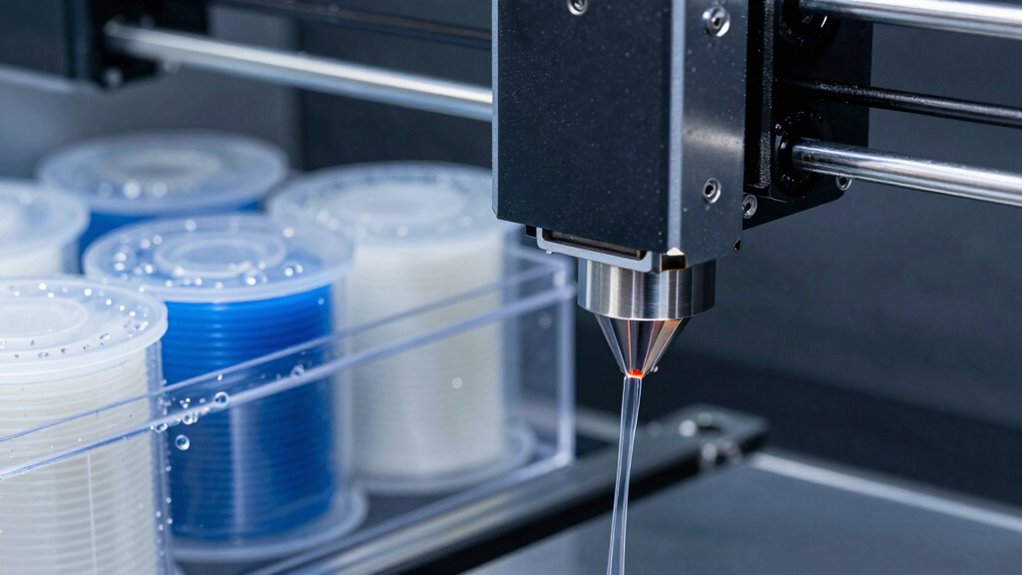
Moisture in 3D printing plastics can substantially affect the quality of your prints, causing issues like warping, stringing, and poor layer adhesion. When moisture is present, it turns into steam during extrusion, which creates bubbles and weak spots in your parts. To combat this, understanding how to control moisture is essential, especially when working with engineering plastics that demand high performance. One effective approach is selecting materials with fiber reinforcement, which enhances mechanical properties and provides added dimensional stability. Fiber-reinforced plastics are less prone to warping because the fibers help distribute heat more evenly and resist deformation caused by moisture-related stresses. This reinforcement not only improves strength but also contributes to better thermal stability, allowing the material to withstand temperature fluctuations during printing and in service. By maintaining low moisture levels, you guarantee that the fibers and matrix bond properly, resulting in parts with higher structural integrity and fewer defects. Additionally, understanding the filtration and airflow in your printing setup can help reduce moisture-related issues by improving the overall environment around your printer. Proper storage plays a critical role in moisture control. Keep your engineering plastics in airtight containers with desiccants to prevent moisture absorption before printing. Many manufacturers recommend drying certain plastics, like nylon or PEEK, in an oven at specific temperatures to remove residual moisture. This step is crucial because even small amounts of water can compromise the material’s thermal stability, leading to inconsistent extrusion and weak spots in the final product. Ensuring your filament is thoroughly dry also helps maintain the fiber reinforcement’s effectiveness, as moisture can weaken fiber-matrix interactions. When you feed dry, moisture-free filament into your printer, you’ll notice smoother extrusion, cleaner finishes, and parts that meet your desired specifications. Monitoring your environment is equally important. Humidity levels in your workspace should be kept low, ideally below 20%. Using enclosed or climate-controlled enclosures for your 3D printer can help maintain stable conditions, minimizing moisture uptake during the printing process. This stability is especially vital for engineering plastics designed for demanding applications, where even minor variations in temperature or humidity can lead to defects. By controlling these conditions, you preserve the fiber reinforcement’s benefits and uphold the thermal stability necessary for high-quality, durable parts. Ultimately, managing moisture isn’t just about preventing surface imperfections; it’s about guaranteeing your parts meet strict performance standards and won’t fail prematurely under stress or heat. When you invest in proper storage, drying, and environmental controls, you maximize the strength, stability, and reliability of your 3D printed engineering components.
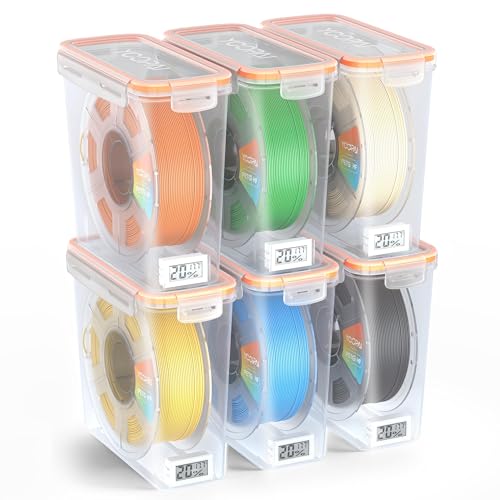
YOOPAI Pro Filament Storage Box with Temperature & Humidity Monitor, Airtight Filament Storage Container with Desiccant for 1KG 1.75mm PLA ABS PETG TPU, Single Spool 3D Printer Filament Storage Box(6)
- Built-in Temperature and Humidity Monitors: Track storage conditions at a glance
- Airtight Seal with Reusable Desiccants: Reduces moisture and dust effectively
- Designed for 1KG 1.75mm Spools: Ensures a precise fit for standard filaments
As an affiliate, we earn on qualifying purchases.
As an affiliate, we earn on qualifying purchases.
Frequently Asked Questions
How Does Moisture Affect Different Types of Engineering Plastics?
Moisture absorption impacts different engineering plastics by causing plastic degradation and weakening their structure. When you expose plastics like nylon or PETG to moisture, they absorb water, which can lead to swelling, reduced strength, and poor layer adhesion during printing. This moisture can compromise part quality and durability, making it essential to control humidity and dry your plastics thoroughly before printing to prevent weak, unreliable parts.
What Are the Long-Term Effects of Moisture on Printed Parts?
Moisture causes long-term material degradation in printed parts, weakening their structural integrity over time. It can also compromise dimensional stability, leading to warping or shrinking that affects fit and function. If you don’t control moisture, your parts may become brittle or distort, reducing their lifespan and reliability. To prevent these issues, guarantee proper storage and drying of your materials, maintaining consistent quality and performance in your final products.
Can Moisture Control Methods Be Integrated Into Existing 3D Printers?
Ever wondered if you can upgrade your existing 3D printer for better moisture control? You definitely can—many systems support maintenance upgrades like adding desiccant chambers or sealed enclosures. Just check software compatibility to make sure these upgrades integrate smoothly. By doing so, you prevent moisture-related issues and improve print quality without replacing your entire machine. Isn’t investing in these upgrades worth the long-term benefits for stronger, more reliable parts?
Are There Any Environmental Concerns With Moisture Control Products?
You might wonder if moisture control products pose environmental concerns. Generally, these products have minimal environmental impact when used properly, but some may involve chemicals or materials that raise sustainability concerns. It’s wise to select eco-friendly options and dispose of them responsibly. By doing so, you help reduce environmental impact, support sustainability, and ensure your 3D printing processes remain eco-conscious without compromising quality.
What Are Cost-Effective Moisture Control Options for Small-Scale Production?
For small-scale production, you can use cost-effective desiccant options like silica gel packs or clay-based desiccants to absorb moisture. Pair these with humidity sensors to monitor environmental conditions and guarantee ideal storage. Regularly checking sensors helps you maintain low humidity levels, preventing weak parts caused by moisture. These affordable solutions are easy to implement, keep costs down, and effectively protect your 3D printing materials from moisture damage.
Conclusion
By mastering moisture control, you’re like a skilled captain steering your 3D prints through stormy seas. Keep your engineering plastics dry, and you’ll prevent weak, brittle parts from sinking your project’s ship. Think of moisture as an invisible thief stealing strength from your creations—stop it in its tracks. With this knowledge, you hold the compass to craft strong, reliable parts that stand tall amidst any challenge. Your mastery turns fragile materials into unbreakable masterpieces.