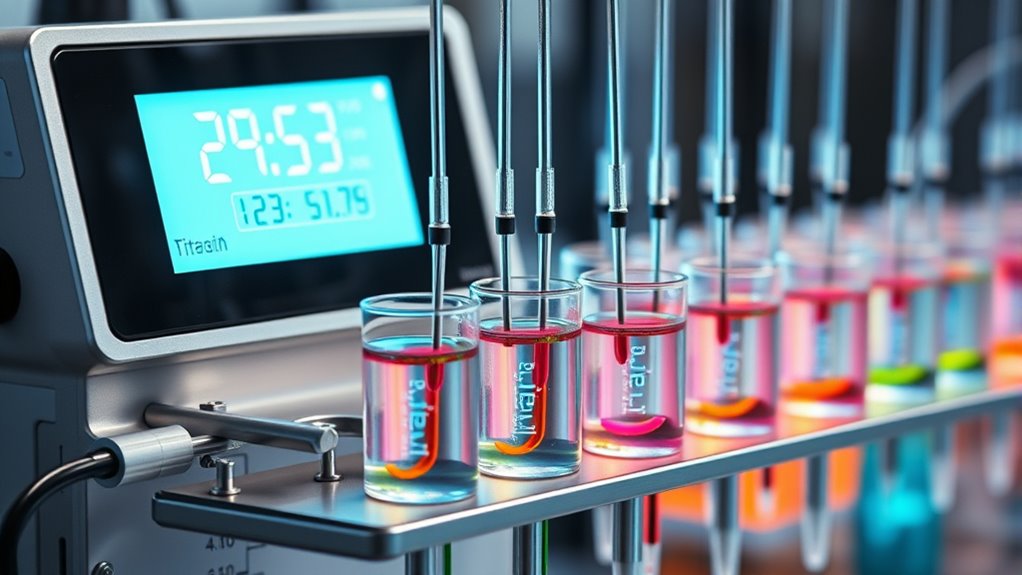

Titration 2.0, featuring automated potentiometric and Karl Fischer methods, transforms your lab work by boosting accuracy, speed, and reliability. You’ll benefit from advanced sensors, built-in calibration routines, and smart data analysis that identify endpoints precisely. Automation reduces manual errors and streamlines your workflow, ensuring consistent results. As you explore further, you’ll discover how these innovations optimize titration practices and support your analytical needs efficiently.
Key Takeaways
- Automated potentiometric titrations use sensor calibration and data analysis to improve accuracy and reproducibility.
- Karl Fischer titration automation enables precise moisture content measurement with minimal manual intervention.
- Integration of sensors and software streamlines workflow, reduces human error, and enhances data reliability.
- Modern systems provide real-time data processing, endpoint detection, and secure data storage for efficient analysis.
- Titration 2.0 advances laboratory efficiency and accuracy through automation, calibration, and sophisticated data interpretation.

Have you ever wondered how modern technology is transforming the way we perform titrations? In today’s lab environments, traditional manual titrations are quickly giving way to automated systems that enhance accuracy and efficiency. These advancements rely heavily on sophisticated sensors and intelligent data analysis, making the process more reliable and less prone to human error. When working with automated potentiometric titrations or Karl Fischer methods, sensor calibration becomes a pivotal step. You need to ensure that the sensors are precisely calibrated to measure pH, voltage, or moisture content accurately. Proper calibration aligns the sensor readings with known standards, which is indispensable for obtaining valid and reproducible results. Automated systems often include built-in calibration routines, but it’s still your responsibility to verify that these calibrations are current and accurate. Accurate sensor calibration reduces discrepancies and boosts confidence that your data truly reflects the sample’s properties. Additionally, understanding the sensor calibration process is crucial for maintaining consistent results over time.
Once your sensors are calibrated correctly, the next essential aspect is data analysis. Modern titration systems collect vast amounts of data in real-time, and interpreting this data efficiently can be challenging without the right tools. Advanced software algorithms process the raw signals, identify the endpoint, and generate titration curves almost instantaneously. You can then analyze these curves to determine precise equivalence points, ensuring your results are consistent with experimental expectations. Data analysis tools also help detect anomalies, such as drift or noise, which might otherwise go unnoticed in manual procedures. This allows you to troubleshoot issues early and maintain high standards of accuracy. Furthermore, these systems often store your data securely, making it easy to review, compare, and report results over time.
The integration of sensor calibration and data analysis in automated titrations streamlines your workflow, saving you time and minimizing errors. You don’t have to manually track the titration’s progress or interpret complex signals; the system does it for you, providing clear, actionable results. This automation not only improves precision but also enhances reproducibility, especially when handling multiple samples or conducting routine analyses. As you become familiar with these technologies, you’ll appreciate how they empower you to focus more on experimental design and interpretation, rather than tedious manual operations. The combination of precise sensor calibration and advanced data analysis truly revolutionizes titration, making it faster, more accurate, and more dependable than ever before.
Frequently Asked Questions
How Does Automation Improve Titration Accuracy?
Automation improves titration accuracy by enhancing precision and reducing errors. When you use automated systems, they precisely control reagent addition and measurement timing, minimizing human mistakes. This consistency guarantees more reliable results and tighter control over variables. As a result, your titrations become more accurate, with fewer inaccuracies caused by manual handling, leading to better data quality and confidence in your analytical outcomes.
Can Titration 2.0 Analyze Multiple Samples Simultaneously?
Yes, Titration 2.0 can analyze multiple samples simultaneously, markedly boosting your sample throughput. It streamlines reagent management by automating reagent addition and calibration, reducing human error and saving time. This efficiency allows you to process more samples in less time, ensuring consistent, accurate results across multiple analyses. By handling several samples at once, you enhance productivity without compromising precision, making your laboratory operations more effective and reliable.
What Are the Maintenance Requirements for Automated Titration Systems?
You need to regularly perform calibration checks on your automated titration system, ideally weekly or as recommended by the manufacturer, to guarantee accuracy. Prevent contamination by cleaning and rinsing the electrodes and sample containers after each use. Keep an eye on reagent levels and replace them when depleted. By following these maintenance routines, you’ll maintain system reliability and extend the lifespan of your automated titration equipment.
How Does the System Handle Complex or Interfering Samples?
Like a modern-day Sherlock Holmes, your system detects and manages complex samples with ease. It handles matrix interference by employing advanced algorithms and smart calibration, reducing the need for extensive sample pretreatment. When interference occurs, the system adapts quickly, ensuring accurate results. You can trust it to analyze challenging samples reliably, saving time and effort, even when dealing with stubborn or complicated matrices.
Is Specialized Training Needed to Operate Titration 2.0 Equipment?
You don’t need specialized training to operate Titration 2.0 equipment, but you should undergo proper operator training to guarantee safety and accuracy. Additionally, familiarizing yourself with calibration procedures is essential for reliable results. The system is designed to be user-friendly, but understanding these key steps helps you troubleshoot issues and maintain precise measurements, especially when handling complex or interfering samples.
Conclusion
Imagine your lab as a finely tuned orchestra, with titration 2.0 as the conductor guiding each instrument seamlessly. Automated potentiometric and Karl Fischer titrations streamline your process, making it more precise and efficient. You’ll find yourself confidently steering through complex analyses, like a maestro effortlessly harmonizing every note. Embrace this technology, and watch your laboratory perform at its best, transforming chaos into a symphony of accuracy and reliability.