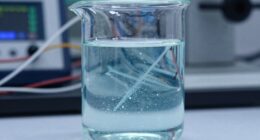
Chromatography helps you separate unwanted impurities from essential substances by exploiting their different interactions with stationary and mobile phases. By choosing appropriate solvents based on the polarity of your mixture, you can improve separation efficiency. The stationary phase, whether polar like silica gel or nonpolar, influences how components move through the system. Understanding these interactions guarantees a clear separation of impurities from your key compounds. Keep exploring to discover how to optimize your process for the best results.
Listen free for 30 days with Audible
Thousands of audiobooks and originals — cancel anytime.
As an affiliate, we earn on qualifying purchases.
Key Takeaways
- Chromatography separates mixtures by exploiting differences in how substances interact with stationary and mobile phases.
- Selecting appropriate solvents based on compound polarity enhances separation efficiency.
- The stationary phase’s properties influence how effectively undesirable and essential components are separated.
- Understanding interactions between solvents, stationary phases, and compounds improves resolution and speed.
- Optimizing these factors allows for effective removal of unwanted substances and isolation of desired components.

Have you ever wondered how scientists separate complex mixtures into their individual components? It’s a fascinating process that relies on understanding the interactions between different substances. At the core of this process is chromatography, a technique that allows you to isolate and analyze the individual parts of a mixture. To do this effectively, you need to consider two critical factors: solvent selection and the stationary phase. These choices determine how well the components separate and how quickly the process occurs.
Chromatography separates mixtures by exploiting interactions between substances, solvents, and stationary phases for effective analysis.
When selecting a solvent, think about its polarity and how it interacts with each component in your mixture. The right solvent helps move the substances through the stationary phase at different rates, based on their affinity for the solvent versus the stationary phase. For example, if you’re working with polar compounds, you’ll want a solvent that’s also polar to ensure effective separation. Conversely, nonpolar compounds require less polar solvents. Additionally, understanding the interactions between solvent and stationary phase can help optimize your separation and improve outcomes.
The stationary phase is equally important. Think of it as the backdrop that interacts differently with each component. Common stationary phases include silica gel or alumina, which are polar, or nonpolar materials like certain coated plates or beads. Your selection depends on your mixture’s composition.
If you’re separating compounds with varying polarities, choosing an appropriate stationary phase ensures that each one interacts differently with the phase, creating distinct separation patterns. The stationary phase essentially acts as a filter that slows down or speeds up different molecules, allowing you to see their individual presence clearly. Its properties influence the resolution and duration of the separation process.
As an affiliate, we earn on qualifying purchases.
Frequently Asked Questions
Can Chromatography Be Used to Analyze Liquids Other Than Water?
Yes, chromatography can analyze liquids beyond water. You need to take into account liquid compatibility and proper solvent selection to ensure effective separation.
Different liquids may require specific solvents that dissolve well and interact suitably with the stationary phase. By choosing the right solvent, you can analyze a variety of liquids, including organic compounds or complex mixtures, making chromatography a versatile tool for diverse liquid samples.
How Does Temperature Affect Chromatography Results?
Think of chromatography as a delicate dance where temperature control guides the performers. When you raise the temperature, solvent volatility increases, causing compounds to travel faster and potentially blur separation lines.
Conversely, cooler temps slow down the process, sharpening results. You need to maintain consistent temperature to prevent distorted data, ensuring each component’s true colors shine through in your analysis.
Temperature truly acts as the conductor in this molecular symphony.
Is Chromatography Safe for At-Home Use?
You might wonder if chromatography is safe for at-home use. While it can be safe with proper safety precautions, you need to be cautious about chemical handling and avoid exposure to hazardous substances.
Always work in a well-ventilated area, wear protective gear, and follow instructions carefully.
If you’re inexperienced, consider consulting a professional or conducting experiments under supervision to guarantee safety.
What Are Common Mistakes to Avoid in Chromatography Experiments?
Think of chromatography as steering a river—small mistakes can cause you to capsize. To avoid this, select the right solvent; using an inappropriate one can ruin your results. Also, focus on sample preparation—dilute or filter your sample properly to prevent clogging or overlapping spots.
Keep your tools clean and work patiently. These steps help guarantee smooth sailing and accurate separation in your experiments.
How Long Does It Typically Take to Complete a Chromatography Separation?
You’ll usually spend anywhere from a few minutes to several hours completing a chromatography separation, depending on factors like sample preparation and the stationary phase.
If your sample is complex or your stationary phase is slow, it might take longer. Proper preparation guarantees smoother runs, so allocate enough time for sample prep and allow the process to fully develop for accurate results.
Patience and attention to detail pay off.
Conclusion
Now that you’ve learned the basics of chromatography, you’re equipped to distinguish the good from the bad with confidence. Think of it as your trusty magnifying glass, helping you separate the wheat from the chaff. With each experiment, you’ll sharpen your skills and see the invisible details that matter. Keep practicing, and you’ll soon have a keen eye for uncovering what’s essential, turning complex mixtures into clear, actionable insights.
NFL season / tailgating Picks
team gear
As an affiliate, we earn on qualifying purchases.