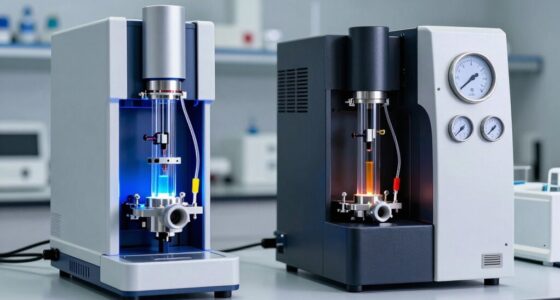
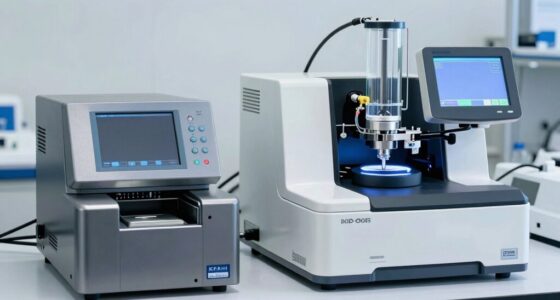
Atomic Force Microscopy (AFM) lets you feel surfaces at the nanometer scale by gently probing molecules and structures with a tiny, sharp tip attached to a flexible cantilever. As it scans, AFM detects minute deflections caused by surface features, creating highly detailed topographical images. It enables you to explore surfaces with extraordinary detail, measuring forces such as adhesion, stiffness, and elasticity. Continue exploring to uncover more about how AFM reveals the secrets of molecules at such tiny scales.

Get school and study supplies delivered free — and shop member deals
- Fast, free delivery on millions of items
- Access to Prime Big Deal Days deals on October 6–7
- Prime Video, Amazon Music and more included
Key Takeaways
- AFM uses a sharp probe to “feel” surface features at the nanometer scale, enabling detailed molecular imaging.
- It detects tiny surface interactions through cantilever deflections, translating them into high-resolution topographical maps.
- AFM can visualize individual molecules and nanostructures without damaging delicate samples.
- It measures forces such as adhesion, stiffness, and elasticity at a molecular level.
- Its versatility allows surface analysis in various environments, including liquids and biological conditions.

Have you ever wondered how scientists see surfaces at the nanometer scale? It’s a fascinating process made possible by atomic force microscopy (AFM), a technique that allows you to explore surfaces with incredible precision. Unlike traditional microscopes that rely on light or electrons, AFM uses a tiny probe that gently “feels” the surface, providing detailed topographical maps at an atomic level.
This capability is crucial for advancing nanotechnology applications, where understanding surface properties can make or break innovations in materials science, electronics, and medicine. When you use AFM for surface characterization, you gain insights into surface roughness, texture, and even mechanical properties, all without damaging the sample. Additionally, AFM can operate in various environments, including liquids, making it highly versatile for biological and chemical research.
In practical terms, AFM works by scanning a sharp tip attached to a flexible cantilever across the surface of your sample. As the tip interacts with surface features, it deflects slightly. A laser beam detects these minute deflections, translating them into detailed images that reveal the surface’s topography with nanometer resolution. Surface analysis is fundamental to nanotechnology development and quality control.
This process gives you a direct, real-space view of features that are otherwise invisible, enabling you to analyze surface structures in exquisite detail. Whether you’re studying the morphology of biological molecules, evaluating the uniformity of thin films, or examining nanostructures on a chip, AFM provides a versatile tool for surface characterization. Moreover, the ability to measure forces at the nanoscale helps in understanding interactions critical to material performance and biological functions.
This technique is particularly valuable because it offers more than just images. You can measure forces between the tip and surface, which helps determine properties like stiffness, adhesion, and elasticity. This multi-faceted approach makes AFM indispensable in nanotechnology applications, especially when precise surface information is essential.
As an affiliate, we earn on qualifying purchases.
Frequently Asked Questions
How Does AFM Compare to Other Nanoscale Imaging Techniques?
When comparing AFM to other nanoscale imaging techniques, you’ll find it excels in revealing surface topography with high resolution.
Unlike electron microscopes, AFM doesn’t require vacuum conditions, making it versatile.
You can also perform force spectroscopy to measure interactions at the nanoscale.
This ability to combine imaging and force measurement sets AFM apart, giving you detailed insights into surface features and molecular forces that other methods can’t provide as effectively.
What Are the Limitations of Atomic Force Microscopy?
You should know that atomic force microscopy has limitations like complex sample preparation, which can affect your results, and tip wear, which reduces accuracy over time. These issues can make it harder for you to obtain clear images consistently.
Additionally, AFM may struggle with soft or dynamic samples, and its scanning speed is relatively slow. Recognizing these limitations helps you improve your technique and interpret your data more effectively.
Can AFM Be Used for Live Cell Imaging?
You might think imaging live cells is like capturing their lively dance, but AFM’s not quite that nimble. Though it can visualize live cell dynamics and cellular morphology, it’s slow and can disturb delicate tissues.
Ironically, trying to freeze live cells in time with AFM may alter their natural behavior, making it more of a snapshot than a true window into their vibrant, ongoing life.
How Is AFM Calibration Performed for Accurate Measurements?
You calibrate AFM by first selecting appropriate calibration standards with known dimensions or forces to guarantee measurement accuracy.
Then, you perform a series of calibration scans, adjusting the cantilever’s sensitivity and spring constant based on the standard’s known properties.
Regular calibration helps maintain precision, allowing you to trust your measurements.
Always verify calibration periodically, especially before critical experiments, to ensure your AFM provides reliable and accurate data.
What Future Advancements Are Expected in AFM Technology?
You’ll see future AFM advancements driven by quantum enhancements and AI integration, which will boost precision and speed. Quantum tech could enable more sensitive force detection, revealing even smaller molecular details.
AI will help automate data analysis, making measurements quicker and more accurate. These innovations will expand AFM’s capabilities, allowing you to explore biological and material surfaces at unprecedented resolutions, opening new frontiers in nanotechnology and scientific discovery.
Conclusion
Now that you’ve explored atomic force microscopy, you realize it’s like wielding a tiny, futuristic sword to feel molecules one nanometer at a time. This powerful tool reveals mysteries at the smallest scales, transforming science and technology. Just imagine, centuries ago, such precision would be considered wizardry! With AFM, you’re on the frontier of discovery, pushing boundaries and opening secrets hidden in the tiniest domains—truly a marvel of modern science.
Halloween Picks
halloween
As an affiliate, we earn on qualifying purchases.