

Selecting the right GC column impacts your results by affecting how well compounds separate, their retention times, and overall resolution. Choose a polar coating for polar compounds or nonpolar for nonpolar ones to optimize interactions and prevent peak overlap. Temperature programming and coating types work together to improve sharpness and reproducibility. If you want to understand how adjusting these factors can refine your analysis, keep exploring these essential concepts.
Key Takeaways
- The choice of coating affects analyte interactions, influencing retention times and separation quality.
- Different coatings are suited for polar or nonpolar compounds, impacting detection sensitivity.
- Proper column selection ensures sharper peaks and reduces peak overlap for clearer results.
- Temperature programming must be tailored to the coating to optimize separation efficiency.
- Selecting the right column minimizes troubleshooting, improves reproducibility, and enhances overall analysis accuracy.
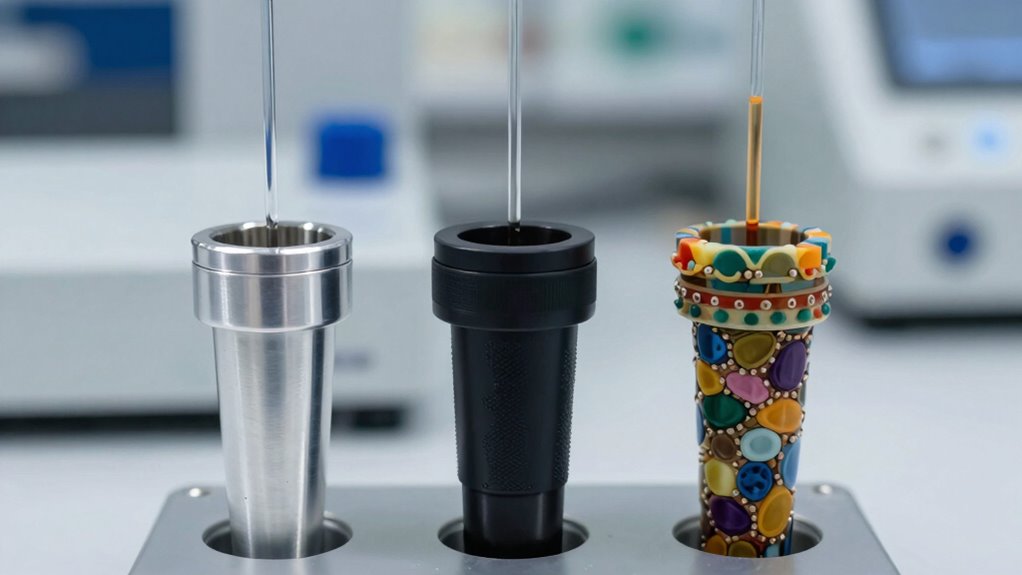
Choosing the right GC column is crucial for achieving accurate and efficient separations in gas chromatography. Your choice of column coating plays a vital role in how well you can distinguish between different compounds. Different coatings, such as polar or nonpolar, interact uniquely with analytes, influencing retention times and separation quality. For example, a polar column coating like polyethylene glycol will better separate compounds with polar functional groups, while a nonpolar coating like dimethylpolysiloxane performs well with nonpolar molecules. Selecting the appropriate coating ensures that your target analytes elute distinctly, reducing overlap and improving overall resolution. Additionally, understanding the interaction mechanisms between analytes and coatings helps optimize your method for better results. Temperature programming is another key factor that can profoundly alter your results. By carefully controlling the temperature ramp during your analysis, you can enhance separation efficiency and reduce analysis time. Starting with a lower initial temperature allows volatile compounds to vaporize and elute early, while gradually increasing the temperature helps heavier compounds move through the column more effectively. This dynamic adjustment prevents broad peaks and tailing, leading to sharper, more defined signals. When you tailor your temperature program to match the properties of your analytes, you improve both sensitivity and reproducibility. Your choice of column coating and temperature programming are interconnected. For instance, a polar coating may require a different temperature profile than a nonpolar one to achieve ideal separation. If the temperature is too high too quickly, you risk losing resolution; too slow, and your analysis becomes unnecessarily lengthy. Fine-tuning both parameters allows you to maximize the column’s potential, ensuring that your analytes are separated cleanly and efficiently. Furthermore, understanding how these factors influence your results helps you troubleshoot and refine your method. If peaks are broad or overlapping, adjusting the temperature program or switching to a more suitable column coating can make a big difference. These choices directly impact the sensitivity, accuracy, and speed of your analysis, making your data more reliable. In essence, selecting the right GC column—considering its coating and temperature programming—can significantly impact the quality of your separations and overall workflow, saving you time and resources while delivering consistent, high-quality results. A thorough understanding of column chemistry can help you optimize your method for specific analytical needs.

Columns for Gas Chromatography: Performance and Selection
As an affiliate, we earn on qualifying purchases.
As an affiliate, we earn on qualifying purchases.
Frequently Asked Questions
How Does Temperature Programming Affect Column Choice?
Temperature programming markedly impacts your column choice because temperature effects influence separation efficiency and analysis speed. You need to select a column compatible with your temperature range, ensuring it withstands high temperatures without degrading. Faster temperature ramps demand columns with appropriate thermal stability and ideal stationary phase properties. By matching your temperature program to your column’s specifications, you achieve better separation, sharper peaks, and more reliable results.
Can Column Selection Impact Analysis Speed?
Yes, column selection impacts analysis speed because different columns have varying efficiencies and flow rates. Choosing the right column can reduce run times, especially when optimized for your sample preparation and method validation. By selecting a column suited to your analytes, you streamline the process, making analysis faster without sacrificing resolution or accuracy. This helps guarantee reliable results while saving valuable time during method validation and routine testing.
What Are the Cost Differences Between Column Types?
You’ll find that stainless steel columns tend to cost more upfront but offer greater durability, making them cost-effective long-term. In contrast, fused silica columns are cheaper initially but may wear out faster, increasing replacement costs. Manufacturing costs directly influence prices, with more complex, durable columns costing more. Your choice hinges on balancing initial expenses against long-term reliability, ensuring you get the best value for your specific analysis needs.
How Often Should GC Columns Be Replaced?
You should replace your GC column when its lifespan reaches about 300-500 injections or if you notice decreased performance, such as loss of resolution or increased baseline noise. Regularly replacing the column helps prevent contamination buildup, which can affect results. To maximize lifespan and guarantee contamination prevention, follow manufacturer guidelines and perform routine maintenance, including proper cleaning and storage when not in use.
Do Different Industries Prefer Specific Column Brands?
Different industries often prefer specific GC column brands to meet industry standards and guarantee consistent results. You’ll notice brand loyalty because certain brands are trusted for their reliability, reproducibility, and compatibility with specialized applications. Whether in pharmaceuticals, environmental testing, or food safety, choosing a brand aligned with industry standards helps maintain quality and compliance. So, your choice of column brand can greatly influence your analysis’s accuracy and acceptance.
Conclusion
Choosing the right GC column can truly make or break your results. It’s not just about fitting your sample, but about ensuring accuracy, resolution, and reproducibility. Have you ever wondered how a simple change in column type might transform your data? By understanding your sample and goals, you can select the best column for your needs. After all, isn’t the goal to get the clearest, most reliable results possible?