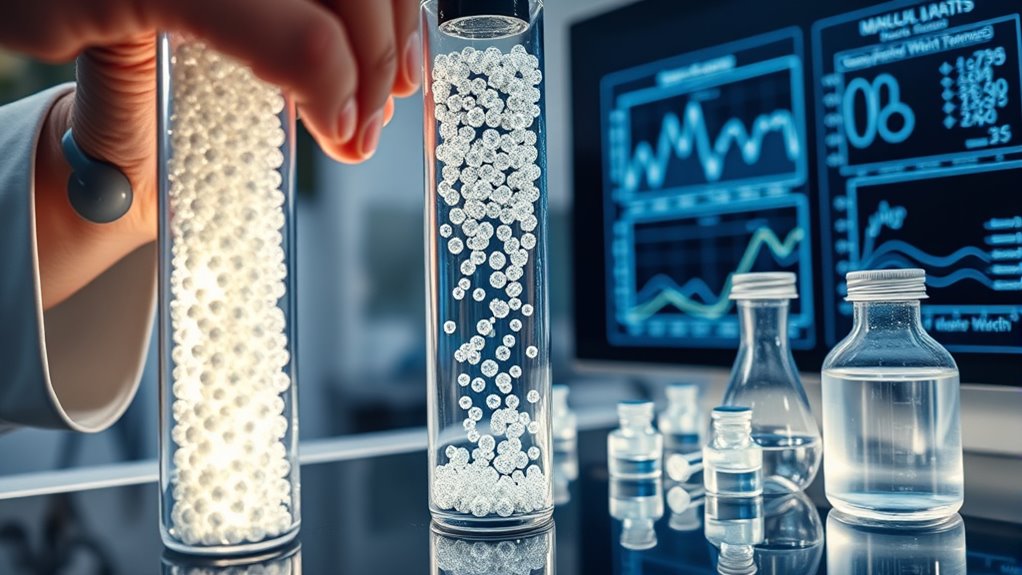

Gel Permeation Chromatography (GPC) helps you measure the molecular weight distribution of polymers by separating molecules based on size. Larger molecules elute first because they can’t enter small pores, while smaller ones take longer. It provides detailed information about your sample’s size and structure, which affects its properties and performance. If you want a clear understanding of how GPC works and its benefits, keep exploring to learn more.

Get school and study supplies delivered free — and shop member deals
- Fast, free delivery on millions of items
- Access to Prime Big Deal Days deals on October 6–7
- Prime Video, Amazon Music and more included
Key Takeaways
- GPC separates molecules based on size, allowing determination of molecular weight distribution in polymers.
- Larger molecules elute first as they cannot enter small pores; smaller molecules elute later.
- Calibration with standards converts elution volume data into accurate molecular weight measurements.
- GPC provides parameters like Mn, Mw, and PDI, indicating polymer uniformity and properties.
- It is widely used for quality control, research, and optimizing polymer synthesis processes.

Gel permeation chromatography (GPC) is a powerful analytical technique used to determine the molecular weight distribution of polymers and other large molecules. When you perform polymer analysis using GPC, you gain essential insights into the size and structure of your molecules. This technique separates molecules based on their size as they pass through a porous stationary phase, allowing you to analyze a broad range of molecular weights efficiently. As your sample travels through the GPC column, larger molecules elute first because they cannot enter the smaller pores, while smaller molecules penetrate the pores and take longer to exit. This separation process enables you to collect detailed data on your polymer’s size distribution.
Understanding the molecular weight distribution is vital because it influences the physical properties, processing behavior, and end-use performance of polymers. With GPC, you can accurately determine parameters such as number-average molecular weight (Mn), weight-average molecular weight (Mw), and the polydispersity index (PDI). These parameters tell you whether your polymer sample is uniform or has a broad distribution, which impacts its strength, transparency, flexibility, and melt behavior. When you analyze the output data, you’ll see a chromatogram that displays the intensity of eluted molecules versus their elution volume. From this, you can derive the molecular weight distribution curve, helping you understand how your polymer molecules vary in size.
Molecular weight distribution impacts polymer properties like strength, transparency, and flexibility, essential for quality and performance.
One of the key advantages of GPC is its ability to provide rapid, reproducible measurements without destroying your sample. To guarantee accurate polymer analysis, you need to select the appropriate solvent that dissolves your polymer fully and does not interact with the stationary phase. Calibration is another critical step, often done using standards with known molecular weights. Proper calibration allows you to convert elution volumes into precise molecular weights, making your analysis more reliable.
The information obtained from GPC is invaluable for quality control, research, and development. If you’re working on new polymers, GPC helps you assess how synthesis conditions affect molecular weight distribution. For manufacturing, it verifies product consistency by monitoring batch-to-batch variations. Whether you’re optimizing polymer properties or troubleshooting production issues, GPC equips you with the detailed molecular weight data needed to make informed decisions. Overall, mastering GPC for polymer analysis lets you access the relationships between molecular structure and material performance, ensuring your applications meet the desired specifications.
Gel Permeation Chromatography GPC system
As an affiliate, we earn on qualifying purchases.
As an affiliate, we earn on qualifying purchases.
Frequently Asked Questions
How Does Temperature Affect GPC Measurements?
Temperature influences GPC measurements because of its temperature sensitivity. When you increase the temperature, polymers may expand or contract, affecting their elution time and apparent molecular weight. If your sample isn’t thermally stable, temperature fluctuations can cause inconsistent results. To guarantee accurate measurements, you should maintain a consistent temperature during analysis, especially if your sample exhibits thermal sensitivity or lower thermal stability.
Can GPC Differentiate Between Polymers With Similar Molecular Weights?
Imagine you’re in a bustling 1920s speakeasy, trying to tell apart two nearly identical jazz tunes. GPC can differentiate between polymers with similar molecular weights if their sizes differ slightly or if their shapes vary, affecting how they elute. While it’s effective for many, closely related polymers with similar sizes and structures may challenge GPC’s resolution, making it harder to distinguish subtle differences in molecular weight and polymer similarity.
What Are Common Errors in GPC Analysis?
You might encounter common errors in GPC analysis like sample contamination, which skews results, or calibration errors, leading to inaccurate molecular weight measurements. Always guarantee your samples are pure and properly prepared to avoid contamination. Regularly calibrate your GPC system with appropriate standards, and verify calibration accuracy. These steps help improve data reliability and prevent errors that can compromise your analysis outcomes.
How Does Solvent Choice Influence GPC Results?
Your solvent choice directly impacts GPC results by affecting solvent polarity and viscosity. If you select a solvent with incorrect polarity, it may cause poor interaction with your sample, skewing the molecular weight distribution. Additionally, higher viscosity can slow down flow rates, reducing resolution. To get accurate results, pick a solvent compatible with your sample’s polarity and verify its viscosity allows smooth, consistent chromatography.
Is GPC Suitable for Analyzing Very Small or Very Large Molecules?
GPC is suitable for analyzing both very small and very large molecules, but your sample size and detection limits matter. For tiny molecules, guarantee your detection system is sensitive enough, as they may be harder to detect. For large molecules, you might need a wider column or different conditions. Adjusting your setup helps you accurately measure molecular weight across a broad size range and get reliable results.
Conclusion
Now that you understand how gel permeation chromatography measures molecular weight, it’s clear that this technique isn’t just a fancy tool—it’s based on solid science. Some skeptics once doubted its precision, but decades of accurate results prove otherwise. So, next time you analyze a polymer, trust GPC to reveal its secrets. After all, science has shown that with the right method, you can truly uncover the hidden details of complex molecules.
Halloween Picks
halloween
As an affiliate, we earn on qualifying purchases.