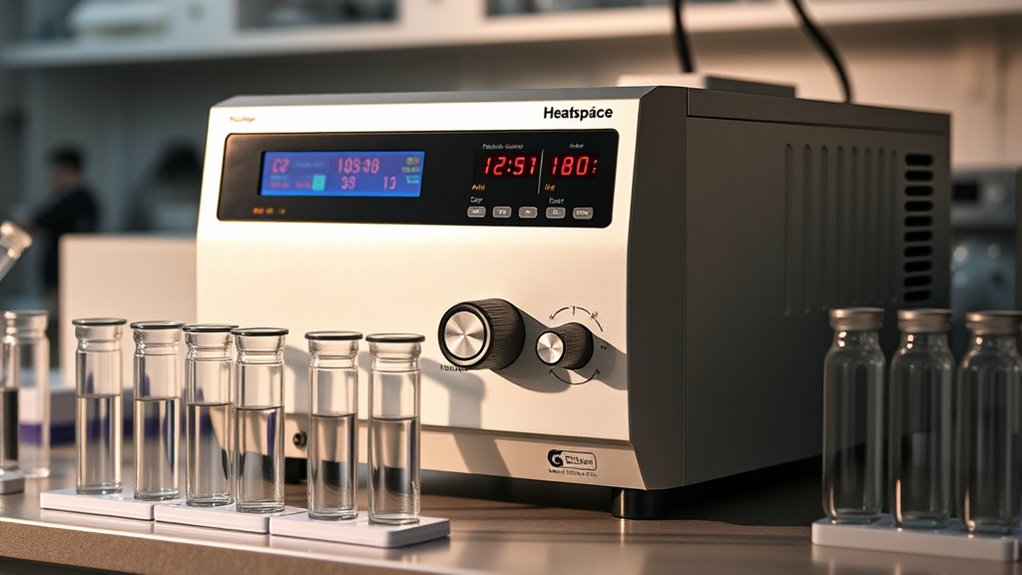

To perform headspace GC for residual solvents, you start by preparing small, accurately weighed samples in sealed vials, ensuring they are contaminant-free and representative. Equilibrate the samples at a specific temperature to vaporize the solvents consistently. Follow standardized procedures and validate your method by checking parameters like accuracy, linearity, and detection limits. Proper sample prep and validation guarantee reliable results. Keep exploring to discover how these steps help maintain high analytical quality and regulatory compliance.
Key Takeaways
- Proper sample preparation involves accurate weighing, sealed vials, and controlled equilibration to ensure consistent transfer of residual solvents.
- Standardized procedures and validation confirm method reliability, sensitivity, and reproducibility for residual solvent analysis.
- Headspace GC requires optimized sample conditioning to enhance solvent vaporization and detection accuracy.
- Validation includes calibration, recovery studies, and system suitability checks to meet regulatory and quality standards.
- Detailed documentation and regular system verification ensure consistent, high-quality residual solvent analysis results.
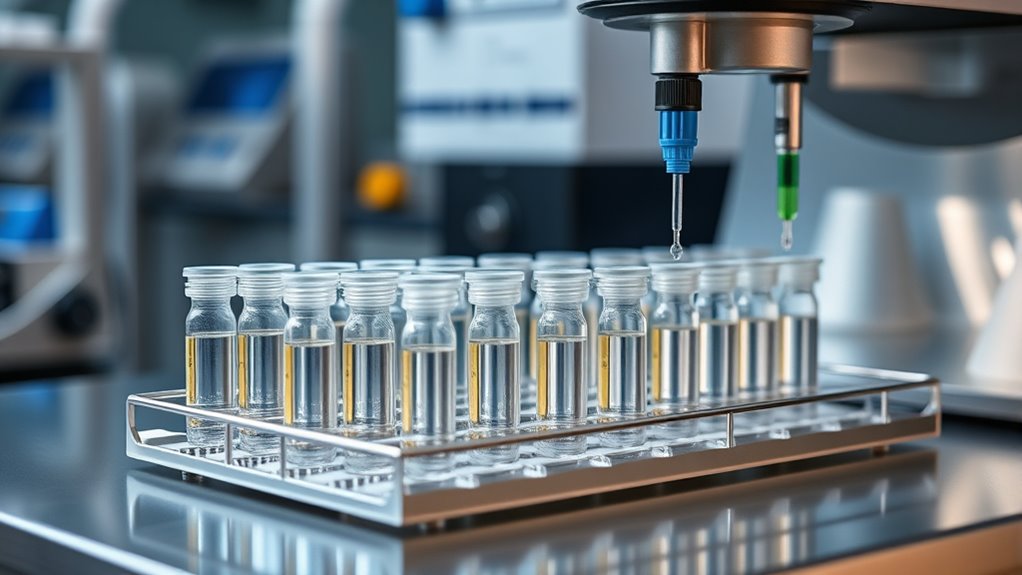
Headspace gas chromatography (GC) is a powerful technique for analyzing residual solvents in pharmaceuticals, food, and other products. When you’re preparing to run a headspace GC analysis, proper sample preparation is essential. You’ll want to guarantee that the sample is representative, free of contaminants, and properly conditioned to release residual solvents efficiently. Typically, you place a small, accurately weighed amount of your sample into a sealed vial, then equilibrate it at a specific temperature to allow the residual solvents to vaporize into the headspace. Consistency in sample prep is vital, so you should follow standardized procedures to reduce variability. This might involve controlling the sample weight, temperature, and incubation time to achieve reproducible results. Proper sample preparation not only enhances sensitivity but also improves the accuracy of your analysis, making sure that the residual solvents are effectively transferred into the headspace for detection. Incorporating uniform sampling techniques ensures that your results are consistent across multiple analyses. Method validation is another critical aspect you must focus on when using headspace GC. Validating your method helps confirm that your results are reliable, reproducible, and compliant with regulatory standards such as those from the USP, EP, or ICH guidelines. During validation, you’ll evaluate parameters like specificity, linearity, accuracy, precision, detection limits, and robustness. You need to demonstrate that your method can accurately quantify residual solvents at the required limits, often as low as parts per million. This involves running calibration standards, performing recovery studies, and assessing the method’s consistency over multiple runs. Validated methods give you confidence that your analysis is sound, enabling you to meet quality control requirements and regulatory submissions. In practice, this means carefully documenting all procedures, establishing appropriate controls, and performing regular system suitability checks to maintain method performance over time.
In essence, successful headspace GC analysis hinges on meticulous sample preparation and thorough method validation. Proper sample prep guarantees that your residual solvents are efficiently transferred into the headspace, while rigorous validation confirms that your analytical process is accurate and reproducible. Together, these steps help you produce high-quality data, whether you’re testing pharmaceuticals for safety, verifying food products, or ensuring compliance with industry standards. By paying close attention to these details, you’ll streamline your workflow, minimize errors, and guarantee the integrity of your analytical results.
Frequently Asked Questions
What Are the Main Advantages of Headspace GC Over Other Methods?
Headspace GC offers you automation efficiency, making sample analysis faster and reducing manual effort. It’s also cost-effective, as it minimizes solvent use and waste, lowering overall expenses. Compared to other methods, you’ll find it easier to handle multiple samples quickly, ensuring consistent results. This technique improves throughput and accuracy, helping you meet regulatory standards efficiently while saving time and money in your residual solvent testing process.
How Do Sample Matrices Affect Headspace GC Analysis?
Imagine your sample matrix as a crowded room where residual solvents try to escape. It influences headspace GC analysis by causing matrix interference, which can obscure or distort results. You need careful sample preparation to clear this space, removing or reducing interfering substances. This guarantees accurate detection of residual solvents, allowing the volatile compounds to freely enter the headspace, much like opening a window to let the true aroma shine through.
What Are Common Troubleshooting Steps for Inconsistent Results?
When troubleshooting inconsistent results, you should first check for calibration issues, ensuring your standards are accurate and fresh. Review your sample preparation methods, making sure samples are properly prepared and consistent. Confirm the vial sealing is secure, and the headspace conditions are stable. Run blanks and controls to identify potential contamination or instrument drift. Regular maintenance and calibration help maintain reliable, reproducible headspace GC analysis.
How Is Method Validation Performed for Residual Solvents?
You perform method validation for residual solvent analysis by evaluating parameters like accuracy, precision, specificity, detection limit, quantitation limit, linearity, and robustness. You prepare standard solutions, run repeated tests, and analyze the results to guarantee the method consistently produces reliable, accurate data. This process confirms your Headspace GC method is suitable for identifying and quantifying residual solvents, ensuring compliance with regulatory standards and product safety.
What Are the Safety Considerations During Headspace GC Analysis?
Safety always comes first—you don’t want to be caught off guard. During headspace GC analysis, follow lab safety protocols and handle equipment carefully to prevent accidents. Wear appropriate PPE, like gloves and goggles, to protect against chemical exposure. Make certain proper ventilation, and handle heated samples with caution. Remember, a stitch in time saves nine—staying vigilant keeps everyone safe and the analysis smooth sailing.
Conclusion
Using headspace GC for residual solvents offers precise, reliable results—you get clarity where uncertainty once reigned. Unlike traditional methods, it’s fast and minimizes sample handling, reducing errors. It’s not just about detecting traces; it’s about safeguarding quality and safety. When you choose headspace GC, you’re not just making an analytical decision—you’re choosing confidence over guesswork. Precision and simplicity stand side by side, proving that advanced technology doesn’t have to be complicated to be effective.