When choosing between DLS and laser diffraction for particle size analysis, consider your sample’s size range. DLS works best for nanometer to sub-micron particles and gives rapid, detailed size distributions, but it requires careful sample preparation to prevent aggregation. Laser diffraction handles larger particles from microns to millimeters and is more tolerant of minor agglomeration. Understanding their strengths and limitations helps you select the right method—if you’re curious about optimizing your analyses, there’s more to discover below.
Key Takeaways
- DLS measures nanoscale particles via Brownian motion, ideal for sub-micron sizes; laser diffraction covers larger particles from microns to millimeters.
- DLS assumes spherical, well-dispersed particles, while laser diffraction is less affected by minor aggregation and can handle broader size ranges.
- Proper sample preparation, including dispersants and pH adjustments, is crucial for accurate results in both DLS and laser diffraction.
- DLS provides rapid, high-resolution size distribution data for small particles; laser diffraction offers quick bulk analysis for larger particles.
- Technique choice depends on particle size range: DLS for nanometers to sub-micron, laser diffraction for larger, millimeter-scale particles.
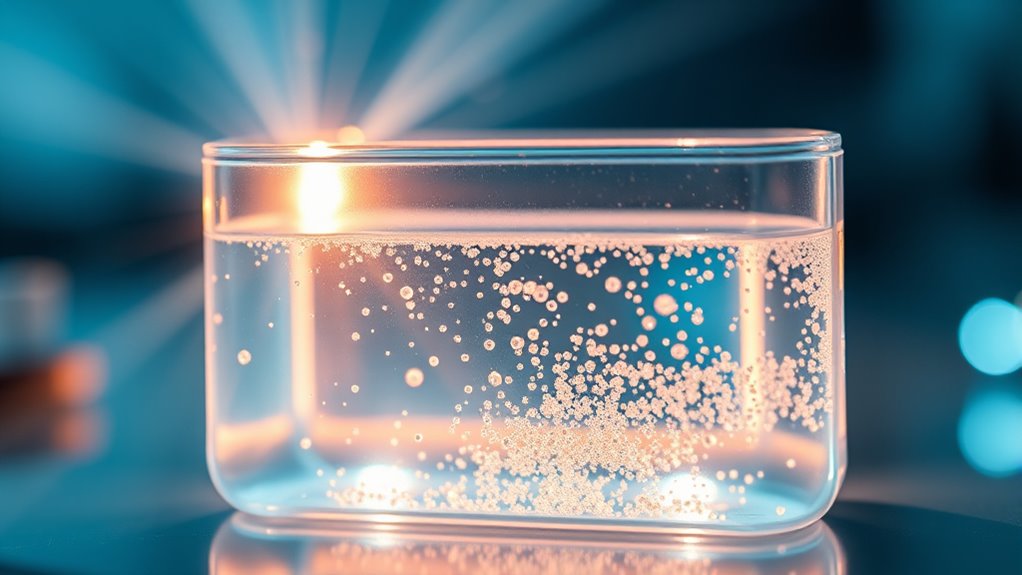
Have you ever wondered how scientists determine the size distribution of particles in a sample? It’s a fascinating process that involves understanding how particles behave and interact within different environments. One key aspect to contemplate is aggregation behavior, which influences how particles cluster together and affects measurement accuracy. When particles tend to stick or form aggregates, it complicates the analysis, making it essential to use proper sample preparation techniques. These techniques aim to disperse particles evenly, minimizing aggregation and ensuring that measurements reflect the true size distribution. Proper sample preparation might involve gentle sonication, adding dispersants, or adjusting pH levels, all designed to break apart clusters and produce a stable, well-dispersed sample.
Once your sample is prepared, you can choose between two popular methods for particle size analysis: Dynamic Light Scattering (DLS) and laser diffraction. Both techniques have their strengths and limitations, but your choice depends on the specific characteristics of your sample and the size range you’re interested in. DLS measures the fluctuations in light scattering caused by particles undergoing Brownian motion. It’s particularly effective for analyzing small particles, typically in the nanometer to sub-micron range, and provides rapid, high-resolution size distribution data. However, DLS assumes that particles are spherical and well-dispersed; if aggregation occurs despite your sample prep efforts, the results can be skewed, misrepresenting the actual size distribution.
On the other hand, laser diffraction involves passing a laser beam through a dispersed sample and analyzing the pattern of scattered light at various angles. This method is better suited for larger particles, from a couple of microns up to millimeters. It’s advantageous because it can handle a wide range of particle sizes and is less sensitive to minor aggregation, provided your sample is well-dispersed beforehand. Laser diffraction’s ability to analyze bulk samples quickly makes it ideal for quality control in industrial settings.
Frequently Asked Questions
How Do Sample Concentration Differences Affect DLS and Laser Diffraction Accuracy?
Sample concentration differences markedly impact both DLS and laser diffraction accuracy. Too high concentration causes multiple scattering, skewing results, while too low leads to weak signals and poor data quality. You should perform sample dilution to optimize concentration effects, ensuring particles are sufficiently dispersed for reliable measurements. Proper dilution minimizes errors, improves repeatability, and enhances the precision of particle size analysis, regardless of whether you’re using DLS or laser diffraction.
What Are Common Troubleshooting Steps for Inconsistent Particle Size Results?
Ever experienced inconsistent particle size results? First, check your sample preparation—make certain proper dispersion and filtration to avoid agglomerates. Then, verify instrument calibration, as miscalibrated devices can skew data. Regularly clean sample cuvettes and calibration standards to prevent contamination. If issues persist, consider re-measuring with freshly prepared samples and recalibrating the instrument. These steps help assure accurate, reliable results and minimize discrepancies.
Can These Methods Analyze Particles in Highly Viscous or Opaque Samples?
You can analyze particles in highly viscous or opaque samples, but proper sample preparation is vital. For DLS, guarantee the sample is well-dispersed and free of aggregates, and consider diluting if necessary. Laser diffraction may require the sample to be optically transparent; if it’s opaque, use appropriate dispersion media or sample dilution. Adjusting preparation methods ensures accurate results despite high viscosity or opacity.
How Do Temperature Variations Influence Measurement Precision?
Imagine the delicate balance of a tightrope walker, where even slight shifts threaten stability. Temperature variations can disturb your measurement precision like that wobble, causing fluctuations in temperature stability. They affect measurement calibration, leading to inconsistent results. To maintain accuracy, you must control the environment, ensuring stable temperatures. By doing so, you preserve the integrity of your analysis, allowing your instruments to perform the best and deliver reliable, precise particle size data.
What Are the Limitations in Measuring Anisotropic or Irregularly Shaped Particles?
Measuring anisotropic or irregularly shaped particles can be challenging because particle shape effects influence measurement accuracy. You might face issues with measurement anisotropy, where different axes produce varying signals, making size estimation less reliable. Both DLS and laser diffraction are limited because they assume spherical particles, so irregular shapes distort results. To improve accuracy, consider complementary imaging techniques that better account for particle shape effects.
Conclusion
As you weigh DLS against laser diffraction, remember that each method reveals a different story about your particles. Will you discover the hidden nuances with DLS’s precision, or will laser diffraction illuminate the broader picture? The choice shapes your understanding, but the true revelation lies in what you might miss. Stay curious, because beneath the surface, the tiniest details could unseal secrets that change everything you thought you knew. Are you ready to see what’s truly hidden?