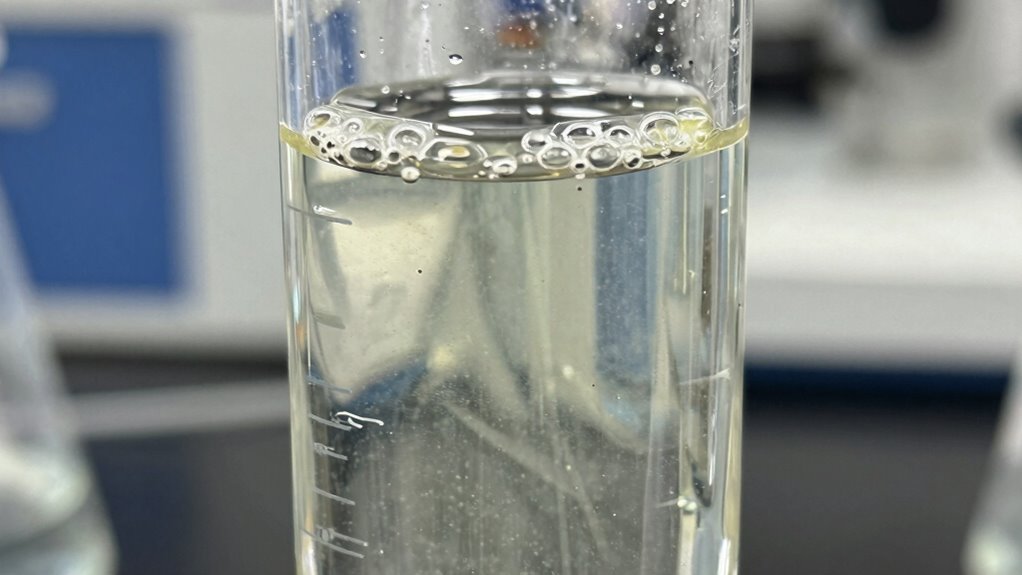
Bubbles in your sample can cause NTU readings to spike because they scatter light just like particles do. When you analyze water, these trapped bubbles mimic suspended solids, giving a false impression of higher turbidity. Proper sample mixing and agitation can help release bubbles, minimizing their impact. If you keep an eye on bubbles and learn ways to prevent or remove them, you’ll improve your testing accuracy and better understand how to get reliable results every time.
Key Takeaways
- Bubbles in samples can scatter light, falsely elevating turbidity measurements and spiking NTU results.
- Inadequate agitation may trap air bubbles, preventing proper particle dispersion and skewing readings.
- Proper mixing helps release and eliminate bubbles, ensuring accurate turbidity measurements.
- Using vortexing or vigorous shaking can reduce bubble formation and stabilize NTU results.
- Identifying and removing bubbles before measurement prevents false high NTU spikes caused by trapped air.
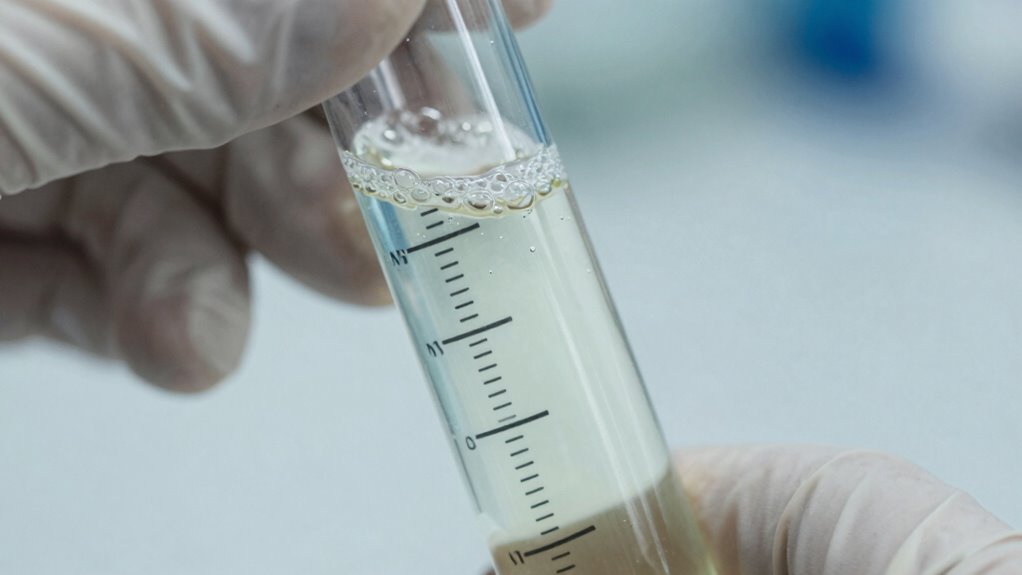
Have you ever wondered how clear your water really is? When you conduct a turbidity test, you’re measuring how much suspended particles scatter light, giving you an NTU (Nephelometric Turbidity Units) reading. But sometimes, the results can be misleading, especially if you notice sudden spikes during testing. One common culprit is particle aggregation, which occurs when tiny particles clump together, forming larger clusters that reflect more light. These aggregates can temporarily increase turbidity readings, making your water seem dirtier than it actually is. To get accurate results, sample agitation becomes essential. When you shake or stir your sample properly, you break up these particle clusters, dispersing them evenly throughout the water. This process helps guarantee that the turbidity measurement reflects the true level of suspended solids, rather than transient clumps that skew your data.
The challenge with particle aggregation is that it’s a natural tendency for many particles in water to stick together, especially if they’re charged or have surface coatings that promote clumping. When you don’t properly agitate your sample, these aggregates remain intact, causing the light scattering to spike and giving you inflated NTU readings. That’s why, during testing, sample agitation shouldn’t be rushed or skipped. By vigorously mixing the sample, you break apart the particle clusters, dispersing them into smaller, more uniform particles. This results in a more stable and reliable turbidity measurement, providing you with a true picture of water clarity. It’s tempting to think that a quick swirl is enough, but consistent and thorough agitation guarantees the particles are evenly distributed, preventing false high readings caused by temporary particle aggregation. Additionally, understanding the colloidal stability of particles can help you better interpret fluctuations in your turbidity results.
Furthermore, understanding the dynamics of particle aggregation and sample agitation helps you troubleshoot unusual turbidity spikes. If your readings suddenly jump, consider whether your sample was adequately agitated beforehand. Sometimes, particles re-aggregate quickly after initial mixing, especially if the sample sits still too long. In those cases, a second round of agitation might be necessary before taking the measurement. Keep in mind that the process isn’t just about mixing; it’s about creating a uniform suspension where particles are evenly dispersed. This way, your NTU results truly reflect the water’s suspended solids and not artifacts caused by clumping or insufficient mixing. By paying attention to these details, you can improve the accuracy of your turbidity testing and make better-informed decisions about water quality.
Frequently Asked Questions
How Often Should Turbidity Tests Be Conducted for Accurate Monitoring?
You should conduct turbidity tests regularly, considering sampling frequency and seasonal variations. Typically, testing weekly or monthly helps track changes accurately, but increase frequency during heavy rainfall or industrial activity. Seasonal variations impact turbidity levels, so more frequent testing in rainy or storm seasons guarantees reliable data. Adjust your sampling schedule based on water source stability and regulatory requirements to maintain accurate monitoring and timely detection of water quality issues.
What Are the Environmental Factors Affecting NTU Readings?
Imagine environmental factors as quiet storytellers shaping your NTU readings. Sediment settling can lower turbidity temporarily, while algae blooms dramatically increase it by releasing particles that cloud the water. Light conditions also play a role—bright sunlight can exaggerate readings, and wind stirs up sediments, causing spikes. Understanding these influences helps you interpret your results accurately, recognizing that natural changes often reflect the environment’s ongoing story rather than measurement errors.
Can Turbidity Tests Detect Specific Contaminants in Water?
You can’t rely on turbidity tests alone to identify specific contaminants in water. Optical interference from bubbles or particles can skew results, making it harder to pinpoint exact pollutants. Proper calibration techniques are essential to minimize inaccuracies. While turbidity measurements indicate overall water clarity, they don’t specify contaminants. For precise detection, you need more specialized tests like chemical analysis or pathogen-specific assays.
How Do Temperature Changes Influence Turbidity Measurements?
Temperature fluctuations can considerably impact your turbidity measurements by affecting sample consistency. As temperature changes, water’s density and particle suspension behavior shift, causing NTU readings to vary even if water quality stays the same. To guarantee accurate results, you should stabilize sample temperatures before testing and handle samples consistently. This minimizes errors caused by temperature differences, giving you more reliable turbidity data for water quality assessments.
Are There Alternative Methods to Turbidity Testing for Water Quality?
Did you know that over 60% of water quality assessments now use advanced sensors? If you’re exploring alternative testing methods, consider advanced sensors like optical or laser-based devices. These tools provide real-time, precise data without the bubble problems that can skew turbidity tests. They’re especially useful for continuous monitoring, helping you guarantee water safety efficiently and more accurately than traditional turbidity testing.
Conclusion
In the world of turbidity testing, a tiny bubble can distort your readings, just like a fleeting shadow can alter your perception of a clear sky. While advanced instruments endeavor for accuracy, these stubborn bubbles remind you that even the smallest details matter. By understanding the bubble problem, you’re better equipped to interpret results accurately. Remember, in testing, as in life, sometimes the smallest things make the biggest difference—so look closer, and question what you see.