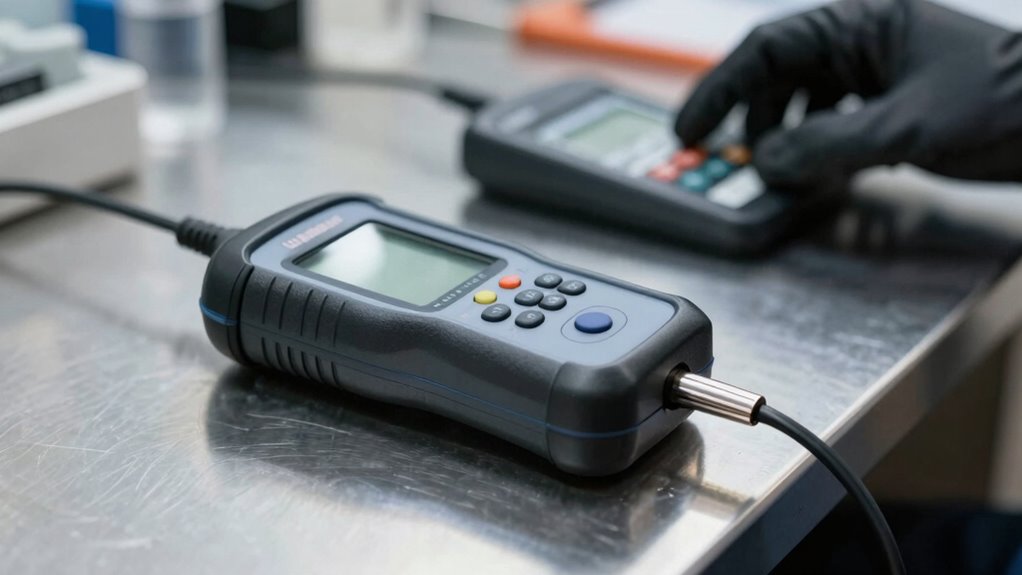
Calibration is vital for ultrasonic thickness gauges because it guarantees your measurements stay accurate and reliable over time. You need to regularly check and adjust your device using certified standards, paying attention to environmental factors and probe condition. Proper calibration helps identify drift or inaccuracies early, preventing costly errors. Staying on top of calibration routines keeps your gauges performing at their best. Want to learn the specific steps to perfect your calibration process? Keep exploring to find out more.
Key Takeaways
- Proper calibration ensures measurement accuracy by aligning the gauge with known standards and material properties.
- Regular calibration detects instrument drift caused by environmental factors, probe wear, or impacts.
- Following manufacturer instructions and using certified standards maintain calibration reliability.
- Environmental conditions and probe condition significantly influence calibration precision.
- Maintaining detailed calibration records helps track accuracy and schedule timely recalibrations.
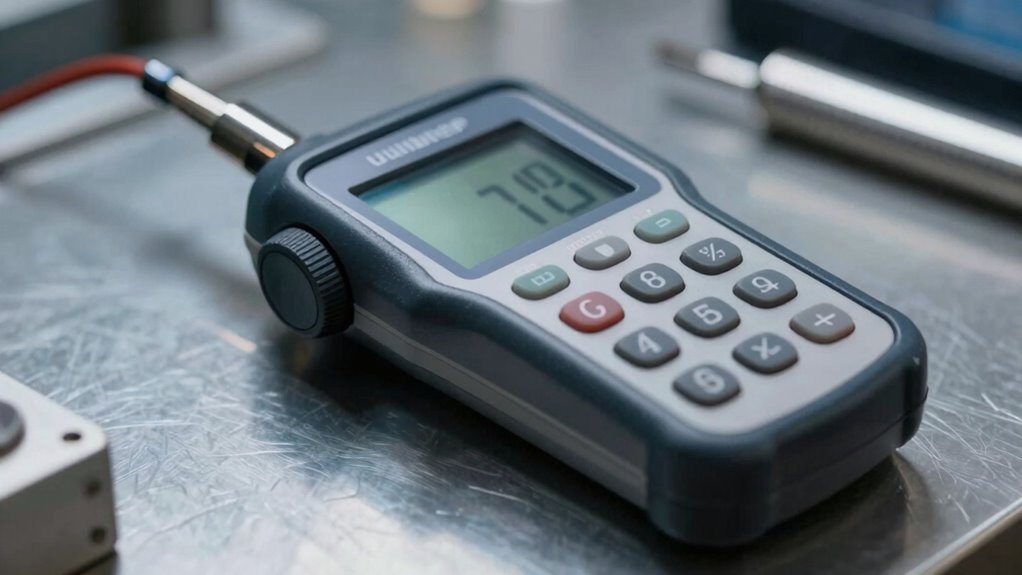
Calibration procedures are not a one-time task; they require regular attention to maintain precision. You should start by setting your gauge to match the material’s known properties, often provided by calibration blocks or standards. First, clean the surface of the material and the calibration block thoroughly to remove any dirt, grease, or corrosion that can interfere with the ultrasonic signal. Then, place the probe firmly against the calibration block, ensuring proper contact and minimal air gaps. Initiate the calibration process, which involves adjusting the device until the displayed thickness matches the known value of the calibration standard. This step may involve zeroing the gauge or adjusting the velocity setting to match the material’s specific acoustic velocity. Remember, calibration procedures can vary depending on the manufacturer and model, so always consult the user manual for detailed instructions. Additionally, understanding the material’s properties is crucial for accurate calibration and measurement. Over time, factors like environmental conditions, probe wear, or accidental impacts can influence your gauge’s accuracy. That’s why periodic recalibration is necessary, especially considering instrument drift, which can affect measurement reliability. Regularly checking the calibration standards as part of your routine can help identify issues early and ensure ongoing accuracy. Implementing a routine calibration schedule will help maintain your gauge’s performance and reduce the likelihood of measurement errors. Proper calibration not only ensures accurate readings but also enhances your confidence in the measurements you report. Keep detailed records of calibration dates and procedures to track your gauge’s performance over time. By paying close attention to material compatibility and adhering to rigorous calibration procedures, you guarantee that your ultrasonic thickness gauge provides reliable, precise measurements every time, avoiding costly errors and ensuring the integrity of your inspections.

Ultrasonic Thickness Gauge Industrial-882 – Metal Thickness Tester for Steel, Pipes and Industrial Materials, 0.039–8.858 in (1–225 mm) Range, Color LCD, Auto Calibration, Handheld Thickness Tester
ULTRASONIC THICKNESS GAUGE – INDUSTRIAL-882 FOR MATERIAL INSPECTION – Industrial-882 ultrasonic thickness gauge is designed for measuring the…
As an affiliate, we earn on qualifying purchases.
As an affiliate, we earn on qualifying purchases.
Frequently Asked Questions
How Often Should Ultrasonic Thickness Gauges Be Recalibrated?
You should recalibrate your ultrasonic thickness gauge regularly, depending on usage and environmental conditions. Typically, calibration standards and reference materials guide this process, ensuring accuracy. Recalibrate whenever you notice inconsistent readings, after any impact or maintenance, or at scheduled intervals, such as monthly or quarterly. Regular calibration maintains measurement reliability and prolongs your gauge’s lifespan, ensuring your inspections remain precise and trustworthy.
What Environmental Factors Affect Calibration Accuracy?
Environmental influences like temperature fluctuations, humidity, and vibration can considerably impact your ultrasonic gauge’s calibration stability. Extreme temperatures may cause materials to expand or contract, affecting measurements, while high humidity can lead to moisture-related issues. Vibration from nearby equipment can also disrupt calibration. To maintain accuracy, you should control these environmental factors, regularly check calibration, and avoid using the gauge in unstable conditions.
Can Calibration Be Performed by End-Users?
Like a tech whiz from the future, you can absolutely perform calibration yourself. With proper calibration tools and a bit of user proficiency, you guarantee your ultrasonic thickness gauge stays precise. Follow the manufacturer’s instructions carefully, and double-check your setup. Regular calibration by end-users keeps measurements accurate, saving time and money. Just remember, patience and attention to detail are key—think of it as a mini-mission to keep your tool in top shape.
What Are the Signs of a Miscalibrated Gauge?
If your ultrasonic thickness gauge is miscalibrated, you might notice inconsistent readings or measurements that don’t match known calibration standards. You could also see a decline in measurement precision over time or discrepancies when measuring identical samples. Regularly checking your gauge against calibration standards helps guarantee accurate results. If you observe these signs, it’s a clear indication that your gauge needs recalibration to maintain reliable, precise measurements.
How Does Temperature Impact Calibration Procedures?
You might not realize it, but temperature can substantially impact your calibration procedures. Fluctuating temperature affects temperature stability, which is vital for accurate measurements. When calibrating, make sure your device and calibration standards are at a consistent temperature to prevent errors. Sudden temperature changes can cause the gauge to give inaccurate readings. Maintaining stable conditions guarantees your calibration remains precise, confirming reliable and consistent thickness measurements every time.
Ultrasonic Thickness Gauge Industrial-882 – Metal Thickness Tester for Steel, Pipes and Industrial Materials, 0.039–8.858 in (1–225 mm) Range, Color LCD, Auto Calibration, Handheld Thickness Tester
ULTRASONIC THICKNESS GAUGE – INDUSTRIAL-882 FOR MATERIAL INSPECTION – Industrial-882 ultrasonic thickness gauge is designed for measuring the…
As an affiliate, we earn on qualifying purchases.
As an affiliate, we earn on qualifying purchases.
Conclusion
Remember, just like tuning a musical instrument guarantees perfect harmony, calibrating your ultrasonic thickness gauge ensures precise measurements. I once saw a technician spend hours troubleshooting a reading, only to realize a simple calibration error was the culprit. That moment reminded me how vital this step is—imagine building a house without a level. Take the time to calibrate properly; it’s the key to reliable, accurate results that stand the test of time.

Wintact Ultrasonic Thickness Gauge Sensor Standard Probe/Transducer Collection (WT5Md10)
High-frequency measurement capabilities: The probe has precise measurements of thickness ranging from 1.0 to 225.0mm, Widely used for…
As an affiliate, we earn on qualifying purchases.
As an affiliate, we earn on qualifying purchases.

5-step Calibration Block for Ultrasonic Thickness Gauge 0.1"-0.2"-0.3"-0.4"-0.5"
This 5-step calibration block is "inch" unit, which is 0.1",0.2",0.3" 0.4" and 0.5"
As an affiliate, we earn on qualifying purchases.
As an affiliate, we earn on qualifying purchases.