
When choosing between XRF and ICP-OES, consider your analytical needs and sample type. XRF offers rapid, non-destructive testing ideal for screening and onsite analysis, but its accuracy can be affected by surface contamination and inhomogeneity. ICP-OES provides higher sensitivity and precision for trace elements, but requires sample digestion. Understanding these strengths and limitations helps you select the best tool—exploring further will help you make well-informed choices tailored to your specific measurements.

Prime made for students and young adults
- Fast, free delivery for dorm and study essentials
- Prime Video and Amazon Music included
- Member-only deals
Key Takeaways
- XRF offers rapid, non-destructive screening suitable for on-site analysis, while ICP-OES provides higher sensitivity for trace element detection.
- Sample preparation for XRF is minimal, whereas ICP-OES requires digestion, affecting analysis time and sample homogeneity.
- Calibration and matrix effects influence XRF accuracy more, but ICP-OES generally provides more precise quantitative results.
- For in-field or preliminary assessments, XRF is advantageous; for detailed, high-accuracy analysis, ICP-OES is preferred.
- Consider the target element concentrations and required detection limits to choose the most appropriate analytical tool.
Ever wondered how scientists determine the composition of materials with such precision? It’s a fascinating process that relies heavily on the right analytical tools. When choosing between X-ray fluorescence (XRF) and inductively coupled plasma optical emission spectrometry (ICP-OES), understanding the importance of spectrometer accuracy and sample preparation can make all the difference. These factors directly influence the reliability of your results and help you select the best method for your specific needs. Additionally, the spectrometer calibration process is crucial to maintaining measurement accuracy over time.
Spectrometer accuracy is vital in both XRF and ICP-OES, but the way it impacts your analysis differs. XRF spectrometers are generally praised for their rapid, non-destructive testing and ease of use, making them ideal for screening and on-site analysis. However, their accuracy can be affected by factors like matrix effects and calibration errors. ICP-OES, on the other hand, offers higher sensitivity and precision, especially when measuring trace elements. Its spectrometers are highly capable of detecting minute concentrations, which is essential for detailed compositional analysis. The key is evaluating your required accuracy level and understanding which instrument aligns better with your analytical goals. Additionally, instrument stability plays a role in ensuring consistent results over time.
Spectrometer accuracy influences analysis differently in XRF and ICP-OES—consider your precision needs carefully.
Sample preparation plays a pivotal role in the accuracy and reliability of either technique. For XRF, sample preparation often involves minimal steps, such as cleaning and sometimes grinding or pressing samples into pellets. This simplicity makes XRF appealing for quick assessments, but it also means that surface contamination or inhomogeneity can skew results. ICP-OES demands more meticulous sample preparation, typically involving digestion or dissolution of samples into a liquid form. This process ensures that the sample is homogenous and free of particulates, which is essential for accurate plasma excitation and emission measurement. Proper preparation reduces interference, enhances reproducibility, and ultimately improves the confidence you can have in your data. Furthermore, understanding sample homogeneity can significantly influence the accuracy of your analysis outcomes.
In addition, controlling sample contamination during preparation is critical for obtaining reliable results, especially when analyzing trace elements.
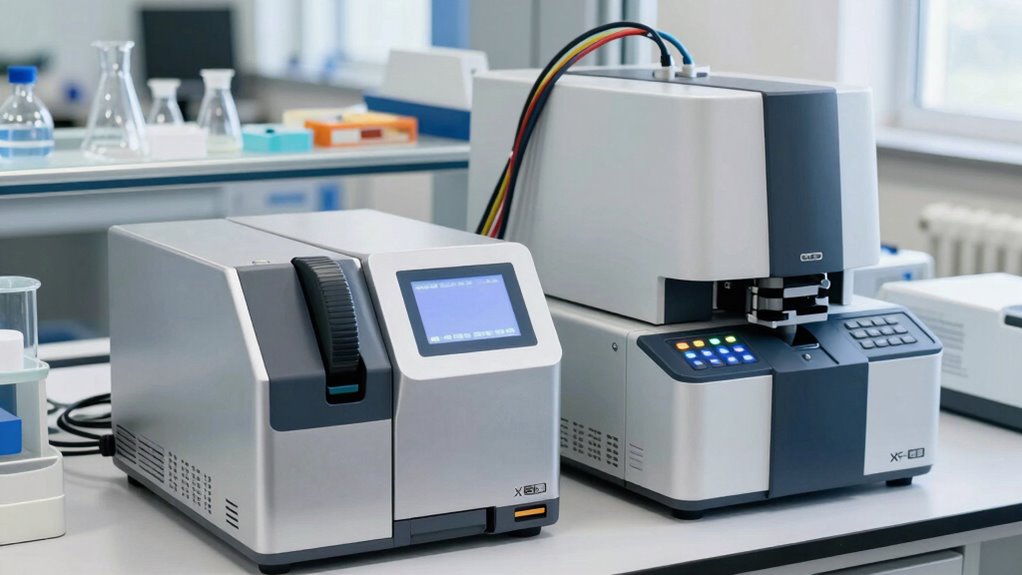
XRF spectrometer for material analysis
As an affiliate, we earn on qualifying purchases.
As an affiliate, we earn on qualifying purchases.
Frequently Asked Questions
What Are the Maintenance Requirements for Each Instrument?
You need to perform regular calibration procedures to guarantee accurate results for both instruments. For XRF, keep the detector clean and replace the X-ray tube when it shows signs of wear. For ICP-OES, clean the torch and check the nebulizer frequently. Maintaining proper calibration and routine cleaning extends instrument longevity. Consistent maintenance keeps both tools running smoothly, improves data quality, and reduces downtime.
How Do Sample Preparation Times Compare?
You’ll find sample processing times vary considerably between XRF and ICP-OES. XRF offers rapid preparation, often requiring minimal steps and quick drying, boosting preparation efficiency. In contrast, ICP-OES demands more extensive sample digestion and preparation, which lengthens the process. This difference can dramatically impact your workflow, especially when speed is critical. So, if time’s tight, XRF might be your faster, more efficient choice for elemental analysis.
Can Both Methods Analyze the Same Range of Elements?
Yes, both methods can analyze a broad range of elements, but their element detection capabilities differ. XRF excels at detecting heavier elements like metals, providing good analytical precision for these. ICP-OES offers wider element detection, including lighter elements, with high analytical precision. Your choice depends on which elements you focus on and the required accuracy, as each technique has strengths suited for specific elemental analysis needs.
What Is the Environmental Impact of Each Technique?
You should consider the environmental footprint of each technique when evaluating their sustainability. XRF generally has a lower environmental impact since it uses minimal reagents and produces less waste, making it more eco-friendly. ICP-OES, on the other hand, requires extensive sample preparation and consumes more energy, which can increase its environmental footprint. Prioritizing methods with smaller environmental impacts aligns with sustainability considerations and reduces overall ecological harm.
Are There Specific Industries Better Suited for One Method?
You’ll find that certain industries favor specific techniques based on their application needs. For example, the mining and environmental sectors benefit from XRF’s rapid, on-site analysis for industry applications, while laboratories in pharmaceuticals or research prefer ICP-OES for its higher sensitivity and accuracy. Recognizing technique suitability helps you choose the right method, ensuring efficient, precise results tailored to each industry’s unique elemental analysis requirements.
Conclusion
Think of choosing between XRF and ICP-OES as selecting the right key for a lock. Each tool open different depths of elemental insight—XRF is your quick, reliable key for surface details, while ICP-OES offers the intricate, hidden chambers of deeper analysis. By understanding your sample’s story, you can pick the key that fits best, ensuring you access the full potential of your data. With the right tool, you’re always one step closer to the truth.
Halloween Picks
halloween
As an affiliate, we earn on qualifying purchases.