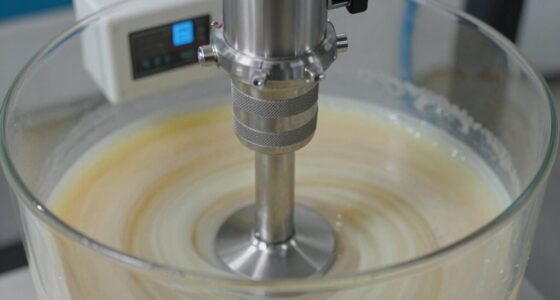

Fick’s laws explain how particles move from areas of high to low concentration, driven by concentration gradients. The first law shows how this movement, or flux, is proportional to the gradient, while the second law describes how concentrations change over time. These laws help you understand how diffusion works in gases, liquids, and solids, influencing many natural and engineered processes. Keep exploring to discover more about how these principles impact various fields.
Open a free Amazon Business account
Business pricing, bulk buying and tax-exempt orders.
As an affiliate, we earn on qualifying purchases.
Key Takeaways
- Fick’s laws describe how particles move from high to low concentration, driven by concentration gradients.
- The First Law quantifies particle flux proportional to the concentration gradient at steady state.
- The Second Law explains how concentration profiles evolve over time during diffusion.
- The diffusion coefficient determines the rate of mass transport, influenced by medium and temperature.
- These laws connect microscopic particle movement to macroscopic mass transport phenomena.

Fick’s Laws describe how particles or molecules move through a medium due to diffusion. When you think about diffusion, you’re looking at the natural movement of substances from areas of higher concentration to areas of lower concentration. This process is driven by the concentration gradients that exist within the medium, creating a flow that aims to equalize differences in particle distribution. Understanding these concentration gradients is vital because they determine the direction and rate at which diffusion occurs. The greater the difference in concentration between two regions, the faster particles tend to move until equilibrium is reached.
Diffusion moves particles from high to low concentration, driven by gradients that influence both direction and rate of movement.
The first law of Fick explains this process quantitatively. It states that the flux of particles—how many particles pass through a unit area per unit time—is directly proportional to the concentration gradient. In practice, this means that if you have a steep gradient, the movement of particles will be rapid. Conversely, as the concentration gradient diminishes, so does the rate of diffusion. This law assumes steady-state conditions, where the concentration profile remains constant over time, and it highlights the importance of the diffusion mechanism itself, which involves the random, Brownian motion of particles. These diffusion mechanisms are fundamental because they underpin how substances like gases, nutrients, and pollutants spread in various environments. Additionally, understanding concentration gradients is essential for many applications in science and engineering, from designing drug delivery systems to modeling environmental pollution.
The second law of Fick extends this idea to situations where concentrations change over time. It describes how the concentration in a medium evolves, considering the diffusion process’s dynamic nature. If you’re studying how a dye disperses in water or how heat spreads through a material, this law helps you predict the concentration at any given point and time. It emphasizes that diffusion isn’t just about particles moving randomly but follows a predictable pattern governed by the underlying concentration gradients. The law incorporates the diffusion coefficient, a parameter that reflects how easily particles diffuse through a specific medium, influenced by factors like temperature and medium composition. Moreover, the diffusion coefficient itself varies with temperature and the properties of the medium, affecting the rate of diffusion in practical applications. A better understanding of mass transport can improve processes in fields such as environmental science, medicine, and engineering. Recognizing how diffusion mechanisms operate at both microscopic and macroscopic levels enhances our ability to manipulate and optimize these processes effectively.
In essence, Fick’s Laws provide a clear framework for understanding mass transport driven by diffusion. They link the microscopic movement of particles to macroscopic phenomena, emphasizing the role of concentration gradients and diffusion mechanisms. Whether you’re analyzing pollutant spread, nutrient absorption, or heat transfer, these laws give you the tools to describe and predict how substances move naturally through different media. By grasping how concentration gradients influence diffusion rates, you gain a powerful perspective on the fundamental processes that shape many physical, biological, and environmental systems.
As an affiliate, we earn on qualifying purchases.
Frequently Asked Questions
How Do Fick’s Laws Apply to Biological Systems?
You can see Fick’s laws applying to biological systems through the cell membrane, where they govern nutrient absorption. As molecules move from high to low concentration, Fick’s laws explain how nutrients like oxygen or glucose passively diffuse into cells. This process guarantees cells receive essential substances efficiently. Understanding this helps you grasp how biological systems optimize mass transport, maintaining proper cell function and overall health.
What Are the Limitations of Fick’s Laws?
Ever wondered if Fick’s laws are perfect for real-world scenarios? Their limitations stem from mathematical assumptions like constant diffusion coefficients and steady-state conditions, which often don’t hold true in complex biological systems. These assumptions can reduce model accuracy, especially when dealing with variable environments or non-linear processes. So, while useful, Fick’s laws might oversimplify reality, making them less reliable for precise predictions in dynamic biological contexts.
How Does Temperature Influence Diffusion Rates?
Temperature effects play a vital role in diffusion rates, as higher temperatures accelerate diffusion. When you increase temperature, molecules gain energy, move faster, and collide more frequently, which enhances diffusion. This diffusion acceleration means substances spread more quickly at elevated temperatures. Conversely, lower temperatures slow down molecular movement, reducing diffusion rates. So, controlling temperature allows you to influence how rapidly substances diffuse in different environments.
Can Fick’s Laws Predict Diffusion in Complex Media?
Fick’s laws struggle to predict diffusion in complex media because they assume a uniform environment. In such media, you often encounter anomalous diffusion, where particles spread irregularly, not following classic patterns. To understand this, you need advanced models that account for heterogeneity and obstacles. So, while Fick’s laws provide a foundation, they don’t fully capture diffusion behaviors in complex media, requiring more nuanced approaches.
What Are Common Applications of Fick’s Laws in Industry?
You often use Fick’s laws in industry to understand material diffusion, which impacts processes like drug delivery, filtration, and coating applications. They help optimize industrial processes by predicting how substances move through materials, ensuring efficiency and quality. Whether designing better membranes or controlling heat transfer, Fick’s laws provide essential insights that improve product performance and process control in various manufacturing fields.
Conclusion
By understanding Fick’s Laws, you grasp how diffusion works, how concentration gradients drive movement, and how factors influence mass transport. You see that diffusion depends on concentration differences, depends on distance, and depends on time. You recognize that mastering these principles allows you to predict, control, and optimize processes across fields. You understand that Fick’s Laws are not just equations but the foundation for understanding how substances move, how systems function, and how progress is made.
NFL season / tailgating Picks
team gear
As an affiliate, we earn on qualifying purchases.