
Flow chemistry helps you achieve cleaner synthesis by providing precise control over reaction conditions, which reduces waste and minimizes hazardous byproducts. Its continuous process allows for safer handling of dangerous chemicals and faster reaction optimization. Automated monitoring ensures ideal performance and safety, making the process more environmentally friendly. By streamlining reactions and promoting sustainability, flow chemistry offers a smarter way to produce cleaner chemicals—if you explore further, you’ll see how it transforms modern synthesis.

Prime made for students and young adults
- Fast, free delivery for dorm and study essentials
- Prime Video and Amazon Music included
- Member-only deals
Key Takeaways
- Flow chemistry enables precise control of reaction conditions, reducing waste and improving overall efficiency for cleaner synthesis.
- Continuous flow minimizes hazardous reagent handling and limits exposure, enhancing safety and environmental sustainability.
- Integration of real-time monitoring and automation ensures optimal reaction parameters, decreasing by-products and impurities.
- Small, contained reaction streams facilitate safer processing of toxic or unstable chemicals, reducing environmental impact.
- Faster reaction optimization and scalable processes lead to greener, more sustainable manufacturing practices.
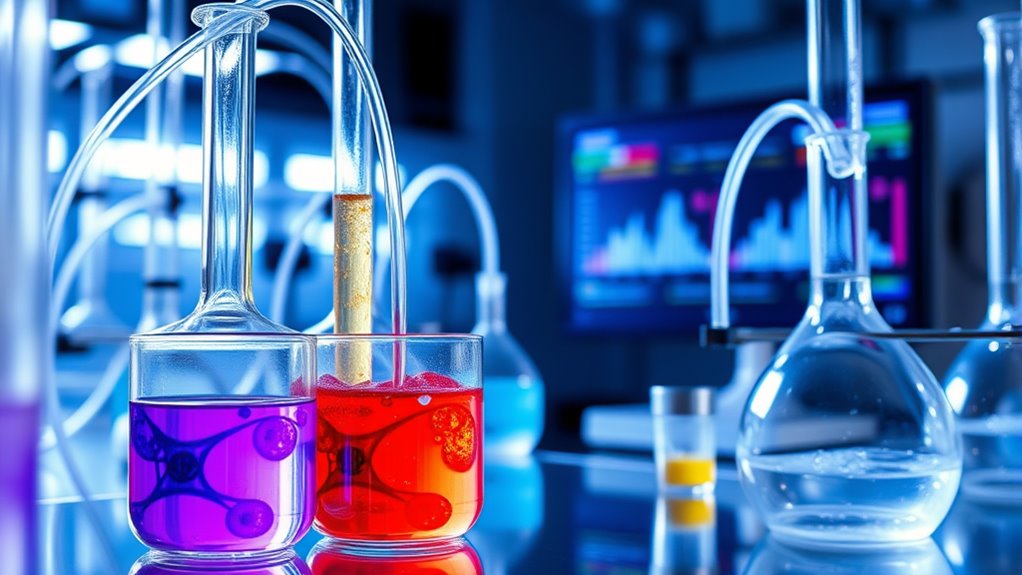
Have you ever wondered how chemists streamline complex reactions? The answer lies in flow chemistry, a method that transforms traditional batch processes into continuous, controlled systems. By moving reactants through a reactor in a steady flow, you gain greater control over reaction parameters, leading to more efficient reaction optimization. This setup allows you to fine-tune temperature, flow rate, and reactant concentrations on the fly, reducing the trial-and-error typically associated with batch processes. As a result, you can achieve higher yields faster, with fewer wasted materials. Reaction optimization becomes more straightforward because you can make incremental adjustments while the process runs, rather than waiting for batch cycles to complete. This precision not only boosts productivity but also makes scaling up reactions more predictable and manageable.
Safety enhancements are one of the most significant advantages of flow chemistry. When dealing with hazardous or unstable reagents, working in small, continuous streams minimizes risk. Instead of handling large quantities of dangerous chemicals at once, you control their flow into the reactor, reducing the potential for accidents. If a reaction becomes exothermic or unstable, the system can be shut down quickly, preventing dangerous build-ups of heat or pressure. This containment makes flow chemistry inherently safer, especially for reactions involving toxic or explosive materials. Additionally, because the process is continuous, any issues can be detected early through online monitoring, allowing you to intervene before problems escalate. The closed nature of flow systems also limits exposure to harmful substances, protecting operators and the environment.
Another aspect that makes flow chemistry appealing is its ability to integrate safety enhancements with reaction optimization seamlessly. Automated control systems can adjust parameters in real-time based on sensor feedback, maintaining optimal conditions while ensuring safety protocols are followed. This integration reduces human error and creates a safer working environment. Plus, the compact footprint of flow reactors means less space is needed compared to traditional batch setups, and the risk of leaks or spills is minimized. Overall, flow chemistry empowers you to conduct complex reactions more safely and efficiently. It enables faster development cycles, better control over reaction conditions, and a safer workspace, all while reducing waste and improving sustainability. If you’re looking to innovate and make your chemical processes more environmentally friendly, embracing flow chemistry could be a game-changer.
As an affiliate, we earn on qualifying purchases.
Frequently Asked Questions
What Are the Main Cost Implications of Adopting Flow Chemistry?
Adopting flow chemistry impacts your costs through initial equipment investment and ongoing cost analysis. You’ll need to budget for specialized reactors and control systems, which can be higher upfront. However, these costs are offset by savings in raw materials, reduced waste, and increased efficiency over time. Continuous operation minimizes downtime and waste, making flow chemistry a cost-effective choice despite the initial investment.
How Scalable Is Flow Chemistry for Industrial Applications?
Scaling solutions swiftly support seamless synthesis, making flow chemistry highly scalable for industrial applications. While scaling challenges exist, process optimization plays a pivotal role in overcoming them. You’ll find that continuous flow systems adapt efficiently to larger volumes, enabling consistent, controlled chemical conversions. By refining equipment and processes, you can confidently scale up, ensuring productivity and performance without sacrificing safety or sustainability, ultimately transforming small-scale success into substantial, sustainable industrial solutions.
Are There Specific Reactions Incompatible With Flow Chemistry?
You might find some reaction limitations with flow chemistry, especially those involving solid catalysts or precipitates, as equipment constraints can cause blockages. Highly exothermic reactions also pose challenges due to heat management issues. Additionally, reactions requiring very long residence times or complex multi-step processes may be less suitable. Overall, while flow chemistry offers many advantages, certain reactions are incompatible because of equipment constraints and specific reaction limitations.
What Safety Concerns Are Unique to Flow Chemistry Systems?
You should be aware that flow chemistry systems pose unique safety concerns like reactor hazards, which can lead to pressure buildup or leaks, and solvent leaks that might cause fires or exposure. Always monitor pressure gauges and ensure proper sealing of reactors. Implement safety protocols for leak detection and emergency shutdowns. Regular maintenance and training help prevent accidents, keeping your process secure and efficient.
How Does Flow Chemistry Impact Overall Sustainability and Waste Reduction?
Flow chemistry acts as a beacon guiding you toward greener practices, markedly boosting sustainability and waste reduction. It improves green metrics by minimizing excess reagents and reducing solvent use, making processes more resource-efficient. With continuous flow, you can optimize reactions in real-time, cutting down waste and energy consumption. This approach transforms your lab into a more environmentally friendly space, turning waste into a thing of the past and sustainability into your guiding star.
Conclusion
As you embrace flow chemistry, you’re opening the door to a cleaner, more sustainable future. It’s like steering a ship through calm waters, guiding your reactions with precision and care. By adopting this approach, you not only optimize your processes but also contribute to a healthier planet. Let flow chemistry be the compass that leads you toward innovative, eco-friendly solutions—turning your lab into a beacon of hope amid the storm of environmental challenges.
Fall Picks
fall essentials
As an affiliate, we earn on qualifying purchases.