Using small channels in flow chemistry reactors improves your process safety by offering better control over reaction conditions and rapid heat transfer. This setup minimizes hot spots, prevents runaway reactions, and limits the scale of reactive events. The continuous flow operation means fewer hazards with hazardous chemicals and easier adjustments for safety improvements. If you keep exploring, you’ll see how these features make your process safer and more reliable.
Key Takeaways
- Small channels limit the scale of reactive events, reducing the risk of large-scale accidents.
- Enhanced heat transfer prevents hot spots and runaway reactions, improving thermal safety.
- Continuous flow minimizes accumulation of hazardous materials, lowering overall safety hazards.
- Precise control over reaction parameters ensures safer process conditions.
- Modular design allows safe incremental capacity increases without large-scale risks.
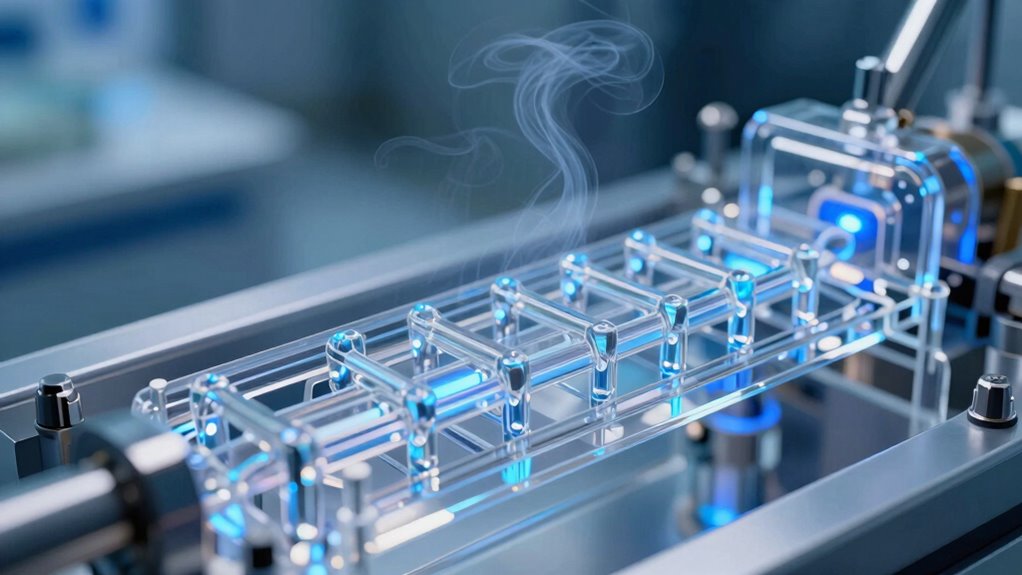
Have you ever wondered how chemists improve reaction efficiency and safety? One key innovation is flow chemistry reactors, which use small channels to streamline chemical processes. Traditional batch processes often face scalability challenges that hinder their efficiency and safety at larger production scales. This is where reactor design plays a vital role. Flow reactors, with their narrow channels and continuous flow, address these challenges by providing precise control over reaction parameters. The small channels facilitate rapid heat transfer, preventing hot spots and runaway reactions that can occur in bulk processes. This design inherently enhances safety, especially when working with hazardous or highly reactive chemicals.
As you consider scaling a chemical process, you’ll find that flow chemistry reactors offer significant advantages. Their modular nature allows you to expand capacity incrementally, avoiding the massive jumps in size and complexity that come with traditional reactors. Instead of designing a giant vessel, you can add more flow modules, maintaining tight control over each step. This flexibility reduces the risk of accidents and improves overall process reliability. Reactor design in flow chemistry also enables better control over residence time, which ensures consistent product quality. Because reactions happen in a continuous, streamlined manner, you get more uniform results, reducing waste and the need for extensive downstream purification. Additionally, the small channels promote rapid heat transfer, which helps maintain stable reaction conditions and prevents thermal runaways. Furthermore, flow reactors make it easier to optimize reactions during development, saving time and resources. Small channels allow for rapid experimentation and adjustment of reaction conditions, such as temperature, pressure, and flow rates. This agility helps you fine-tune processes before scaling up, minimizing surprises and safety issues later on. Incorporating scalable reactor designs is crucial for transitioning from lab-scale to industrial production, ensuring safety and efficiency. The inherent predictability of flow reactors makes them particularly suitable for managing complex chemical reactions safely. Moreover, advances in reactor automation further enhance safety and efficiency by enabling real-time monitoring and control. As you move toward industrial-scale production, the inherent scalability of flow reactors becomes a game-changer. Their design helps overcome the traditional scalability challenges by maintaining safe operating conditions, improving heat management, and ensuring consistent product quality. This makes flow chemistry not only safer but also more economical and environmentally friendly, as it reduces waste and energy consumption.

stonylab Flow Electrochemical Cell, Graphite Plate and Frame Electrolysis Device Flow Electrolysis Device Electrolytic Cell Reactor Electrolyzer
- System Type: Plate and frame electrolysis design
- Reaction Area: Approximately 10 cm²
- Components Included: Circulation tank, electrodes, pipelines
As an affiliate, we earn on qualifying purchases.
As an affiliate, we earn on qualifying purchases.
Frequently Asked Questions
How Do Flow Chemistry Reactors Impact Environmental Sustainability?
Flow chemistry reactors boost environmental sustainability by enabling eco-friendly design and waste reduction. You benefit from precise control over reactions, minimizing excess reagents and reducing hazardous waste. Small channels improve heat and mass transfer, making processes more efficient and safer. This approach lowers energy consumption and emissions, helping you create greener, more sustainable chemical processes. Overall, flow reactors support your goals of reducing environmental impact while maintaining high product quality.
What Are the Initial Costs of Implementing Flow Chemistry Systems?
Getting started with flow chemistry systems requires a solid investment, but it’s not a shot in the dark. The initial costs involve a detailed cost analysis, focusing on equipment investment, like specialized reactors and control systems. While these upfront expenses might seem steep, they often pay off through safer, more efficient processes down the line. It’s a classic case of paying now to save later.
Can Flow Reactors Be Scaled up for Industrial Production?
You can scale up flow reactors for industrial production, but scalability challenges often arise. You need to carefully consider reactor design to guarantee safety and efficiency at larger scales. While small channels improve safety and control, increasing size demands innovative designs to ensure uniform flow and heat transfer. With proper engineering, flow reactors can be effectively scaled, making them suitable for large-scale manufacturing, though it requires strategic planning and adaptation.
How Do Flow Reactors Handle Complex Multi-Step Syntheses?
You handle complex multi-step syntheses in flow reactors by integrating catalysts directly into the small channels, enabling efficient, continuous reactions. Reaction monitoring is essential; it allows you to track each step in real-time, ensuring ideal conditions and quick adjustments. This combination simplifies multi-step processes, reduces waste, and enhances safety, making flow reactors highly effective for complex syntheses compared to traditional batch methods.
What Training Is Required to Operate Flow Chemistry Equipment?
Operating flow chemistry equipment is like learning to ride a bike—you need proper training. You should undergo safety protocols training and obtain operator certification to guarantee safe handling of chemicals and equipment. This training covers safety procedures, emergency response, and proper operation techniques. With the right knowledge, you can confidently manage complex reactions, minimize risks, and maintain process safety, making your work both efficient and secure.
Conclusion
By now, you see how small channels in flow chemistry reactors dramatically boost safety, efficiency, and control. Did you know that reactions in microchannels can reduce hazardous byproducts by up to 90%? This means less risk and cleaner processes for you. Embracing these tiny channels isn’t just a trend—it’s a game-changer for safer, more sustainable chemical manufacturing. So, consider integrating flow reactors into your processes and experience the transformative impact firsthand.