TL;DR

Prime made for students and young adults
- Fast, free delivery for dorm and study essentials
- Prime Video and Amazon Music included
- Member-only deals
NASA Technical Bulletin 26-09 says a hammer-tap test does not need an idealized half-sine force pulse to be useful. Test adequacy depends on accurate, complete force and response measurements and whether the excitation covers the test’s intended frequency, amplitude and nonlinear-response ranges.
NASA Technical Bulletin TB 26-09 says instrumented hammer-tap tests do not need to produce a smooth, idealized half-sine force pulse to provide usable data. The guidance says engineers should judge a test by the accuracy and completeness of its measured force and structural response, and by whether those measurements cover the test’s intended range.
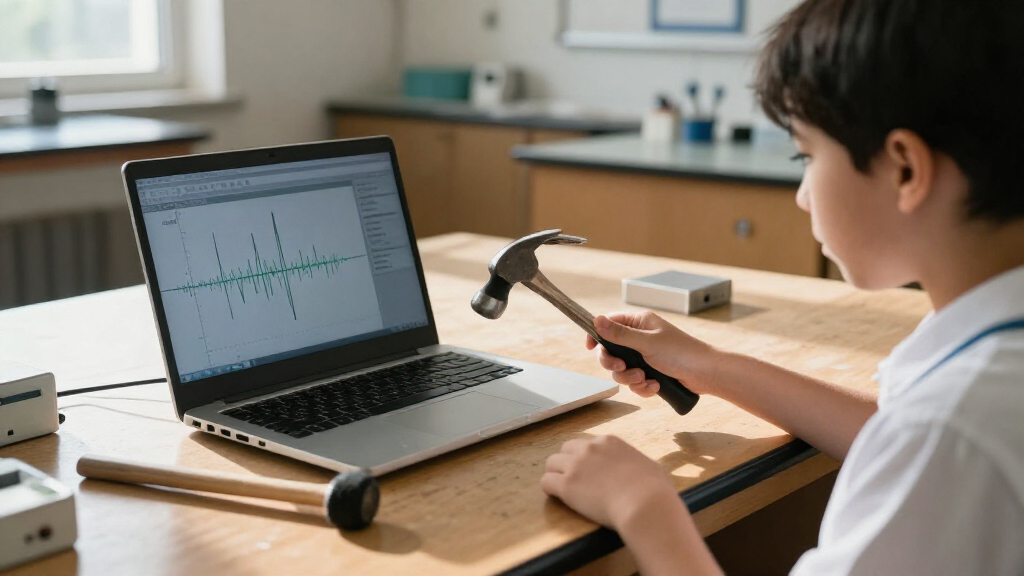
The bulletin addresses impact tests used in modal analysis and, in some cases, before pyroshock testing. It contrasts three kinds of force histories: a half-sine pulse, a pulse with ripples near its crest, and impacts that separate and make contact again. NASA’s point is that the latter shapes are not automatically invalid. When the applied force and resulting response are measured accurately, those features remain part of the known input history rather than being reasons on their own to discard a test.
The timing of separated contacts matters because the structure continues to vibrate during a gap in applied force. A later contact acts on a structure already moving. According to the bulletin, the relationship between force and response therefore depends on the complete measured history, including the intervals and repeated contacts, not just the appearance of the first impact.
NASA also cautions that a half-sine pulse is broadband but not spectrally flat. For a pulse of duration T, the bulletin defines f₀ = 1/(2T) and says the finite half-sine spectrum has zeros at f/f₀ = 3, 5, 7 and other odd values. Crest rippling can add spectral content and fill some of those notches, while the timing between separate contacts creates deterministic interference. The bulletin recommends reviewing the unnormalized measured spectrum and response signal-to-noise ratio, rather than inferring adequate excitation from a waveform’s visual shape or from spectra normalized to their own DC values.
How Engineers Should Judge Impact Tests
The guidance matters because a test can be rejected for the wrong reason if engineers treat a visually imperfect pulse as proof that the data are unusable. Conversely, a clean-looking half-sine does not guarantee that a test has excited the structural behavior the analysis needs. TB 26-09 shifts the practical question from “Does the pulse look ideal?” to whether the force and response were measured reliably and the test covered its stated objective.
That distinction affects the interpretation of structural models. The bulletin says an exact model and test article given the same force history and initial conditions should produce identical responses under the stated uniqueness argument. An approximate model, however, may show different prediction errors when different inputs excite different frequencies, amplitudes or nonlinear states. A measured, irregular input can still be useful, but engineers need to account for what it actually excited before drawing conclusions about model performance.
The recommended practice is to check force-sensor bandwidth, calibration, dynamic range and timing; confirm response sensors have suitable bandwidth and signal-to-noise ratio and were not clipped or saturated; and verify that the excitation covers the relevant frequency, amplitude and nonlinear-response ranges. The bulletin says a test should be rejected or repeated only when a specific measurement, excitation or coverage deficiency has been identified.
Popular right now

LG 85-Inch QNED84B Mini LED 4K Smart TV (2026)

Samsung 75-Inch M80H Series Mini LED 4K Smart TV (2026)

Dyson Car+Boat Cordless Handheld Vacuum
As an affiliate, we earn on qualifying purchases.
Why Pulse Shape Is Not the Whole Test
Instrumented hammer testing is used to examine how structures respond to applied impacts. In modal testing, engineers use measured inputs and responses to characterize structural vibration. NASA’s bulletin also notes that hammer tests can come before pyroshock testing, where the test objective may call for particular response conditions. The required excitation therefore depends on the purpose of the test, rather than on a single preferred waveform.
The bulletin’s argument rests on measuring both sides of the test: the force applied by the hammer and the response of the structure. Its discussion distinguishes a theoretical comparison, in which an exact model receives the same force and initial conditions as a test article, from practical modeling, where approximations and nonlinear behavior can affect the comparison. NASA cites a separate September 2026 paper on the validity and predictability of measured hammer-tap inputs, along with references on modal testing, mechanical mobility, vibration testing and nonlinear oscillations. The supplied bulletin excerpt does not provide further publication details for TB 26-09 itself.
What the Bulletin Does Not Specify
The guidance does not give universal numeric thresholds for adequate bandwidth, calibration accuracy, dynamic range or response signal-to-noise ratio. Those requirements must be set for the particular test objective; the bulletin’s supplied material does not provide a single pass-or-fail criterion applicable to every structure or impact test.
The source excerpt also does not identify a specific test program, structure or disputed result that prompted TB 26-09, nor does it report new experimental results in the bulletin itself. It presents recommended practice and refers readers to a separate technical paper for the derivation behind its exact-model argument. The source does not say whether the bulletin supersedes earlier NASA guidance or whether any organization has adopted its recommendations.
Applying the Guidance to Each Test
For engineers planning or reviewing hammer tests, the next step described in the bulletin is to document the intended objective and check the records against it: the complete force history, response measurements, sensor performance and the frequency and amplitude coverage. If those checks identify a specific shortfall, the test may need to be repeated or its conclusions limited. If they do not, a rippled crest or a sequence of contacts is not, by itself, grounds for rejection.
NASA directs readers seeking more information to Joel W. Sills at Langley Research Center and provides a PDF version of the bulletin. The supplied material does not announce a deadline, follow-up test or additional agency action.
Key Questions
Does NASA say a hammer test must produce a half-sine pulse?
No. TB 26-09 says an idealized half-sine is not required if the applied force and resulting response are measured accurately and the test covers its objective.
Can separated hammer contacts still produce useful data?
They can. NASA says the force history should include the gap and later contact, since the structure continues vibrating during the zero-force interval. Whether the test is adequate depends on measurement quality and coverage, not contact separation alone.
How should engineers assess whether excitation was adequate?
The bulletin recommends checking the measured force spectrum, response signal-to-noise ratio, sensor bandwidth and calibration, dynamic range, timing, and coverage of the required frequency, amplitude and nonlinear-response ranges.
Does the bulletin provide universal numerical acceptance limits?
No universal thresholds appear in the supplied bulletin excerpt. It says adequacy depends on the intended test objective and the quality and coverage of the measurements.
Source: nasa.gov