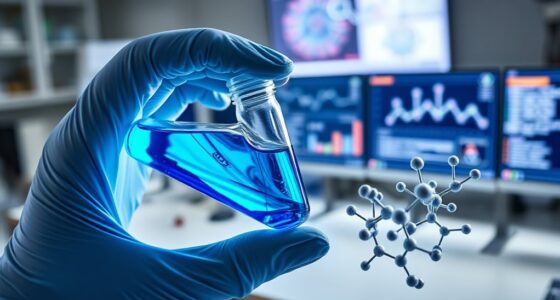
Excipients that control tablet performance include binders, disintegrants, and fillers. Binders hold the ingredients together, guaranteeing the tablet’s strength during handling and transport. Disintegrants promote quick breakdown in the body, aiding absorption. Fillers add volume and affect stability. Choosing the right excipients guarantees your tablet disintegrates at the desired rate and remains stable, balancing safety and effectiveness. Continue exploring to discover how these ingredients influence each step of medication delivery.
Prime for Young Adults — start your free trial
Fast free delivery, streaming and member deals for eligible 18–24 year olds.
As an affiliate, we earn on qualifying purchases.
Key Takeaways
- Disintegrants facilitate rapid tablet breakup, controlling disintegration time for optimal drug release.
- Binders provide mechanical strength, influencing tablet hardness and ensuring proper disintegration post-ingestion.
- Fillers and diluents affect tablet weight, stability, and disintegration characteristics.
- Coatings can modify disintegration profiles and protect active ingredients from environmental factors.
- Lubricants and glidants improve manufacturing flow but must be compatible to avoid interfering with disintegration.

Have you ever wondered what makes a tablet release its active ingredient effectively? The answer lies in the careful selection and function of excipients, especially those that influence tablet disintegration and binder functionality. These components are essential because they determine how quickly and efficiently a tablet dissolves in your body, guaranteeing the medication works as intended. When you take a tablet, it’s not just about swallowing a pill; it’s about how that pill breaks down and releases its medicine. That’s where tablet disintegration comes into play. This process involves the tablet breaking apart into smaller particles once it reaches your stomach or intestines. Proper disintegration ensures the active ingredient is accessible for absorption. If a tablet disintegrates too slowly, the medicine might not be fully absorbed in time, reducing its effectiveness. Conversely, if it disintegrates too quickly, it could cause local irritation or dose dumping, which might be harmful. Hence, formulators pay close attention to excipients that promote ideal disintegration times, balancing speed with safety. Additionally, advances in formulation science have led to the development of excipients that can modulate disintegration profiles to optimize therapeutic outcomes. These innovations help tailor medication release profiles to meet specific treatment needs, and understanding these disintegration mechanisms is vital for pharmaceutical scientists.
Another key role of excipients is binder functionality. Binders are substances that hold the ingredients of a tablet together, giving it the necessary hardness and cohesion so it can be handled, packaged, and transported without breaking apart prematurely. You might not realize it, but the binder’s performance directly impacts the tablet’s durability during manufacturing and its integrity during storage and transportation. An effective binder maintains the tablet’s shape until it reaches your digestive system but also allows for proper disintegration once ingested. Achieving this balance is a careful process—too strong, and the tablet might not disintegrate properly; too weak, and it could crumble prematurely. Binders such as cellulose derivatives, povidone, or starches are chosen based on their ability to provide the right mechanical strength and disintegration profile. Understanding the role of excipients in this process highlights their importance in pharmaceutical formulation. Moreover, the compatibility of excipients with active ingredients is crucial for product stability and overall effectiveness. Additionally, the selection of excipients is guided by their compatibility with active ingredients, ensuring stability and effectiveness of the final product.
As an affiliate, we earn on qualifying purchases.
Frequently Asked Questions
How Do Excipients Affect Tablet Shelf Life?
Excipients directly impact your tablet’s shelf life by influencing their stability and formulation compatibility. If chosen wisely, they protect active ingredients from moisture, oxygen, and light, preventing degradation over time. Poorly compatible excipients can cause stability issues, reducing shelf life. You must carefully select excipients that are compatible with your formulation, ensuring they don’t negatively affect the tablet’s stability, potency, or safety during storage.
Can Excipients Cause Allergic Reactions?
Yes, excipients can cause allergic reactions. If you’re sensitive or allergic to certain ingredients, you might experience hypersensitivity reactions, such as skin rashes, swelling, or difficulty breathing. Excipient allergies are rare but possible, especially with additives like dyes, preservatives, or fillers. Always check the ingredient list carefully, and if you have known allergies, consult your healthcare provider before taking a new medication to avoid adverse hypersensitivity reactions.
Are Natural Excipients as Effective as Synthetic Ones?
Natural excipients can be just as effective as synthetic ones, especially when you consider natural alternatives that offer improved biocompatibility and reduced side effects. While synthetic excipients often provide consistency and stability, natural options like plant-based fillers and binders work well in many formulations. Your choice depends on your specific needs, but in many cases, a synthetic comparison shows natural excipients can deliver comparable performance with added safety benefits.
How Do Excipients Influence Drug Release Rates?
Excipients influence drug release rates mainly through matrix diffusion and swelling behavior. When they form a matrix, they control how quickly the drug diffuses out, slowing or speeding up release. Swelling excipients absorb water and swell, creating a gel layer that regulates drug diffusion. By adjusting these properties, you can fine-tune the release profile, ensuring the drug delivers effectively over the desired time frame.
What Are the Environmental Impacts of Excipient Production?
You should consider that excipient production impacts environmental sustainability through production emissions, which contribute to air pollution and climate change. Manufacturing processes often involve energy consumption and waste generation, affecting ecosystems and communities. By choosing environmentally friendly excipients and optimizing production methods, you can reduce emissions and promote sustainability. This way, you help minimize the environmental footprint of pharmaceutical manufacturing and support greener practices in the industry.
Conclusion
You might find it surprising how these excipients, often overlooked, play such a vital role in tablet performance. Their precise formulations guarantee consistent release and stability, making your medication reliable. It’s almost like a coincidence—tiny details working together seamlessly, much like a well-orchestrated symphony. Next time you take a tablet, remember these unassuming ingredients quietly shaping your health, proving that sometimes, the smallest components make the biggest difference.
Flea & tick season Picks
flea and tick prevention
As an affiliate, we earn on qualifying purchases.