Medicinal chemistry has made incredible strides, starting with the discovery of penicillin, which revolutionized infection treatment. Advances in chemical synthesis and biological understanding paved the way for antibiotics, antivirals, and targeted therapies. Today, breakthroughs like mRNA vaccines showcase how innovative chemistry enables precise medicine. If you want to explore how these milestones transformed healthcare and opened new frontiers, there’s plenty more to discover ahead.
Key Takeaways
- Discovery of penicillin marked the first antibiotic, revolutionizing infectious disease treatment.
- Advances in chemical synthesis enabled the design of diverse drugs and improved existing therapies.
- Development of high-throughput screening accelerated identification of promising drug candidates.
- Breakthroughs in nucleic acid chemistry led to the creation of mRNA vaccines for COVID-19.
- Modern medicinal chemistry integrates biological insights and innovative synthesis to develop personalized and targeted therapies.
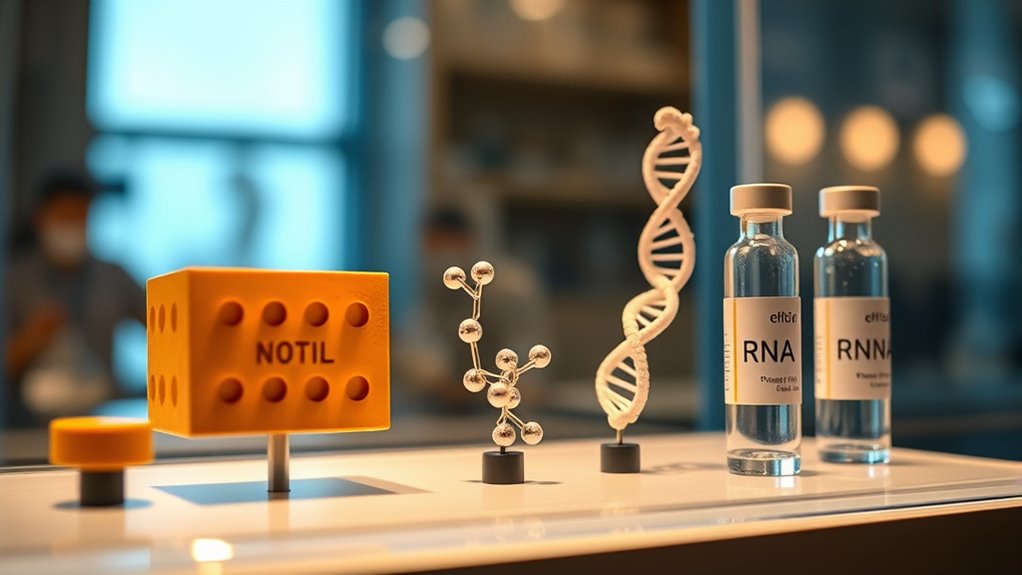
Medicinal chemistry has transformed medicine by turning discoveries into effective drugs that save lives. You’re at the forefront of this incredible process, where scientific insight meets innovative techniques to develop vital medications. At its core, drug discovery is a meticulous journey that involves identifying promising biological targets and designing molecules capable of modulating them. You recognize that this process requires a deep understanding of biochemistry and pharmacology, but equally important is the ability to translate these insights into tangible compounds through chemical synthesis. Chemical synthesis is the backbone of medicinal chemistry, allowing you to create complex molecules with precision. It involves building compounds step-by-step, often starting from simple, commercially available chemicals, and carefully modifying them to enhance efficacy, reduce side effects, or improve pharmacokinetic properties. This meticulous craftsmanship has enabled the rapid development of numerous life-saving drugs.
Your work often begins with screening vast libraries of chemical compounds, seeking those that show potential activity against specific disease targets. Once a promising candidate emerges, you investigate chemical synthesis to optimize its properties. This process might involve adding functional groups, altering molecular structures, or creating stereoisomers, all aimed at increasing potency or reducing toxicity. The ability to efficiently synthesize these compounds accelerates drug discovery, making it possible to bring new therapies to patients faster. Over the decades, advances in chemical synthesis techniques—such as microwave-assisted synthesis, solid-phase synthesis, and flow chemistry—have drastically shortened development timelines and expanded the chemical space you can explore. These innovations empower you to craft molecules that were once thought impossible.
Furthermore, integrating novel synthesis techniques has become essential in exploring complex molecular architectures that target difficult biological pathways. From the discovery of penicillin to the development of mRNA vaccines, medicinal chemistry has continually evolved, fueled by breakthroughs in chemical synthesis and a better understanding of biological systems. You’ve seen how early antibiotics revolutionized medicine, and now, with modern techniques, you’re helping develop personalized therapies and innovative vaccine platforms. Each milestone reflects your ability to harness chemical principles, turning raw scientific insights into practical drugs. Your work guarantees that new treatments are not only effective but also safe and accessible. As you continue to push the boundaries of chemical synthesis and drug discovery, you stay committed to improving human health, driving forward a legacy of innovation that saves lives and shapes the future of medicine.
Frequently Asked Questions
How Has Medicinal Chemistry Evolved in the 21ST Century?
In the 21st century, medicinal chemistry has evolved markedly through advancements like pharmacophore modeling and lead optimization. You now harness computational tools to identify promising drug candidates faster and more accurately. You refine molecular structures efficiently, improving efficacy and reducing side effects. This progress accelerates drug discovery, enabling personalized medicine and tackling complex diseases more effectively, transforming how you develop new therapies today.
What Role Do Artificial Intelligence Tools Play in Drug Discovery?
AI tools play a pivotal role in drug discovery by enabling AI-driven screening, which speeds up identifying promising compounds. You benefit from machine learning optimization, as it analyzes vast data sets to predict drug interactions and efficacy more accurately. This accelerates the development process, reduces costs, and improves success rates, making modern medicinal chemistry more efficient and innovative in bringing new medicines to patients faster.
Which Recent Breakthroughs Are Shaping Future Medicinal Chemistry?
Recent breakthroughs in medicinal chemistry include innovative synthetic methodologies that enable faster, more efficient drug development. You benefit from these advances by accessing precisely tailored compounds, often derived from natural products, which enhance efficacy and reduce side effects. These breakthroughs also facilitate the creation of complex molecules that were previously challenging to synthesize, opening new avenues for treating diseases and personalized medicine.
How Do Regulatory Policies Impact Drug Development Milestones?
Regulatory policies substantially impact your drug development milestones by creating regulatory hurdles and shaping approval processes. These policies guarantee safety and efficacy but can delay progress if not navigated efficiently. You need to stay informed about evolving regulations, submit thorough data, and meet strict standards to gain timely approvals. Understanding these policies helps you plan development stages effectively, reducing setbacks and accelerating your pathway to bringing new medicines to market.
What Are the Challenges in Developing Personalized Medicine?
You face challenges in developing personalized medicine, like biomarker identification and genetic profiling. Finding reliable biomarkers requires extensive research, and genetic profiling demands advanced technology and data analysis. You must also navigate regulatory hurdles and guarantee patient privacy. These factors make it difficult to create targeted treatments efficiently, but overcoming them can lead to more effective, tailored therapies that improve patient outcomes.
Conclusion
As you’ve seen, medicinal chemistry has journeyed from penicillin’s discovery to the cutting-edge domain of mRNA technology. Each milestone is a stepping stone, building a bridge to better health and innovation. Just like a finely tuned symphony, these breakthroughs harmonize science and medicine, guiding us toward a future where cures are within reach. Keep your eyes on the horizon — this ongoing melody promises even more remarkable notes ahead.