
Marie Curie’s legacy goes beyond myth, showcasing her groundbreaking work in chemistry and radioactivity. You’ll see how she discovered polonium and radium through careful, rigorous experiments under tough conditions. Her perseverance challenged gender norms and inspired future scientists. Her commitment to scientific integrity and precision set standards that still influence research today. If you keep exploring, you’ll uncover how her resilience and social courage continue to shape science and society in profound ways.
Key Takeaways
- Marie Curie’s meticulous experimental methods and precise measurements established foundational principles in radioactivity research.
- Her discoveries of polonium and radium significantly advanced understanding of nuclear chemistry.
- Beyond her scientific achievements, she challenged societal norms, advocating for women in science.
- Her rigorous approach under difficult conditions exemplifies resilience and integrity in scientific inquiry.
- Curie’s legacy continues to influence modern nuclear physics, medicine, and gender equality in STEM fields.

Have we truly understood Marie Curie beyond the myth of her as a pioneering scientist? Her story often highlights groundbreaking discoveries in radioactivity and her relentless pursuit of knowledge. But beneath that reputation lies a complex reality shaped by gender barriers that she relentlessly challenged. As a woman in late 19th and early 20th-century science, she faced skepticism, limited opportunities, and societal expectations that sought to confine her. Yet, she persisted, breaking through these barriers not just for herself but for countless women who would follow. Her scientific legacy is not only rooted in her discoveries but also in her defiance of the norms that tried to restrict her. She proved that gender should never determine one’s capacity to contribute to knowledge, inspiring future generations to pursue science regardless of gender.
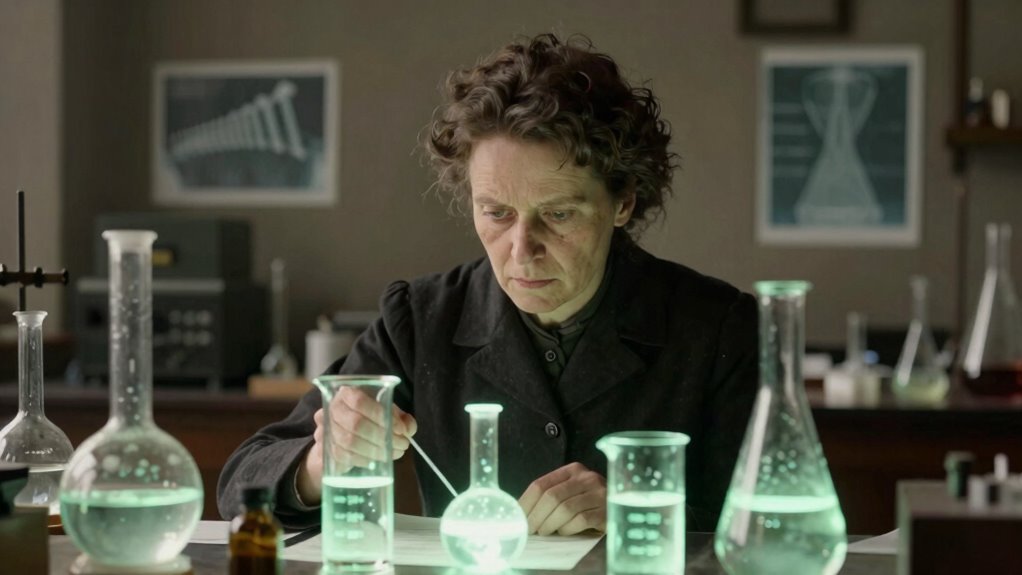
When you examine her work in chemistry and radioactivity, you see a meticulous, rigorous mind at work. Curie’s dedication to rigorous experimentation and precise measurement set a new standard in scientific inquiry. She approached her research with discipline, often working under challenging conditions, including limited resources and the constant threat of health hazards from radioactivity. Her discovery of polonium and radium wasn’t accidental; it was the result of sustained effort, careful observation, and relentless testing. She refused to cut corners, understanding that scientific progress demanded rigor and patience. Her work laid the foundation for nuclear physics and medicine, but it also exemplified her unwavering commitment to integrity in science. Additionally, her approach to scientific rigor demonstrated her commitment to meticulous methods, which remains a benchmark in scientific research today. Her perseverance in the face of health risks highlights her unwavering dedication to scientific integrity. Such resilience underscores the importance of gender barriers and their impact on scientific progress, which Curie actively challenged throughout her career.
Beyond her scientific achievements, Marie Curie’s legacy encourages us to view science as a pursuit rooted in perseverance, precision, and resilience. She demonstrated that groundbreaking discoveries are often born out of meticulous effort and unwavering dedication, not just flashes of insight. Her pioneering spirit extended beyond her research—she challenged societal norms, advocating for women’s participation in science and breaking gender barriers that kept many women in the shadows. Her life exemplifies how scientific rigor and social courage can intersect to forge a lasting legacy. Today, her story reminds us that true scientific progress requires both intellectual rigor and the courage to challenge the status quo—traits Marie Curie embodied fully, transforming her into an enduring symbol of scientific excellence and resilience. Her contributions also highlight the significance of scientific testing devices in advancing research accuracy and safety, reinforcing her commitment to precise measurement and experimentation.

MindWare Explore S.T.E.M. with Marie Curie Science Kit – STEM Projects for Kids Ages 8 & Up
- Educational STEM Kit: Teaches science concepts through hands-on projects
- Fosters Scientific Interest: Encourages curiosity in chemistry and physics
- Interactive Learning Activities: Includes making slime and creating X-rays
As an affiliate, we earn on qualifying purchases.
As an affiliate, we earn on qualifying purchases.
Frequently Asked Questions
How Did Marie Curie’s Work Influence Modern Nuclear Medicine?
Your work paved the way for modern nuclear medicine by enabling radiation therapy and diagnostic imaging. Thanks to Marie Curie’s research on radioactivity, you now benefit from targeted cancer treatments and precise imaging techniques like PET scans. Her discoveries allowed scientists to develop safer, more effective ways to diagnose and treat diseases, transforming healthcare. Without her pioneering efforts, advancements in nuclear medicine wouldn’t have been possible.
What Challenges Did Curie Face as a Woman in Science?
You face significant challenges as a woman in science due to gender barriers and societal expectations. Marie Curie encountered skepticism and limited opportunities because of her gender, often being overlooked or dismissed. Despite these obstacles, she persisted with determination, proving her expertise and dedication. Her struggles highlight how societal norms can hinder women’s progress, but her success also inspires future generations to challenge these barriers and pursue scientific excellence.
How Did Curie’s Discoveries Impact Global Scientific Collaboration?
Your understanding of Curie’s impact shows how her discoveries fostered global scientific collaboration. She encouraged interdisciplinary research by bridging chemistry and physics, inspiring scientists worldwide. Her pioneering work promoted international partnerships, as countries collaborated on radioactivity studies and medical applications, breaking national barriers. Curie’s legacy continues to exemplify how groundbreaking discoveries can unite scientists across borders, advancing science for the collective good.
What Are the Long-Term Health Effects of Curie’s Radioactivity Exposure?
You’d likely experience long-term health effects from Curie’s radioactivity exposure, including increased cancer risks and radiation burns. To minimize these risks, radiation safety measures and consistent health monitoring are vital. If you worked with radioactive materials like Curie did, understanding the importance of protective gear and regular health checks helps prevent severe health consequences. Staying vigilant about safety protocols ensures your well-being in environments involving radioactivity.
How Is Marie Curie’s Legacy Preserved in Today’s Scientific Community?
Like a torch passed down through generations, Marie Curie’s legacy is preserved today through her pioneering spirit in scientific ethics and gender equality. You see her influence in ongoing efforts to promote diversity and responsible research, inspiring new scientists to challenge norms. Her groundbreaking work reminds you that perseverance and integrity continue shaping the scientific community, ensuring her contributions remain integral to scientific progress and equality.
Conclusion
You now see Marie Curie not just as a mythic figure, but as a fierce scientist whose passion and rigor carved a path through the dark clouds of ignorance. Like a steady lighthouse guiding ships through stormy seas, her dedication illuminated new frontiers in chemistry and radioactivity. Her story reminds us that behind every myth lies a relentless pursuit of truth, inspiring us to shine brightly in our own pursuits, no matter how challenging the journey.