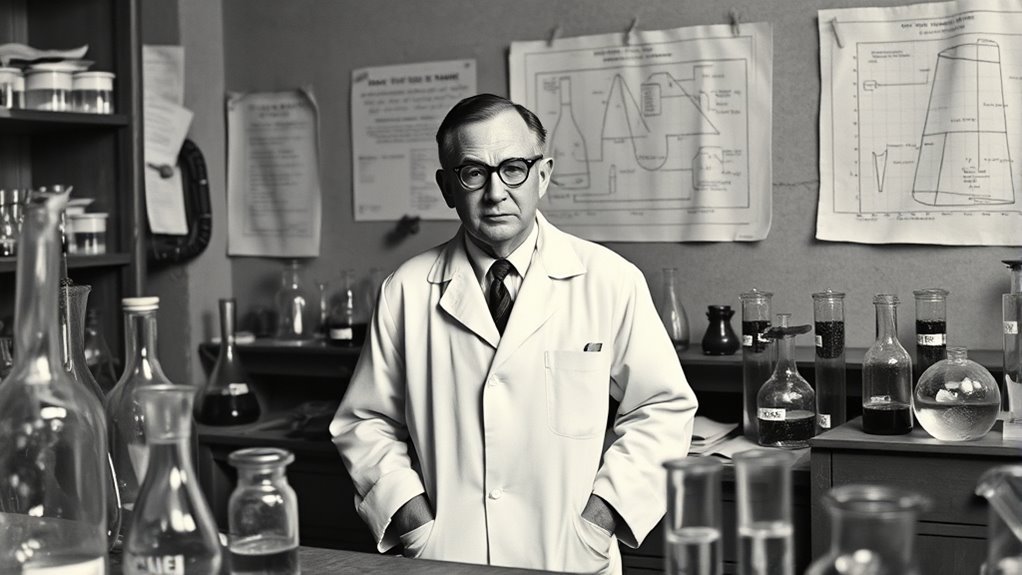

Wallace Carothers revolutionized material science by pioneering the development of nylon, the first successful synthetic fiber that transformed industries globally. He focused on creating polymers with tailored properties, replacing natural fibers like cotton and silk. His innovations included manipulating molecular structures and optimizing synthesis processes. Nylon’s lightweight, strong, and elastic qualities changed textiles, industrial uses, and consumer products. To discover how his groundbreaking work laid the foundation for modern polymers, keep exploring his influential contributions.
Key Takeaways
- Wallace Carothers pioneered the development of synthetic polymers, leading to the invention of nylon in 1935.
- His research focused on creating strong, durable polymers suitable for fiber spinning applications.
- Nylon was the first commercially successful synthetic fiber, revolutionizing textiles and industrial uses.
- Carothers’s molecular innovations enabled precise control over polymer properties, enhancing performance.
- His work laid the foundation for the modern synthetic fiber industry, transforming material manufacturing worldwide.

Wallace Carothers played a pivotal role in transforming the world of materials with his groundbreaking work on synthetic polymers, leading to the invention of nylon. His contributions mark a turning point in polymer chemistry, opening the door to a new era of synthetic fibers that revolutionized industries worldwide. Before Carothers’s innovations, natural fibers like cotton, silk, and wool dominated textiles. But he explored the science of polymer chemistry, understanding how molecules could be combined to create new, durable materials. His focus was on developing polymers that could be spun into fibers, which would be lightweight, strong, and versatile. This pursuit led him to synthesize complex polymers through chemical reactions, laying the foundation for synthetic fibers that could replace natural ones in countless applications.
Wallace Carothers revolutionized textiles with synthetic polymers, pioneering nylon and transforming industries worldwide.
Carothers’s expertise in polymer chemistry allowed him to manipulate molecular structures precisely, enabling the creation of polymers with specific properties. He studied how different monomers linked together, optimizing conditions to produce long, stable chains. His work on polyamides and polyesters demonstrated that synthetic polymers could possess strength, elasticity, and resistance to wear—traits essential for fibers used in textiles, industrial products, and even military applications. These synthetic fibers, which he pioneered, could be manufactured consistently and at scale, providing a reliable alternative to natural fibers that were often limited by availability or cost. Advances in polymer synthesis unlocked the potential for creating fibers with tailored characteristics that met the demands of various industries.
As you explore the history of nylon, you’ll see that Carothers’s innovations were driven by a desire to improve upon existing materials. His deep understanding of polymer chemistry enabled him to design molecules that could be spun into fibers with remarkable qualities. Nylon, the first commercially successful synthetic fiber, exemplifies this achievement. It’s lightweight, elastic, and resistant to damage, making it ideal for clothing, ropes, and countless other uses. Carothers’s work proved that synthetic fibers could outperform natural ones in many respects, transforming industries from fashion to aerospace.
Ultimately, Carothers’s pioneering efforts in polymer chemistry and synthetic fibers laid the groundwork for the multi-billion dollar industry of synthetic textiles we know today. His scientific insights changed how materials are made, offering new possibilities for innovation and durability. When you think about nylon’s widespread use, you’re witnessing the impact of Carothers’s genius—a scientist who harnessed chemistry to create materials that continue to shape your everyday life.

Rit DyeMore Single Bottle 7 Oz. Synthetic Liquid Fiber Dye for Clothing, Décor, and Crafts – Chocolate Brown
- Eco-Friendly Dyeing: Rejuvenate old clothes and fabrics
- Wide Compatibility: Suitable for polyester, acrylic, acetate
- Versatile Use: Ideal for clothing, décor, crafts
As an affiliate, we earn on qualifying purchases.
As an affiliate, we earn on qualifying purchases.
Frequently Asked Questions
What Inspired Wallace Carothers to Pursue Polymer Chemistry?
You’re curious about what inspired Wallace Carothers to pursue polymer chemistry. He was driven by the desire to develop synthetic fibers that could revolutionize textiles, providing stronger, lighter, and more versatile materials. His passion for chemical innovation pushed him to explore new possibilities in polymers. Carothers aimed to create groundbreaking materials that would meet industry needs and advance science, ultimately leading to the invention of nylon.
How Did Carothers’ Background Influence His Scientific Research?
Your background greatly shaped your scientific pursuits. Family influences fostered your fascination with chemistry, encouraging curiosity and creativity. Your educational background, especially your studies in chemistry and advanced degrees, provided a solid foundation for innovation. Alliteration highlights how your upbringing and academic experiences combined to cultivate your curiosity, fueling your focus on polymer chemistry. This blend of family and education helped you pioneer groundbreaking materials like nylon, transforming modern industry.
What Challenges Did Carothers Face During Nylon Development?
You face several challenges during nylon development, including limited research funding and technological limitations of the time. These issues slow down experimentation and make it harder to access advanced equipment. You also encounter setbacks in achieving the desired polymer properties, requiring persistent effort. Despite these obstacles, your determination pushes you forward, ultimately leading to breakthroughs that revolutionize materials science and create one of the most important synthetic fibers.
Are There Any Personal Anecdotes About Carothers’ Work Ethic?
Imagine a relentless storm of dedication guiding your every move—that’s how Carothers’ work ethic stories reveal his unwavering drive. His personal motivation fueled long nights and tireless experiments, often at the expense of leisure. His passion for discovery burned brighter than any obstacle, inspiring those around him. Carothers’ dedication wasn’t just about science; it was about transforming dreams into reality through sheer perseverance and unwavering commitment.
How Did Carothers’ Discoveries Impact Modern Materials Science?
Your understanding of Carothers’ work shows how his discoveries revolutionized modern materials science. His development of synthetic fibers like nylon paved the way for material innovation, impacting industries such as textiles, automotive, and aerospace. You see how his pioneering efforts continue to influence new polymers and fibers, driving advancements that make products stronger, lighter, and more versatile. His legacy fuels ongoing research, shaping the future of innovative materials you encounter daily.
Conclusion
You see how Wallace Carothers revolutionized the world with nylon, transforming everyday life and inspiring future innovations. You witness the power of curiosity, perseverance, and invention working together to create something extraordinary. You realize that through dedication and discovery, you too can make a lasting impact. Embrace the spirit of innovation, chase your passions, and remember that with determination, you can turn ideas into history just like Carothers did with nylon.