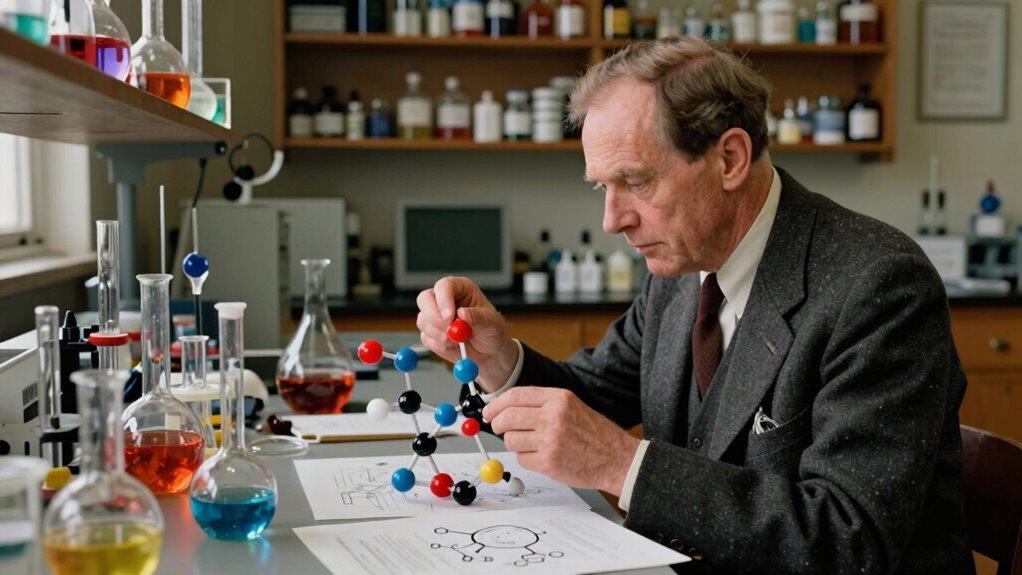

Robert Burns Woodward revolutionized organic chemistry by pioneering the art of total synthesis, demonstrating how complex natural compounds can be systematically recreated in the lab. You see, he broke down complicated molecules into manageable fragments and developed innovative, strategic reactions to piece them back together. His work pushed chemical boundaries and introduced new techniques that became standards in the field. If you explore further, you’ll discover how his creative and rigorous approach continues to shape modern synthesis strategies.

Get school and study supplies delivered free — and shop member deals
- Fast, free delivery on millions of items
- Access to Prime Big Deal Days deals on October 6–7
- Prime Video, Amazon Music and more included
Key Takeaways
- Robert Burns Woodward pioneered total synthesis by strategically assembling complex natural molecules from simpler fragments.
- He introduced innovative reactions and methodologies that became foundational in organic chemistry.
- Woodward’s approach emphasized understanding molecular reactivity and predicting chemical behavior for efficient synthesis.
- His work enabled the creation of vital compounds like quinine, vitamin B12, and cortisone in the lab.
- His legacy lies in combining scientific rigor and creativity, inspiring modern synthetic strategies and chemical innovation.

Have you ever wondered how chemists can recreate complex natural compounds in the lab? It’s a fascinating process that relies on sophisticated synthesis strategies and bold chemical innovation. Robert Burns Woodward, a pioneer in organic chemistry, mastered these techniques, transforming the way we understand and produce natural products. His work demonstrated that, with the right approach, even the most intricate molecules could be assembled piece by piece in a controlled environment. This wasn’t just about copying nature; it was about understanding the underlying principles that govern molecular construction and applying them to synthetic routes.
Woodward’s approach to total synthesis involved meticulous planning and strategic sequencing of reactions. He broke down complex molecules into simpler, more manageable fragments, which he then assembled step-by-step. This method required an intimate knowledge of chemical reactivity and the ability to predict how different compounds would behave during synthesis. His innovations often pushed the boundaries of what was thought possible, introducing new reactions and techniques that became staples in organic chemistry. These synthesis strategies allowed him to achieve total synthesis of natural compounds such as quinine, vitamin B12, and cortisone—milestones that proved the power of chemical innovation. His work also emphasized the importance of predictive chemistry in designing efficient synthetic routes. Additionally, his pioneering techniques laid the groundwork for modern synthetic methodologies used throughout the field today. Moreover, his contributions underscored the significance of molecular understanding in advancing chemical synthesis.
Through his work, Woodward showed that total synthesis wasn’t just an academic exercise but a practical tool for understanding biological activity and creating new drugs. His mastery of synthesis strategies enabled him to construct molecules that closely mimicked their natural counterparts, providing insights into their function. This precision opened doors for pharmaceutical development, leading to breakthroughs in medicine. His approach combined creativity with rigorous scientific methodology, illustrating how chemical innovation could unlock nature’s secrets. Furthermore, his legacy continues to inspire chemists to explore new synthetic techniques and push the boundaries of what is chemically possible.
As an affiliate, we earn on qualifying purchases.
Frequently Asked Questions
What Inspired Robert Woodward to Pursue Chemical Synthesis?
You’re inspired by historical influences and personal motivations to pursue chemical synthesis. Robert Woodward’s fascination with complex natural products and the challenge they present sparked your interest. You admire how his innovative approaches transformed organic chemistry. His passion for discovery and desire to understand molecular structures motivated you to explore total synthesis. Ultimately, the blend of scientific curiosity and admiration for pioneering chemists like Woodward fuels your dedication to this field.
How Did Woodward’s Work Influence Modern Pharmaceutical Development?
Your work profoundly influenced modern pharmaceutical development by advancing synthetic methodology and tackling molecular complexity. You enabled chemists to create complex molecules more efficiently, leading to the development of new drugs. By mastering total synthesis, you opened pathways for designing medications with precise structures. This progress has made pharmaceuticals more effective and accessible, shaping the future of medicine through innovative chemical processes and a deeper understanding of molecular intricacies.
What Challenges Did Woodward Face During Complex Syntheses?
You face challenges like synthetic complexity and experimental obstacles when tackling complex syntheses. Woodward encountered these issues as he worked to replicate intricate natural products, often dealing with unpredictable reactions and low yields. His perseverance and innovative strategies allowed him to overcome these hurdles, pushing the boundaries of organic chemistry. By methodically solving these problems, you can develop efficient pathways, making complex molecules more accessible for scientific and medicinal advances.
Which of Woodward’s Projects Was Considered Most Groundbreaking?
You’ll find that Woodward’s most groundbreaking project was the total synthesis of quinine. He used innovative strategies and precise chemical techniques, which led to significant chemical breakthroughs. His work not only demonstrated the power of meticulous planning but also pushed the boundaries of organic synthesis. This achievement revolutionized how chemists approach complex natural products, showcasing his mastery and pioneering spirit in the field of total synthesis.
How Did Woodward’s Teaching Impact Future Generations of Chemists?
Your journey in chemistry is like a river fed by Woodward’s innovative teaching, shaping countless future chemists. His mentorship legacy flows through generations, inspiring new ideas and breakthroughs. His engaging methods didn’t just teach reactions; they ignited passion and curiosity. You benefit from his influence, carrying forward his spirit of discovery. Woodward’s impact is a beacon, guiding your path and those who follow in the relentless pursuit of chemical mastery.
Conclusion
So, next time you marvel at a complex molecule, remember Robert Burns Woodward’s genius—he didn’t just dream it, he built it from scratch. His mastery in total synthesis turned chemistry into an art form, proving that with enough wit and perseverance, you can tame even the most elusive compounds. Who knew that a little bit of madness and a lot of patience could uncover nature’s greatest secrets? Now, go ahead, impress your friends with your newfound appreciation—synthesized, of course.
Fall Picks
fall essentials
As an affiliate, we earn on qualifying purchases.