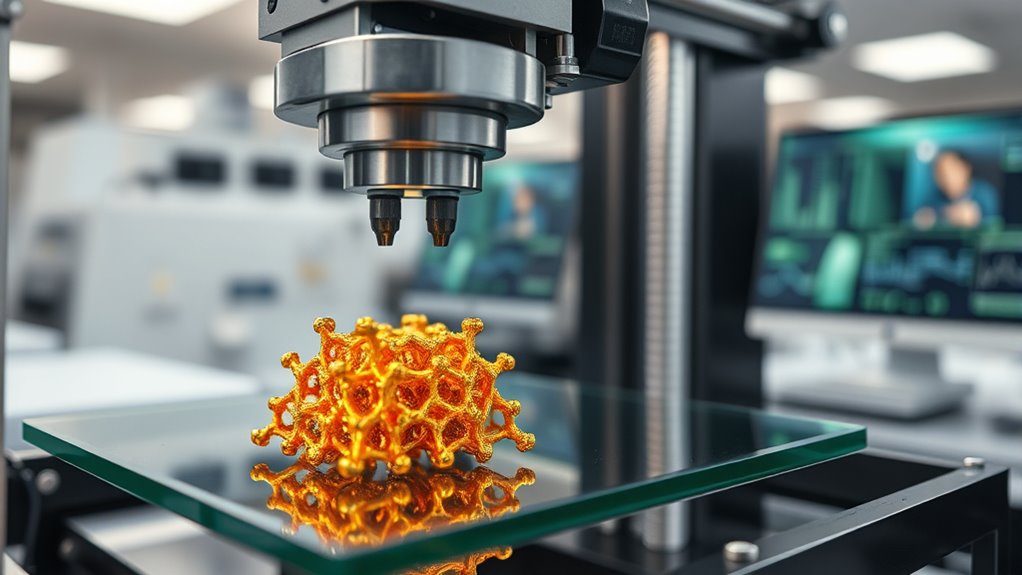

3D printing is transforming catalyst production by allowing you to create complex, customized structures quickly and cost-effectively. You can design intricate geometries that improve surface area, flow, and efficiency, all with precise control over internal features. This method reduces waste and energy use, making the process more sustainable. If you keep exploring, you’ll discover how these innovations lead to better, more adaptable catalysts that can revolutionize various chemical processes.
Key Takeaways
- Enables rapid, cost-effective production of complex catalyst geometries, reducing reliance on molds and machining.
- Allows design customization to optimize surface area, flow dynamics, and overall catalytic efficiency.
- Facilitates internal microchannels and intricate structures that improve reactant flow and mass transfer.
- Supports material integration and multifunctional catalysts within a single additive-manufactured structure.
- Promotes sustainable manufacturing by minimizing waste, reducing energy use, and enabling quick design iterations.

3-D printing is revolutionizing catalyst production by enabling manufacturers to create complex, customized designs quickly and cost-effectively. This transformative technology, known as additive manufacturing, allows you to build intricate catalyst structures layer by layer, eliminating many limitations of traditional manufacturing methods. Instead of relying on costly molds or extensive machining, you can now design highly specific geometries tailored to your application, reducing both material waste and production time.
This flexibility opens up new possibilities for optimizing catalyst performance, as you can experiment with novel structures that enhance surface area, improve flow dynamics, and increase efficiency. Additionally, the ability to produce complex internal features** enables the creation of microchannels and internal architectures that optimize reactant flow and catalyst contact, further boosting performance. These internal geometries can also be designed to facilitate material integration, allowing for multifunctional catalysts** with combined properties.
With additive manufacturing, precision fabrication becomes more accessible than ever. You can produce catalysts with micron-level accuracy, ensuring each component meets exact specifications. This high degree of precision means better control over pore sizes, surface textures, and overall architecture, which directly impacts catalytic activity.
As a result, you gain the ability to fine-tune catalysts for particular reactions or processes, leading to more effective and efficient outcomes. The customization potential also allows for rapid prototyping—testing new designs without the lengthy lead times associated with traditional methods—so you can iterate quickly and bring innovations to market faster.
Another key advantage of 3-D printing in catalyst production is its capability to create complex internal features that are impossible to manufacture through conventional means. For example, you can incorporate channels and microstructures within the catalyst body to enhance mass transfer, improve reactant access, and reduce pressure drops. These internal geometries can be precisely controlled to optimize performance for specific chemical processes, making your catalysts more efficient and durable.
Additionally, additive manufacturing enables you to combine different materials within a single structure, creating multifunctional catalysts that can perform multiple roles simultaneously, further expanding the scope of chemical reactions you can facilitate.
Furthermore, 3-D printing reduces the environmental impact by minimizing waste and energy consumption during production. Since you build catalysts layer by layer, only the necessary material is used, unlike subtractive methods that carve away excess. This sustainability benefit, combined with the ability to rapidly adapt designs, positions additive manufacturing as a game-changer for catalyst development.
As you continue to explore and implement this technology, you’ll find that it not only accelerates innovation but also enhances your capacity to create highly specialized, efficient catalysts tailored precisely to your needs.

AeroDash 3D Printed Walking Shoes for Men – Lightweight Breathable Lattice Sneakers, Quick-Dry & Non-Slip, Flexible Athletic Footwear for Travel, Beach & Workout (White, US Footwear Size System, Adult, Men, Numeric, Wide, 8.5)
- Seamless 3D-Printed Construction: Lightweight, glue-free, barefoot-friendly fit
- Ultra-Lightweight & Rebound: Reduces fatigue with energy-returning design
- Breathable & Quick-Dry Lattice: Keeps feet cool, dry, and odor-free
As an affiliate, we earn on qualifying purchases.
As an affiliate, we earn on qualifying purchases.
Frequently Asked Questions
How Does 3-D Printing Improve Catalyst Customization?
You can achieve precise tuning of catalysts with 3-D printing by customizing their design to fit specific reactions. It enables rapid prototyping, so you test different structures quickly, optimizing performance faster than traditional methods.
This technology allows you to create complex geometries and tailored surface areas, enhancing efficiency and selectivity. Overall, 3-D printing empowers you to refine catalysts more efficiently, tailoring them precisely to your process needs.
What Materials Are Used in 3-D Printed Catalysts?
Did you know that 3D-printed catalysts can reduce production costs by up to 50%?
You’ll find that materials like advanced nanoparticles, which are synthesized through precise nanoparticle synthesis techniques, are key. Binder materials, often polymers or ceramics, help hold the structure together.
These innovative materials enable you to create highly customized catalysts tailored for specific reactions, revolutionizing efficiency and sustainability in industrial processes.
Are 3-D Printed Catalysts More Cost-Effective Long-Term?
You’ll find that 3D-printed catalysts offer significant cost savings over time thanks to their scalability and customization. They reduce material waste and allow rapid production of complex designs, which lowers manufacturing costs.
As you scale up production, these catalysts become more economical, making them a smart long-term investment. This flexibility can streamline your processes and improve efficiency, ultimately leading to sustained cost benefits in catalyst manufacturing.
How Does 3-D Printing Impact Catalyst Lifespan?
You might think catalysts last forever, but 3-D printing actually revolutionizes their lifespan. By customizing structures, you enhance catalyst stability and reduce surface erosion, making them more durable than ever.
This precise control means your catalysts can withstand extreme conditions longer, dramatically extending their functional life. So, instead of worrying about premature wear, you benefit from 3-D printed catalysts that stay effective and stable, revolutionizing efficiency and reducing replacement costs.
Can 3-D Printing Enable On-Demand Catalyst Production?
You can see that 3D printing enables on-demand catalyst production, allowing you to quickly respond to needs without traditional manufacturing delays.
However, scalability challenges might arise as you try to produce larger quantities efficiently.
Additionally, regulatory hurdles could slow your progress, since ensuring safety and compliance becomes more complex with 3D-printed catalysts.
Despite these obstacles, on-demand production becomes more feasible, offering flexibility and customization for your catalyst needs.
Conclusion
As you embrace 3D printing, you’re on the brink of revolutionizing catalyst production like never before—this technology isn’t just changing the game; it’s rewriting the entire playbook. With the ability to create complex, custom designs instantly, you could see innovation happen faster than you ever imagined. The future of catalysts is now in your hands, and it’s so groundbreaking, it might just make traditional methods seem like ancient history. Get ready to lead the charge into this exciting new era.