
TL;DR
Prebuilt AI workstations now often cost as much as DIY builds due to component shortages and bulk buying. The decision depends on your time, expertise, and need for support versus control and customization.
You need an AI workstation. Do you build it yourself, or buy one ready-made? That question used to be simple: build for cheaper, buy for convenience. But today, the lines blur. In 2026, the real decision hinges on more than just price — it’s about time to deploy, control over your hardware, and how much support you want.
This isn’t just about saving a few bucks. It’s about whether you’re up for the challenge of tuning your machine, or if you prefer a factory-validated rig that’s ready to run. Let’s unpack what matters most in this high-stakes choice.
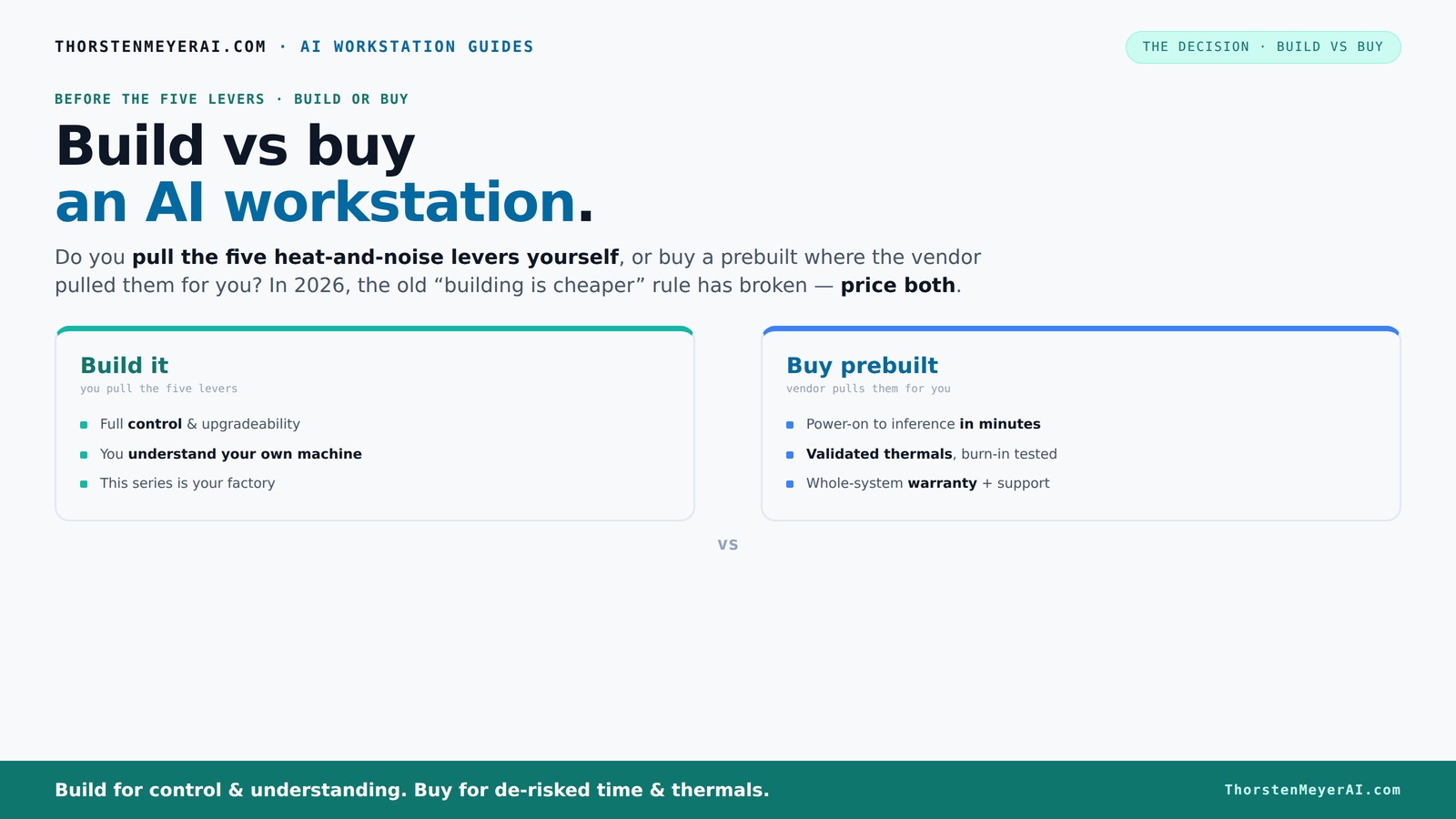
Build vs buy
an AI workstation.
The real question behind this whole series: do you pull the five heat-and-noise levers yourself, or buy a prebuilt where the vendor pulled them for you? And in 2026, the old “building is cheaper” rule has broken. Match your situation in Part 3.
Key Takeaways
- In 2026, prebuilt AI workstations often match or beat DIY costs due to component shortages and bulk buying.
- Thermal management is a key factor — prebuilts handle it for you, while DIY lets you customize for quieter, cooler operation.
- Choose a prebuilt if you want quick deployment, validated thermals, and warranty support. Build if you want control and upgrade flexibility.
- Prioritize GPU VRAM and cooling for AI workloads. A GPU with 16-24GB VRAM is ideal for most inference and training tasks.
- Always price both options today — don’t assume DIY is cheaper anymore.

WIWB Gaming PC Desktop Core I9-14900HX, GeForce RTX 5060 Ti 8G, 16G DDR5 RAM, 1TB NVME SSD, WiFi 6, 4K 8K High-End Prebuilt PC Computer Tower for Streaming, Video Editing & Workstation Use (Black)
- Powerful Processor: Intel Core i9-14900HX with 24 Cores
- High-Performance Graphics: GeForce RTX 5060 Ti 8GB GDDR7
- Fast Memory & Storage: 16GB DDR5 RAM and 1TB NVMe SSD
As an affiliate, we earn on qualifying purchases.
As an affiliate, we earn on qualifying purchases.
Why the old rule 'Build is Cheaper' No Longer Holds in 2026
In the past, building your own AI workstation was the clear money-saver. Components like GPUs and RAM used to be cheaper when bought separately, and DIY was the way to go for maximum bang for your buck.
Today, supply chain snarls and bulk purchasing by prebuilt vendors have flipped that script. For example, a high-end GPU like the NVIDIA RTX 4090, which used to cost around $1,600, now often sells for near retail or above on the secondhand market. Meanwhile, prebuilt systems from companies like Lambda or BIZON bundle these parts at prices that sometimes beat what you’d pay piecemeal.
The result? A build that used to cost under $2,000 now often exceeds that, especially once you factor in OS licenses, assembly, and testing. This shift is significant because it challenges the traditional view that DIY always saves money. It implies that for many users, the cost advantage of building is diminishing, especially at high-end specs where component scarcity and vendor discounts influence pricing. This makes prebuilt systems more attractive not just for convenience but also for potential cost savings, provided you compare current prices carefully.
Who Pulls the Levers? Building vs Buying in 2026
Building or buying boils down to who pulls the five levers of thermal and noise management: undervolting GPUs, matching coolers, optimizing airflow, tuning fans, and strategic placement.
Buy a prebuilt—the vendor pulls these levers. They run extensive tests, validate thermals, and often include water-cooling or noise-reduction tech. Think of it as a factory tune-up, ready for your AI workload. This means you get a system that’s optimized for stability and longevity, often with warranty support, reducing your risk of thermal throttling or hardware failure during intensive tasks.
Build it yourself — you’re the one pulling those levers. You select a quiet GPU, like the RTX A6000, undervolt it using tools like MSI Afterburner, choose a case with sound-dampening panels, set up custom fan curves, and position your machine for optimal airflow. This process allows you to tailor thermal and acoustic performance precisely to your needs, potentially reducing noise and heat, which can extend hardware lifespan and improve performance consistency. However, it requires a deeper understanding of hardware and more time investment. The tradeoff is control versus convenience: prebuilt systems handle it for you, while DIY builds empower you to optimize based on your specific environment and workload.
For example, if you’re running large models like GPT-4 inference locally, thermal management is critical. A prebuilt might guarantee no thermal throttling, but a DIY build lets you tweak until it’s whisper-quiet, even during prolonged workloads. This deep level of tuning can be the difference between a system that performs reliably under load and one that throttles or overheats, impacting productivity and system lifespan.
Cost, Performance, and Reliability — The Showdown
Here’s a quick comparison table to make things clear:
| Aspect | Build Your Own | Prebuilt |
|---|---|---|
| Cost | Often cheaper upfront, but depends on your time and effort | Can be comparable or even cheaper due to bulk buying, especially for high-end configs |
| Performance | You control parts, tuning, and cooling; potential for max optimization | Factory-validated, often with advanced cooling tech, ready to run at peak |
| Reliability | Depends on your assembly skills and component quality | Validated at the factory, includes warranty and support |
| Upgradeability | Usually easier, with standard parts and open layouts | Varies; some OEMs use proprietary parts that complicate upgrades |
Choosing between the two involves understanding these tradeoffs. Building offers the flexibility to select specific components, customize cooling, and optimize performance at a granular level, which can be crucial for specialized workloads. However, it also requires technical skill and time to ensure stability and compatibility. Prebuilts, on the other hand, provide a hassle-free experience with validated configurations, warranties, and support, which can be invaluable for reducing downtime and troubleshooting. The decision hinges on your priorities: do you value control and customization, or convenience and support?
The Core Components That Make or Break Your AI Workstation
When choosing between build or buy, focus on these core components:
- GPU: The heart of AI workloads. For large models or training, you want at least an RTX 4080 or better, with 16-24GB VRAM. The GPU’s performance and VRAM capacity directly influence training speed, inference latency, and the size of models you can handle. Investing in a high-end GPU ensures your system can scale with your projects.
- VRAM: More VRAM means larger models and bigger batch sizes. 24GB is ideal for top-tier inference or fine-tuning. Insufficient VRAM can force you to split models or reduce batch sizes, which hampers efficiency and increases complexity. Therefore, prioritizing VRAM is crucial for smooth workflows, especially as models grow in size.
- System RAM: 64GB is a good starting point for data loading and multitasking; 128GB if you’re doing serious training. Adequate RAM prevents bottlenecks during large data transfers or multiple concurrent tasks, ensuring your CPU and GPU can operate at full capacity without waiting for data.
- Storage: NVMe SSDs with 2TB or more ensure fast dataset loading and checkpoint saving. Fast storage reduces training and inference times, especially when working with large datasets or frequent model checkpoints. It also improves overall system responsiveness, making your workflow smoother.
- Cooling & Power: High-quality PSUs and quiet cooling solutions prevent throttling and noise, especially during long runs. Good cooling maintains consistent performance, prolongs hardware lifespan, and reduces noise pollution in your workspace. Check out this guide for cooling tips. Balancing power supply capacity with energy efficiency and thermal management is essential for stable, reliable operation over time.
Which Type of User Should Build or Buy?
If you’re a researcher, developer, or hobbyist with time and technical skill, building your own machine gives you ultimate control and upgrade flexibility. It allows you to tailor every aspect—from cooling solutions to component selection—ensuring the system perfectly matches your workload. This can lead to better performance tuning, cost savings in the long run, and a deeper understanding of your hardware setup.
On the other hand, if you’re a busy professional or part of a team that needs a reliable, supported system ready to run from day one, a prebuilt system saves time and reduces risk. It comes with validated thermals, warranty support, and often optimized configurations that are tested for stability under heavy loads. This reduces the chances of hardware failures or thermal issues that could cause costly downtime. For example, startups rapidly deploying models or teams with limited hardware expertise benefit from prebuilts’ plug-and-play nature, while AI researchers with deep hardware knowledge may prefer custom builds to fine-tune every aspect for maximum efficiency.
FAQs About Building or Buying Your AI Workstation
Is a prebuilt AI workstation worth it? Yes, if you want quick setup, validated thermals, and support. It’s especially valuable for teams where downtime costs money. Prebuilts reduce the complexity of assembly and testing, allowing you to focus on your AI tasks instead of hardware troubleshooting.
Is it cheaper to build my own AI workstation? Not always. Due to current component shortages and bulk buying, prebuilts often match or beat DIY prices, especially at high-end specs. Additionally, consider the value of your time and potential troubleshooting—sometimes, the hidden costs of building can outweigh savings.
What GPU do I need for AI workloads? For most inference tasks, a GPU with at least 16GB VRAM like the RTX 4080 works well. For training large models, consider the RTX A6000 or similar with higher VRAM to handle bigger datasets and models efficiently.
How much VRAM do I need? For models like GPT-3 or Stable Diffusion, 16-24GB VRAM is a good baseline. More VRAM enables handling larger models, bigger batch sizes, and reduces the need for model splitting or frequent data transfers, which can bottleneck performance.
Should I prioritize GPU, CPU, or storage? For AI workloads, the GPU is the most critical component. Prioritize VRAM capacity and fast NVMe SSDs for data transfer and model loading. CPU matters less unless your workflow involves heavy data preprocessing or multitasking. Balancing these components based on your workload will optimize performance and cost-effectiveness.
Frequently Asked Questions
Is a prebuilt AI workstation worth it?
Absolutely, if you need a system that works out of the box with validated thermals and support. It minimizes downtime and lets you focus on your AI tasks, not hardware troubleshooting.
Is it cheaper to build my own AI workstation?
Not always. In 2026, component shortages and bulk buying often make prebuilts just as affordable or cheaper for high-end configurations, especially when you consider your time and troubleshooting costs.
What GPU do I need for AI workloads?
A GPU with at least 16GB VRAM like the RTX 4080 suits most inference tasks. For training large models, consider options like the RTX A6000 with 48GB VRAM for best performance.
How much VRAM do I need?
For models like GPT-3, 16-24GB VRAM is a solid baseline. More VRAM supports larger models, bigger batch sizes, and reduces the need for frequent model splitting.
Should I prioritize GPU, CPU, or storage first?
The GPU is the most critical for AI workloads. Next, focus on VRAM capacity and fast NVMe SSDs for data transfer. CPU matters less unless your workflow involves heavy preprocessing.
Conclusion
The real decision isn’t just about price — it’s about what you value most: quick, supported deployment or complete control and customization. In 2026, the best choice depends on your workload, skills, and how you plan to grow.
If you’re looking for a machine that’s ready to go, a prebuilt offers validated performance and support. Want to tinker, upgrade, and learn? Building your own still makes sense — just be ready to invest more of your time and effort.