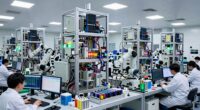
As microelectronics advance, labs are upgrading to ultra-pure standards by tightening cleanroom protocols, refining equipment calibration, and enhancing contamination prevention. You’ll need to follow strict gowning procedures, maintain rigorous environmental controls, and schedule regular cleaning to prevent particles from compromising device quality. Ensuring these standards are met helps achieve higher performance and reliability. Staying current with these changes is essential—you’ll discover key strategies to enhance your lab’s cleanroom environment and meet new industry demands.
Key Takeaways
- Labs are implementing stricter cleanroom protocols to prevent contamination as microelectronics demand higher purity levels.
- Equipment calibration is becoming more precise to meet tighter tolerance requirements for advanced chip fabrication.
- Enhanced air filtration and environmental controls are critical to maintain ultra-pure conditions in manufacturing environments.
- Routine cleaning and strict personnel gowning procedures are enforced to minimize particulate and impurity ingress.
- Continuous monitoring and rapid response systems are deployed to detect and correct deviations from ultra-pure standards.

Advancements in microelectronics are transforming the way we live and work, enabling faster, smaller, and more efficient devices. As these innovations push the boundaries of technology, the environments where microchips are developed and manufactured must meet increasingly strict standards. You’ll find that strict cleanroom protocols are now essential to maintain the ultra‑pure conditions needed for fabricating high-performance chips. Every step involves meticulous control of airborne particles, humidity, and temperature to prevent contamination. You’re responsible for guaranteeing that all personnel follow gowning procedures and that equipment is properly maintained to uphold these standards. Any lapse could introduce particles or impurities that compromise device performance or yield.
Equipment calibration becomes even more critical as tolerances tighten. You need to regularly verify and calibrate tools such as photolithography machines, etching systems, and deposition equipment to guarantee they operate within specified parameters. Precise calibration doesn’t just improve results; it’s a safeguard against costly defects. When calibrating, you check for minute deviations and fine-tune equipment to match exact specifications. This process demands attention to detail and consistency, as even slight inaccuracies can ripple through the manufacturing process, affecting the functionality of microelectronic components. Calibration procedures are fundamental to maintaining the integrity of the entire manufacturing process.
In these ultra-pure environments, maintaining rigorous cleanroom protocols helps you prevent contamination that could lead to device failure. You must be vigilant about gowning procedures, air filtration systems, and surface cleanliness. Regular cleaning schedules, proper material handling, and strict access controls become routine parts of your workflow, helping to keep the environment as pristine as possible. You’re also tasked with monitoring environmental parameters continuously, recording data, and responding swiftly to any deviations from set standards. This proactive management is essential for ensuring the reliability of the chips being produced.
As microelectronics continue to evolve, the demands for cleanroom discipline and equipment calibration grow more stringent. You play an indispensable role in upholding these standards, knowing that the slightest oversight could impact the entire production line. Your attention to detail ensures that the microchips meet the high-quality benchmarks required for modern electronics. Ultimately, these upgrades aren’t just about conforming to regulations—they’re about pushing the limits of what’s possible while safeguarding the integrity of every device that relies on your precision. Your efforts help deliver faster, smaller, and more efficient technologies that shape the future.
As an affiliate, we earn on qualifying purchases.
Frequently Asked Questions
How Do Ultra-Pure Environments Impact Microelectronics Manufacturing Costs?
Ultra-pure environments increase your microelectronics manufacturing costs because you need advanced contamination control measures and specialized equipment. These environments demand strict cost management to prevent contamination, which can ruin expensive chips. You’ll spend more on cleanroom facilities, filters, and ongoing maintenance. However, maintaining these ultra-pure standards guarantees higher quality and reliability, ultimately saving you money by reducing defects and rework, making the investment worthwhile.
What New Safety Protocols Are Necessary for Ultra-Pure Lab Environments?
Like a vigilant sentinel guarding a fortress, you need strict safety procedures in ultra-pure labs. Implement contamination control measures such as air filtration and gowning protocols. Regularly train staff on handling materials safely, maintain equipment meticulously, and enforce strict entry controls. These steps help prevent contamination, ensuring product integrity and safety for everyone. Staying proactive and vigilant keeps the environment secure and up to standard, just like a fortress protecting its treasures.
How Does Ultra-Pure Technology Affect Device Performance and Longevity?
You’ll notice that ultra-pure technology greatly boosts device reliability and lifespan by minimizing impurities that cause corrosion or malfunction. Precise impurity control ensures cleaner, more consistent performance, reducing failures over time. This means your devices operate smoother and last longer, thanks to the strict environment that keeps contaminant levels extremely low. Overall, adopting ultra-pure methods directly enhances device durability, delivering better performance and longer-term value.
Are There Specific Materials That Become More Viable With Increased Purity?
With increased purity, materials like gallium arsenide and silicon carbide become more viable due to their improved chemical compatibility. You’ll find that ultra-pure environments enable better material selection, reducing contamination risks. This enhances device performance and longevity, especially for sensitive components. By choosing materials that thrive in ultra-pure conditions, you optimize your lab processes and guarantee reliable, high-quality microelectronic devices.
What Training Is Required for Personnel Working in Ultra-Pure Microelectronics Labs?
Ever wondered what it takes to work safely in ultra-pure microelectronics labs? You need specialized training in cleanroom protocols and contamination control to minimize particles and impurities. This includes understanding gowning procedures, equipment handling, and environmental monitoring. You’ll also learn best practices for maintaining ultra-clean conditions, ensuring that your work doesn’t compromise material purity. Proper training is essential to protect both the products and the integrity of the research.
Conclusion
As you navigate these delicate shifts in microelectronics, imagine stepping into a pristine laboratory where every molecule whispers purity. These upgrades aren’t just technical tweaks—they’re gentle evolutions, refining the very fabric of innovation. With each subtle change, you’re guiding technology toward a brighter, more refined horizon, like a craftsman honing a masterpiece. Embrace the quiet transformation, knowing that in this delicate dance, even the smallest upgrade helps shape a cleaner, more luminous future.