For most students, I’d start with the Roaring Spring Chemistry Lab Spiral Notebook: its numbered pages and familiar bound format suit a semester of organized lab records. The BookFactory Carbonless Chemistry Lab Notebook is a stronger fit when you need duplicate records, while the Yeplan Chemistry Lab Notebook with 0.25-inch grid favors students who regularly draw tables or plots. The main tradeoffs are between plain recording space and structured layouts, single-copy simplicity and carbonless duplicates, and portability and writing room. The best chemistry lab notebook for you depends on your course’s recordkeeping rules as much as its page count. Read on for the full comparison and guidance on choosing a format that matches your lab.

Prime made for students and young adults
- Fast, free delivery for dorm and study essentials
- Prime Video and Amazon Music included
- Member-only deals
Key Takeaways
- Numbered pages distinguish the Roaring Spring option: its 120 numbered pages offer a straightforward way to keep a semester’s records in sequence, unlike notebooks described mainly by page count or grid format.
- Carbonless copies serve a different purpose from extra pages: BookFactory and several student-oriented options provide duplicate sets, which help when a lab requires a copy to be submitted or shared.
- Grid layouts are useful for data-heavy work: Yeplan’s 0.25-inch grid and the Tuun Fuplan grid notebook suit students who expect to build tables or sketch graphs by hand.
- Large formats favor workspace over portability: 8.5 x 11-inch notebooks such as the JUBTIC and Yeplan models provide room for extended entries, while the 5.5 x 8.2-inch Science Lab Spiral is easier to carry but more limited for full-page work.
- Similar product names do not mean identical formats: BookFactory and Student Lab Notebook options appear in both 50- and 100-set versions, so buyers should match copy quantity and layout to course requirements rather than choosing by name alone.



| chemistry lab notebooks for student | Binding |
|---|---|
| Yeplan Chemistry Lab Notebook | Hardbound sewn binding |
| Roaring Spring Chemistry Lab S | Spiral bound; center sewn and tape bound |
| JUBTIC Laboratory Notebook for | — |
| BookFactory Carbonless Chemist | Wire-O, spiral-bound |
| Barbakam Lab Notebook | Spiral-bound |
| Student Lab Notebook for Chemi | Not specified |
| Carbonless Lab Notebook with P | Wire-bound |
| Yeplan Chemistry Laboratory No | Perfect bound |
| Student Lab Notebook: Chemistr | Not specified |
| Yeplan Chemistry Laboratory No | Not specified |
| Tuun Fuplan Laboratory Noteboo | Case-bound, lay-flat |
| BookFactory Carbonless Chemist | Wire-O |
| Student Lab Notebook: Chemistr | — |
| Science Lab Spiral Notebook | Spiral |
| Yeplan Carbonless Lab Notebook | Wire-O described; binding type also listed as unknown |
More Details on Our Top Picks
Yeplan Chemistry Lab Notebook, 0.25-Inch Grid
The Yeplan Chemistry Lab Notebook is the strongest fit here for students who regularly draw tables, record measurements, or show calculations directly in their notes. Its 0.25-inch grid gives those entries a consistent structure, while numbered pages make it easier to reference work later. At 8 7/8 by 11 1/4 inches, it offers more working area than the smaller Roaring Spring notebook, though it will take up more space in a backpack. The sewn hardbound cover is a practical advantage for a notebook expected to travel between class and lab, and the paper is designed to limit ink bleed-through. The tradeoff is that it has 96 pages and no duplicate-copy system, so students who need removable records should look to BookFactory instead.
Pros:- Numbered 0.25-inch grid pages support organized calculations and experiment data.
- Hardbound faux leather cover is suited to frequent transport and handling.
- Thick paper is designed to reduce ink bleed-through.
- Large page area leaves room for tables, diagrams, and written observations.
Cons:- Its larger dimensions are less convenient to carry than the Roaring Spring notebook.
- The 96-page count is lower than Roaring Spring’s 120 numbered pages.
- It does not provide carbonless duplicate copies.
Best for: Chemistry students who need a durable, roomy notebook for calculations, data tables, and sequentially referenced experiments.
Not ideal for: Students who must submit duplicate records or prefer narrow-ruled pages for mostly written notes.
- Brand:Yeplan
- Format:0.25-inch grid
- Pages:96
- Dimensions:8 7/8 x 11 1/4 inches
- Cover material:Faux leather
- Binding:Hardbound sewn binding
- Color:Blue
Our verdict“Choose Yeplan for a sturdy, spacious grid notebook; pick Roaring Spring for more pages in a smaller format or BookFactory when duplicate records matter.”
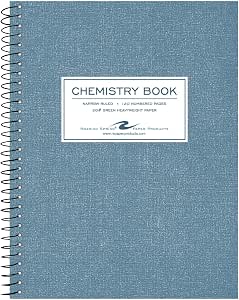
Roaring Spring Chemistry Lab Spiral Notebook, 9.75 x 7.5 Inches, 120 Numbered Pages
For students whose lab records are mainly written observations, the Roaring Spring Chemistry Lab Spiral Notebook offers a more compact alternative to Yeplan’s large grid format. Its 120 numbered pages, narrow ruling, and margin suit dated entries and ongoing class notes, while green-tinted paper with blue lines gives the pages a distinct layout. The 9.75-by-7.5-inch size is easier to carry than the Yeplan hardbound notebook, and the spiral format makes pages easier to turn during a lab session. It is also described as designed for permanent notes, with center-sewn and tape-bound construction. The main compromise is protection: its soft blue cover is less substantial than Yeplan’s hardcover. Its ruled pages are also less suited to drawing data tables than a grid notebook, and it has no carbonless copies like BookFactory.
Pros:- 120 sequentially numbered pages provide more writing space than the Yeplan notebook.
- Compact 9.75 x 7.5-inch format is easier to carry than a full-size lab notebook.
- Narrow ruling and a margin support orderly written entries.
- Spiral binding and sewn, tape-bound construction support frequent page turning and permanent records.
Cons:- Soft-cover construction offers less protection than Yeplan’s hardbound cover.
- Ruled pages are less convenient than grid pages for tables, graphs, and calculations.
- No carbonless copy pages are specified.
Best for: Students who want a portable notebook for sequentially numbered written observations and routine chemistry class notes.
Not ideal for: Students who need a rigid cover, grid pages for frequent calculations, or duplicate copies of lab records.
- Brand:Roaring Spring
- Dimensions:9.75 x 7.5 inches
- Page count:120 numbered pages
- Paper weight:20 lb
- Paper color:Green tinted
- Ruling:Narrow ruled, blue lines with margin
- Binding:Spiral bound; center sewn and tape bound
- Country of origin:USA
Our verdict“Pick Roaring Spring for a portable, higher-page-count notebook centered on written notes, not grid work or duplicate records.”
JUBTIC Laboratory Notebook for Project Organization, 8.5 x 11 Inches
The JUBTIC Laboratory Notebook takes a project-planning approach rather than the more specialized chemistry record format of Yeplan’s grid notebook or BookFactory’s duplicate sets. Its numbered pages and four index pages give students a way to organize dates, objectives, action items, and experiment notes across a longer assignment. The 100 gsm acid-free paper is designed to resist bleed-through, and the pen loop, ribbon bookmark, elastic closure, and expandable pocket add useful organization for carrying loose lab materials. Those extras make it more versatile for coursework, but they do not replace chemistry-specific fields or a defined grid. The large 8.5-by-11-inch size also takes up more bag space than Roaring Spring. Product details conflict on whether the pages are carbonless or carbon-copy, so I would not choose it when duplicate records are a requirement.
Pros:- Numbered pages and four index pages help organize extended projects.
- 100 gsm acid-free paper is designed to limit ink bleed-through.
- Pen loop, ribbon bookmark, elastic closure, and expandable pocket support everyday organization.
- Large page format leaves room for project notes and action items.
Cons:- At 8.5 x 11 inches, it is less portable than the Roaring Spring notebook.
- The description gives conflicting information about carbonless and carbon-copy pages.
- No specific grid ruling or chemistry record fields are listed.
Best for: Students managing semester-long lab projects who want indexed notes, planning fields, and a place for loose reference materials.
Not ideal for: Students who need a confirmed carbonless copy system, chemistry-specific record fields, or a smaller notebook for daily transport.
- Brand:JUBTIC
- Size:8.5 x 11 inches
- Cover:Vegan leather
- Page material:100 gsm acid-free paper
- Index pages:4
- Color:Dark green
- Page organization:Numbered pages
- Additional features:Elastic closure, pen loop, ribbon bookmark, expandable back pocket
Our verdict“Choose JUBTIC for indexed project planning and useful storage extras, but choose BookFactory or Yeplan when a clearly specified chemistry record format matters more.”
BookFactory Carbonless Chemistry Lab Notebook, 100 Sets
When a student needs a retained original and a copy to hand in or share, the BookFactory Carbonless Chemistry Lab Notebook is the clearest choice in this group. Each of its 100 numbered sets pairs an original with a perforated page marked “Duplicate,” making record transfer part of the notebook rather than an extra copying step. The 1/4-inch grid supports calculations and data tables, while fields for project title, date, book number, and inventor and witness signatures give the page a more formal recordkeeping structure than JUBTIC’s general project layout. Its Wire-O binding lets it lie flat, which can help when referencing notes beside lab equipment. Compared with the hardbound Yeplan, the polypropylene cover offers less rigid protection; compared with Roaring Spring, it is built around copies rather than a larger count of ordinary numbered pages.
Pros:- 100 numbered original-and-duplicate page sets support reliable transfer of lab records.
- Perforated copy pages are designed for removal.
- 1/4-inch grid pages suit calculations and experiment data.
- Wire-O binding lies flat, and record fields include project, date, book number, and signatures.
Cons:- The polypropylene cover is less protective than Yeplan’s hardbound cover.
- Duplicate pages add a specialized format that may be unnecessary for routine class notes.
- The 100 sets provide fewer original entries than Roaring Spring’s 120 numbered pages.
Best for: Students in courses that require a retained lab record plus a removable copy for submission, review, or collaboration.
Not ideal for: Students who want a rigid hardcover, do not need duplicate pages, or prefer a simple ruled notebook for daily notes.
- Brand:BookFactory
- Page sets:100
- Page dimensions:8.5 x 11 inches
- Grid format:1/4 inch (6 mm)
- Binding:Wire-O, spiral-bound
- Cover material:Polypropylene (PP)
- Weight:1.6 pounds
- Origin:Made in USA
Our verdict“Choose BookFactory when your course needs numbered, transferable duplicate records; for ordinary notes without copies, Roaring Spring is the simpler fit.”
Barbakam Lab Notebook, 100 Carbonless Pages, Spiral-Bound with Perforated Copy Pages
The Barbakam Lab Notebook is a straightforward option for students who need carbonless copies but do not need the structured chemistry fields listed for BookFactory. Its 100 carbonless pages and perforated copy pages make it possible to remove a copy for submission while keeping a record in the notebook. That workflow is similar to BookFactory’s, but BookFactory specifies numbered duplicate sets, a 1/4-inch grid, and fields for dates and signatures; those details make it the more clearly organized choice for formal lab documentation. Barbakam’s spiral binding keeps the format simple, though the available product information does not specify page dimensions, paper ruling, cover material, or whether the pages are numbered. Those gaps make it harder to judge fit for a particular course. Compared with Yeplan, it favors copy distribution over a durable hardbound grid notebook.
Pros:- Carbonless pages provide a copy without separate photocopying.
- Perforated copy pages are designed for easy removal.
- Spiral binding supports a familiar notebook format.
- 100 pages offer a defined supply for coursework.
Cons:- No page dimensions or ruling are provided, making layout suitability difficult to confirm.
- Numbering and chemistry-specific record fields are not specified, unlike BookFactory.
- Cover material and construction details are not listed.
Best for: Students who need removable carbonless copies for routine lab submissions and do not require a specified grid or formal record fields.
Not ideal for: Students whose course requires numbered records, a defined grid, signature fields, or confirmed page dimensions.
- Pages:100
- Paper:Carbonless
- Binding:Spiral-bound
- Copy pages:Perforated
- Page dimensions:Not specified
- Ruling:Not specified
Our verdict“Choose Barbakam for a basic carbonless copy workflow, but select BookFactory if your lab requires specified grids, numbering, or formal record fields.”
Student Lab Notebook for Chemistry, Biology, Medical, Physics, and Science
This notebook is a flexible pick for students whose lab work spans more than chemistry. Its 8.5 × 11-inch pages provide room for full-size notes, while the four-squares-per-inch grid helps align calculations, sketches, and data tables. Compared with the Yeplan Chemistry Laboratory Notebook, 105 Pages, 8.5 x 11 Inches, its appeal is the stated range of subjects rather than a specified page count or thicker paper. That breadth suits a shared science-course notebook, but the sparse product details make it harder to judge how long it will last or how well it handles ink. Students who need duplicate records should choose a carbonless option such as the Carbonless Lab Notebook with Periodic Table instead; this one is a straightforward single-record choice.
Pros:- Designed for chemistry and several other science subjects
- Full letter-size pages leave room for notes and diagrams
- Four-squares-per-inch grid supports organized calculations and sketches
Cons:- Page count is not provided, so buyers cannot gauge how long it may last
- Paper weight and ink bleed-through performance are unspecified
- No duplicate-copy format is listed
Best for: College students taking chemistry alongside biology, physics, or medical science courses who want one grid notebook for several labs
Not ideal for: Students who need duplicate copies, a confirmed page count, or detailed paper-quality information before buying
- Page size:8.5 × 11 inches
- Paper ruling:Grid, 4 squares per inch
- Intended use:Laboratory notes
- Subjects:Chemistry, biology, medicine, physics, and science
- Page count:Not specified
- Binding:Not specified
Our verdict“Choose this notebook for broad science-course use and a familiar letter-size grid, but pick a better-documented or carbonless model if format details or copies matter.”
Carbonless Lab Notebook with Periodic Table, 25 Duplicate Sets, 50 Pages
The defining advantage here is its carbonless duplicate format: each of the 25 sets creates a copy, useful when a student needs to keep one record and hand another to a lab partner or instructor. The wire binding lets the 8.5 × 11-inch notebook lie flat while writing, and its quarter-inch grid gives space for diagrams and structured observations. Compared with Student Lab Notebook: Chemistry, 100 Duplicate Sets, this notebook offers more documented practical details, including page colors and binding, but far fewer duplicate sets. The back-cover periodic table is a handy reference, not a substitute for course materials. Its paper cover and limited 25-set supply make it less suited to a long, intensive lab course than a higher-capacity duplicate notebook.
Pros:- Carbonless pages provide a copy for sharing and record keeping
- Wire binding supports flat writing on a bench
- Quarter-inch grid accommodates diagrams and organized data
- Periodic table is printed on the back cover
Cons:- Only 25 duplicate sets may not cover extensive lab work
- Paper cover offers less protection than a rigid cover
- Duplicate pages add a sharing feature that students keeping only one record may not need
Best for: Students who must submit or share copies of selected experiments and prefer a letter-size, lay-flat notebook
Not ideal for: Students recording experiments throughout a lengthy or high-volume course who may use more than 25 duplicate sets
- Pages:50 pages (25 duplicate sets)
- Page format:1/4-inch (6 mm) grid
- Dimensions:8.5 × 11 inches
- Binding:Wire-bound
- Page colors:White and yellow
- Cover material:Paper
- Weight:7.8 ounces
- Package quantity:1
Our verdict“Pick this for convenient lab-record copies and a lay-flat letter-size format, but choose a higher-set-count notebook for frequent duplication.”
Yeplan Chemistry Laboratory Notebook, 101 Pages, 8 x 10 Inches
At 8 × 10 inches, this Yeplan is easier to carry between classes than the letter-size Yeplan Chemistry Laboratory Notebook, 105 Pages, 8.5 x 11 Inches, while still offering 101 pages for ongoing lab work. Its five-squares-per-inch grid gives students a tighter structure for plotting observations or lining up calculations, and the product description says the thick paper is designed to resist ink bleed-through. The smaller page area is the main compromise: students who make large diagrams or write lengthy procedures may prefer the roomier 8.5 × 11-inch model. Perfect binding also means it does not have the stated wire-bound, lay-flat behavior of the Carbonless Lab Notebook with Periodic Table. The blue flexible cover favors portability, but no pen or ink compatibility details are supplied.
Pros:- Smaller 8 × 10-inch format is easier to carry than letter-size alternatives
- 101 pages provide a stated amount of space for course notes
- Five-squares-per-inch grid supports calculations and detailed sketches
- Thick paper is described as designed to prevent ink bleed-through
Cons:- Reduced page area can constrain large diagrams and lengthy entries
- Perfect binding is not described as lay-flat
- Pen and ink compatibility details are not provided
Best for: Chemistry students who carry a notebook between classes and want a substantial page count in a smaller-than-letter-size format
Not ideal for: Students who need expansive pages, duplicate copies, or a binding explicitly designed to lie flat
- Brand:Yeplan
- Pages:101
- Size:8 × 10 inches
- Ruling:Grid, 5 squares per inch
- Cover material:Leather
- Binding:Perfect bound
- Color:Blue
- Unit count:1
Our verdict“Choose this Yeplan for portable, detailed grid notes, but favor the larger Yeplan model if page area matters more than carrying size.”
Student Lab Notebook: Chemistry, 100 Duplicate Sets
For students who need to make copies often, the headline feature is its 100 duplicate sets, a much larger stated supply than the 25 sets in the Carbonless Lab Notebook with Periodic Table. That makes this a plausible fit for courses where records are regularly shared or submitted. The limitation is how little else is specified: the listing gives no page dimensions, ruling, binding, paper details, or explanation of the duplicate format. By comparison, the Carbonless Lab Notebook with Periodic Table makes its grid, wire binding, and page colors clear, so buyers can better picture how it will work at the bench. I would rank this option for duplicate capacity, not for a known writing layout or build. Students who rely on grid paper or need a confirmed size should choose a more fully documented notebook.
Pros:- 100 duplicate sets are specified
- Chemistry is the stated subject focus
- Higher stated duplicate-set count than the 25-set Carbonless Lab Notebook with Periodic Table
Cons:- Page size and ruling are not provided
- Binding and paper characteristics are unspecified
- Product details do not explain the copy format or page layout
Best for: Chemistry students who expect to submit or share many duplicate experiment records and can confirm the format suits their course
Not ideal for: Students who need specified page dimensions, grid ruling, binding, or paper details before choosing a notebook
- Subject:Chemistry
- Duplicate sets:100
- Page size:Not specified
- Ruling:Not specified
- Binding:Not specified
- Paper details:Not specified
Our verdict“Consider this for a course with frequent copy requirements, but choose a better-documented notebook if you need to know its layout and construction first.”
Yeplan Chemistry Laboratory Notebook, 105 Pages, 8.5 x 11 Inches
This Yeplan pairs letter-size pages with 105 pages, giving students a roomy surface for lab procedures, data tables, calculations, and sketches. Its five-squares-per-inch grid is denser than the four-squares-per-inch ruling in Student Lab Notebook for Chemistry, Biology, Medical, Physics, and Science, which can help with more finely aligned graphs and notes. The product also describes its pages as thick and its cover as flexible for everyday lab use. Compared with the 8 × 10-inch Yeplan notebook, this version favors page area over portability. The tradeoffs are a grid-only layout and an unspecified binding; students who want a known lay-flat design or carbonless copies should look to the Carbonless Lab Notebook with Periodic Table instead.
Pros:- Letter-size pages provide generous room for lab entries
- 105 pages give a stated notebook capacity
- Five-squares-per-inch grid supports precise calculations and sketches
- Thick paper and flexible cover are described for everyday use
Cons:- Grid-only pages may not suit students who prefer lined or blank layouts
- Binding type is not specified
- No duplicate-copy feature is listed
Best for: Chemistry students who want full letter-size pages, a stated page count, and a dense grid for calculations and diagrams
Not ideal for: Students who prefer lined or blank pages, require duplicate copies, or need a confirmed binding style
- Brand:Yeplan
- Page count:105 pages
- Size:8.5 × 11 inches
- Layout:Blank grid, 5 squares per inch
- Paper:Thick paper
- Binding:Not specified
- Color:Blue
- Unit count:1
Our verdict“Choose this Yeplan for roomy, dense-grid chemistry notes; pick the smaller Yeplan for easier carrying or a carbonless model when copies are required.”
Tuun Fuplan Laboratory Notebook, 1/4-Inch Grid, 8 x 10 Inches, Black
The Tuun Fuplan makes a strong choice for students who need more than a place to jot down results: its table of contents, user-data section, documentation guidance, and project pages provide prompts for keeping work organized. The 1/4-inch grid suits data tables and sketches, while signature blocks support signed entries. Compared with the Science Lab Spiral Notebook, this hardcover book is much more oriented toward formal lab documentation, though it lacks that notebook’s compact backpack-friendly format. Its lay-flat binding and 100 gsm acid-free paper are helpful for writing and drawing across the page, but the 120-page count may be limiting for a student recording a full year of experiments. The grid also leaves less flexibility for readers who prefer lined or blank paper.
Pros:- Contents, user-data, documentation, and project sections support organized record keeping.
- Quarter-inch grid and signature blocks accommodate tables, diagrams, and formal entries.
- Lay-flat binding makes it easier to write across the page.
- Acid-free 100 gsm paper is designed to resist fading and reduce ink bleed-through.
Cons:- At 120 pages, it may not hold a full year of frequent lab work.
- The fixed grid format may not suit students who prefer lined or blank pages.
- The product information does not specify tested pen or ink compatibility.
Best for: Chemistry students who want guided sections and signature fields for organizing project records and experiment notes.
Not ideal for: Students who need a high-capacity notebook for a full year of coursework or prefer lined, blank, or smaller-format pages.
- Size:8 x 10 inches
- Pages:120
- Grid:1/4 inch
- Paper:100 gsm acid-free
- Cover:Hardcover, black
- Binding:Case-bound, lay-flat
- Weight:15.2 ounces
Our verdict“Choose this notebook for guided, structured chemistry records, but pick a higher-capacity option if you expect to fill pages quickly.”
BookFactory Carbonless Chemistry Lab Notebook, 50 Duplicate Page Sets
For a chemistry course that requires a retained original and a shareable copy, the BookFactory’s 50 numbered carbonless sets make its purpose clear. Each set pairs a permanent original with a perforated duplicate, and the project-detail and inventor/witness fields support more formal documentation than a general student notebook. Compared with the Yeplan Carbonless Lab Notebook, this model explicitly lists signature fields and a translucent polypropylene cover, while Yeplan adds inch and centimeter rulers. Its Wire-O binding lies flat for bench work, but the set count is modest for students who record experiments often. The duplicate sheets are useful when copies are required, yet they are specialized transfer pages rather than ordinary extra writing pages; students who only need personal notes may prefer a standard notebook.
Pros:- Numbered original-and-duplicate sets help keep matching records together.
- Perforated carbonless copies can be removed for submission or sharing.
- Project fields and inventor and witness signature spaces support formal entries.
- Wire-O binding allows the notebook to lie flat.
Cons:- Only 50 duplicate sets are provided, which may not last through a busy course.
- Carbonless transfer pages are specialized and not equivalent to standard extra writing pages.
- Its chemistry-record focus is less suited to general class notes.
Best for: Chemistry students in courses or lab settings that require numbered, signed records and removable duplicate copies.
Not ideal for: Students who only need a personal study notebook or want a large supply of ordinary pages for frequent experiments.
- Page size:8.5 × 11 inches
- Grid:1/4 inch (6 mm)
- Page sets:50
- Pages per set:1 original and 1 perforated carbonless duplicate
- Binding:Wire-O
- Cover:Translucent polypropylene
- Weight:12.8 ounces
- Country of manufacture:USA
Our verdict“Pick BookFactory when signed, removable copies matter more than maximizing ordinary note-taking capacity.”
Student Lab Notebook: Chemistry, 50 Duplicate Sets
This notebook’s clearest advantage is its chemistry-specific student format with 50 duplicate sets, making it a focused option for coursework that calls for copies of recorded work. Compared with the more fully specified BookFactory Carbonless Chemistry Lab Notebook, however, the listing provides little information about page layout, binding, or how the duplicate sets are produced. That makes it harder to judge whether its pages will suit detailed tables, sketches, or signatures before buying. Its narrower description may appeal to students who want a chemistry-labeled notebook without broader science framing, but buyers should not assume it has a particular grid, perforation, or cover material from the available details. The limited published specifications are the main tradeoff against more clearly documented choices such as the BookFactory and Yeplan carbonless models.
Pros:- Designed specifically for chemistry lab work.
- Includes 50 duplicate sets for keeping copies of recorded work.
- Student-focused format may suit course-based lab documentation.
Cons:- Page size and paper layout are not specified in the provided product details.
- Binding, cover material, and duplicate-page construction are not described.
- The sparse specifications make it difficult to compare with better-documented carbonless notebooks.
Best for: Chemistry students who need a student-focused notebook with 50 duplicate sets and do not require confirmed details about binding or page layout.
Not ideal for: Students whose instructor specifies a grid size, signature fields, perforated copies, or a particular binding style.
- Subject:Chemistry
- Format:Student lab notebook
- Sets:50 duplicate sets
Our verdict“Consider it for chemistry coursework if the 50 duplicate sets meet your needs, but choose a more fully specified model when page format or binding matters.”
Science Lab Spiral Notebook, 5.5 x 8.2 Inches
The Science Lab Spiral Notebook is the most portable option in this group: its 5.5 x 8.2-inch hardcover format fits easily into a backpack, and the spiral binding lets it lie flat during quick notes or experiment planning. Its 140 wide-ruled pages offer more writing space than the Tuun Fuplan’s 120 pages, but they are not a substitute for a chemistry grid when recording measurements or drawing data tables. Compared with the BookFactory Carbonless Chemistry Lab Notebook, this is a simpler personal notebook rather than a system for producing duplicate, signed records. That makes it easier to use for informal course notes, but less suitable where instructors require numbered entries, copies, or structured lab documentation. The wide ruling also leaves less room for compact calculations and diagrams.
Pros:- Compact dimensions make it easy to carry in a backpack.
- Hardcover helps protect pages during everyday transport.
- Spiral binding allows the notebook to lie flat.
- 140 pages provide room for notes and planning.
Cons:- Wide-ruled paper is less suited to measurement tables and detailed diagrams than grid paper.
- It does not provide carbonless copies or listed signature and project fields.
- The smaller page size leaves less room for full-page experimental records.
Best for: Students who want a small, protected notebook for informal chemistry notes, experiment planning, and journaling between classes.
Not ideal for: Students required to keep formal, grid-based lab records or produce carbonless duplicate copies.
- Size:5.5 x 8.2 inches
- Sheets:70
- Pages:140
- Paper:Double-sided, wide-ruled
- Binding:Spiral
- Cover:Hardcover
- Unit count:1
Our verdict“Choose this compact spiral notebook for informal class notes, not for courses that require structured or duplicated lab records.”
Yeplan Carbonless Lab Notebook, 8.5 x 11 Inches, 50 Sets of Grid Pages
Yeplan combines two practical lab features: carbonless duplicate records and grid pages with inch and centimeter rulers. The full letter-size format gives students room for data tables and diagrams, while the rulers help with quick measurements or scale references directly on the page. Compared with the BookFactory Carbonless Chemistry Lab Notebook, Yeplan calls out dual-unit rulers and a 360-degree flip, whereas BookFactory more clearly specifies project and signature fields. Both provide 50 duplicate sets, so neither is the obvious choice for a student who needs copies throughout a long, high-volume course. The listed Wire-O binding is described as lay-flat and able to flip around, though the product details also label the binding type as unknown, leaving a small specification ambiguity. Its carbonless format is unnecessary if copies are not part of your workflow.
Pros:- Carbonless pages create duplicate records while writing.
- Grid paper supports data tables and experiment diagrams.
- Inch and centimeter rulers offer convenient dual-unit references.
- Wire-O design is described as lay-flat and able to flip 360 degrees.
Cons:- The 50-set supply may be limited for students with frequent lab sessions.
- The product details describe Wire-O binding but also list the binding type as unknown.
- Duplicate-copy pages add little value for students who only need a personal record.
Best for: Chemistry students who record measured data and need duplicate copies plus inch and centimeter references on full-size grid pages.
Not ideal for: Students who do not need duplicate records, need more than 50 sets, or require clearly documented signature fields and binding specifications.
- Paper size:8.5 x 11 inches (21.6 x 28 cm)
- Page sets:50
- Paper type:Carbonless science grid paper
- Rulers:Inches and centimeters
- Binding:Wire-O described; binding type also listed as unknown
- Cover:Translucent
- Special feature:Creates duplicate copies while writing
- Unit count:1
Our verdict“Choose Yeplan for full-size grid records with duplicate copies and dual-unit rulers, but favor BookFactory if explicit signature fields matter more.”

How We Picked
I compared these 15 notebooks through the needs of a student keeping chemistry records: usable page structure, room for observations and calculations, binding and portability, and whether duplicate pages are provided. I also considered how clearly each listing specifies its format, since page dimensions, numbered pages, grid spacing, and copy-set counts can affect everyday lab use. I did not treat a higher page count or more specialized feature as an automatic advantage; the feature matters only when it fits the student’s course and workflow.
The ranking favors options with a clear, broadly useful role, then separates notebooks by the needs they serve. The Roaring Spring model leads for its combination of numbered pages and a student-friendly spiral format; carbonless BookFactory models rank higher for duplicate-record needs, while grid and compact choices suit narrower use cases. Products with similar names are compared by their stated format and set count, not assumed to be interchangeable. Before buying, students should check whether their instructor requires a specific notebook style, page sequence, or copy system.
Factors to Consider When Choosing Chemistry Lab Notebooks For Students
A notebook can be well made and still be wrong for a particular lab course. I’d match the format to the way records will be written, checked, and submitted before comparing page totals. These broader choices can prevent the common mistake of buying a notebook that looks convenient but conflicts with the instructor’s recordkeeping rules.
Match the notebook to your course’s recordkeeping rules
Start with the syllabus or ask the instructor whether pages must be numbered, entries kept in a bound book, or copies submitted. A notebook with numbered pages can make entries easier to reference, but it does not replace any course-specific rules about corrections, signatures, or dating. Carbonless duplicates may be useful for partnered work or turn-ins, yet they add little if the course expects one original record. Students often buy based on a familiar format before checking these requirements. If directions are vague, ask before ordering; a required format is more important than a notebook’s extra features.
Choose grid, ruled, or open pages for the work you actually do
Grid paper gives a consistent structure for tables, graph sketches, and measurements, which can help when chemistry assignments involve repeated data columns. Ruled pages may feel more natural for longer explanations, procedure notes, and observations. Open pages allow flexible diagrams but can make tables harder to keep aligned. A grid is not automatically better: dense print can compete with small handwriting, and some students prefer a separate graphing method. Think about the balance of calculations and written notes in your course before choosing a layout.
Treat carbonless duplicates as a workflow choice
Carbonless pages make sense when a second copy has a defined job, such as handing in a record while retaining the original. Compare the number of duplicate sets with the number of experiments or lab sessions you expect to complete; a large set count can go unused in a short course. Perforation can make copies easier to detach, but detached pages need a safe way to stay matched with the original entry. Do not assume every notebook labeled carbonless offers the same page arrangement or duplicate quantity. Check whether your instructor accepts copies and whether your partner is permitted to use them.
Balance writing space against carrying size
A larger notebook provides room for calculations, observations, and tables on the same page, reducing cramped entries during a busy lab. It can also be awkward to carry alongside a textbook or fit on a crowded bench. Compact formats travel more easily, but may force students to continue an entry elsewhere or write smaller. That can make pages harder to review later. Consider where the notebook will be used, how much you write per experiment, and whether your bag or lab workspace has room for a full-size book.
Check page count, set count, and dimensions separately
Listings may describe total pages, duplicate sets, or carbonless copies, and those numbers do not always mean the same thing. A notebook advertised by duplicate sets may provide an original and a copy for each entry, while a page count can refer to individual sheets or printed sides depending on the product. Check the stated dimensions too: two notebooks with similar names can differ in size and layout. A common mistake is to compare headline quantities without confirming how many usable experiments the notebook supports. When the listing leaves a detail unclear, verify it with the seller or course staff before choosing.
Pay for features that solve a real lab problem
Paying more makes sense when a feature reduces friction throughout the course, such as numbered pages for orderly references or carbonless copies for a required submission process. A specialized format is less useful if the class does not use that workflow. Likewise, extra pages have limited value if they make the notebook too bulky to carry or the semester only requires a small number of entries. For beginners, a clear, conventional layout can be easier to maintain than a feature-heavy book. Choose the simplest notebook that meets course rules and gives you enough room to record complete, readable work.
Frequently Asked Questions
Should I choose a numbered notebook or one with carbonless duplicate pages?
Choose numbered pages if your main need is keeping entries in order and referring to them consistently during the course. Choose carbonless duplicates when an instructor, lab partner, or submission process requires a second copy of each record. These features solve different problems, so one does not replace the other. Confirm your course’s rules before deciding, especially if pages must remain bound or copies must be handed in. If neither feature is required, a simpler notebook may be easier to manage.
Are 50 duplicate sets enough for a semester of chemistry labs?
That depends on how many experiments require a separate record and whether every entry needs a copy. Count the planned lab sessions, then allow room for repeat experiments, pre-lab notes, and any extra records your instructor expects. A 50-set notebook may suit a shorter course or fewer duplicate submissions, while a 100-set format leaves more room for frequent lab work. Check how the product defines a set before comparing it with a page count. If the course schedule is uncertain, ask the instructor which entries need duplicates.
Is grid paper worth choosing for a chemistry lab notebook?
Grid paper is useful when you expect to organize measurements in tables, sketch graphs, or align calculations by hand. It can make data easier to scan, but it may feel visually busy for students who write long narrative observations. Some courses supply graph paper separately, which reduces the value of a grid notebook. Consider the typical assignment, not just the word chemistry on the cover. If your lab work mixes detailed prose with frequent data tables, decide which task needs the most space and structure.
What size chemistry notebook is easiest to use at a lab bench?
A full-size notebook gives more room for a complete entry on one page, but a compact book is easier to carry and may fit better on a crowded bench. The right choice depends on how much you record during each session and how much workspace your lab provides. Students who write extensive calculations or tables may find smaller pages restrictive. Students carrying several course materials may prefer a smaller notebook if the class allows it. Check the listed dimensions rather than relying on labels such as student-sized or standard.
Can I use a general science lab notebook for a chemistry course?
A general science notebook can work if its page layout and recordkeeping features match the chemistry course’s instructions. Check for any required page numbering, duplicate copies, grid spacing, or bound-page rules before using a broad-purpose book. A notebook marketed for several sciences may offer flexibility, but it may lack a feature your instructor expects. If the course does not prescribe a specific format, prioritize clear writing space and a layout that supports your lab data. Confirm with the instructor when the rules are not explicit.
Conclusion
For most students, I recommend the Roaring Spring Chemistry Lab Spiral Notebook as the best overall choice because numbered pages and a familiar spiral format support orderly semester records. For best value in function, I’d choose the Yeplan Chemistry Lab Notebook with 0.25-inch grid when data tables and hand-drawn graphs are frequent; the best value depends on actually using that structure. The BookFactory Carbonless Chemistry Lab Notebook is my best premium-style pick for students who need duplicate records, while the straightforward student-oriented formats are better for beginners who want a conventional lab book. For compact carry, the Science Lab Spiral Notebook is the specific-fit option, though its smaller pages limit workspace. Match the final choice to your instructor’s requirements first, then choose between numbered pages, grid structure, duplicates, and portability.