A powered air respirator for lab work can reduce breathing effort, but the right choice depends on the specific hazard, required protection, and whether your lab permits that equipment. My best overall pick is the 3M Versaflo TR-300N+ ECK, with the WORK PAPR Half Mask Kit standing out as a simpler particulate-focused option and the Allegro 9200-01 for work that calls for a remote air supply. These products are not interchangeable: particulate filters do not automatically protect against gases or vapors, and supplied-air systems differ from filter-based PAPRs. I weigh verified protection, compatible filters, fit, maintenance, and practical lab use rather than assuming a product’s broad marketing claims cover every exposure. Read on for the full breakdown and the questions to resolve before choosing respiratory equipment.

Prime made for students and young adults
- Fast, free delivery for dorm and study essentials
- Prime Video and Amazon Music included
- Member-only deals
Key Takeaways
- The 3M Versaflo TR-300N+ options lead the lineup for buyers seeking established PAPR systems, but the ECK and Heavy Industry kits should be compared by included components and task demands—not treated as identical bundles.
- The WORK PAPR Half Mask Kit has a clearer particulate-focused role than the generic 40mm-filter systems; neither should be selected for solvent vapors without verified filter compatibility and hazard-specific approval.
- The Allegro 9200-01 is the lineup’s distinct supplied-air choice, using a pump and long hose rather than drawing lab air through a belt-mounted filter; that changes mobility and setup requirements.
- The Trend Airshield Pro and 3M Powerflow 6800PF put more of the system at the head or face, which may appeal for particular work patterns but can feel heavier than a belt-mounted configuration.
- Several listings use broad claims such as gas, chemical, or activated-carbon protection without enough detail in the product name to establish suitability for a specific laboratory exposure; confirm approvals, filter codes, and site requirements before buying.
| HANUU High-Efficiency PAPR Respirator System |  | Best for Adjustable Full-Face Coverage | Maximum airflow: Up to 170 L/min | Motor: 12 W | Battery runtime: Up to 10 hours | VIEW ON AMAZON | See Our Full Breakdown |
| Electric Wearable Air Purifier Mask with HEPA Filter |  | Best for Basic Particulate Tasks | Filter type: H13 HEPA | Filtration efficiency: More than 99.7% | Battery life: 8–10 hours | VIEW ON AMAZON | See Our Full Breakdown |
| Full Face Respirator Protective Mask with Air Pump |  | Best for Buyers Comparing Basic Pumped-Air Kits | Air supply flow: 62–74 L/min | Power supply: 110–220 V | Battery life: Over 7 hours | VIEW ON AMAZON | See Our Full Breakdown |
| 3M Versaflo TR-300N+ ECK Powered Air Purifying Respirator Kit | 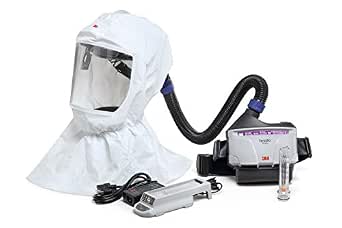 | Best for Documented Particulate-Focused Lab Work | Protection: Particulates; not vapors or gases | Battery runtime: 8–12 hours | Kit components: Disposable hood, PAPR unit, high-capacity battery and charger, easy-clean belt, high-efficiency filter, spark arrestor, pre-filter, breathing tube, airflow indicator | VIEW ON AMAZON | See Our Full Breakdown |
| Trend Airshield Pro Respirator & Face Shield Bundle |  | Best for Woodworking Dust, Not General Lab Use | Brand: TREND | Model number: U*AIR/PRO/D6 | Battery life: 8 hours | VIEW ON AMAZON | See Our Full Breakdown |
| 3M Versaflo TR-300N+ Heavy Industry PAPR System Kit |  | Best Overall for Particulate-Focused Lab Tasks | Protection type: Particulates | Battery life: 8–12 hours | Weight: 10 pounds | VIEW ON AMAZON | See Our Full Breakdown |
| WORK PAPR Half Mask Kit – NIOSH Approved, Reusable Powered Air Purifying System with HEPA Filter |  | Best Lightweight Half-Mask Option | Approval: NIOSH | Filtration efficiency: 99.97% | Weight: Under 1 pound | VIEW ON AMAZON | See Our Full Breakdown |
| 3M Powerflow Powered Air Purifying Respirator Kit 6800PF, Face-Mounted, Medium |  | Best Face-Mounted Full-Face Option | Model: 6800PF | Face size: Medium | Battery life: Up to 8 hours | VIEW ON AMAZON | See Our Full Breakdown |
| MicroClimate Air3 Powered Respirator (Air3 Kit) |  | Best for Visibility and Replaceable Components | Certification: NIOSH approved | Assigned protection factor: APF 25 | Battery life: Up to 8 hours | VIEW ON AMAZON | See Our Full Breakdown |
| Allegro 9200-01 Full Mask Supplied Air Respirator System with ¼ HP Pump & 50’ Hose |  | Best Supplied-Air Choice for Fixed Work Areas | Pump power: ¼ HP | Pump type: Oil-less rotary vane | Hose length: 50 feet | VIEW ON AMAZON | See Our Full Breakdown |
| 3M PAPR Respirator System, Heavy Industry Kit, NIOSH, High Capacity Battery |  | Best for Demanding Lab Environments | Model: TR-600-HIK | Battery life: Up to 12 hours | Weight: 12.9 pounds | VIEW ON AMAZON | See Our Full Breakdown |
| PAPR Respirator System with 40mm Activated Carbon Filter, Reusable Supplied Air Respirator Mask for Gases, Organic Vapors, Dust, Paint, Chemicals |  | Best for Full-Face Coverage and Adjustable Airflow | Filter size: 40mm | Filters included: Two activated carbon filters | Battery life: Up to 9 hours | VIEW ON AMAZON | See Our Full Breakdown |
| powered air respirator for lab work | Battery life | Weight |
|---|---|---|
| HANUU High-Efficiency PAPR Res | — | — |
| Electric Wearable Air Purifier | 8–10 hours | — |
| Full Face Respirator Protectiv | Over 7 hours | — |
| 3M Versaflo TR-300N+ ECK Power | — | Not specified |
| Trend Airshield Pro Respirator | 8 hours | Not specified |
| 3M Versaflo TR-300N+ Heavy Ind | 8–12 hours | 10 pounds |
| WORK PAPR Half Mask Kit | — | Under 1 pound |
| 3M Powerflow Powered Air Purif | Up to 8 hours | — |
| MicroClimate Air3 Powered Resp | Up to 8 hours | — |
| Allegro 9200-01 Full Mask Supp | — | 36 pounds |
| 3M PAPR Respirator System | Up to 12 hours | 12.9 pounds |
| PAPR Respirator System with 40 | Up to 9 hours | Described as lightweight; exact weight not specified |
More Details on Our Top Picks
HANUU High-Efficiency PAPR Respirator System
The HANUU stands out in this group for its full-face mask and adjustable airflow, a combination that may suit lab tasks involving particulates when the filter type and system approval match the hazard assessment. Its advertised flow reaches 170 L/min, higher than the 62–74 L/min range listed for the Full Face Respirator Protective Mask with Air Pump, and the three 40 mm filter ports offer a different configuration from that simpler canister setup. A 59-inch hose keeps the blower at the waist rather than adding its weight to the face.
The tradeoff is that the listing does not identify a filter standard, specific compatible contaminants, or NIOSH approval. Its broad claims about gases and chemicals are not enough to establish suitability for a laboratory hazard. I would choose the 3M Versaflo TR-300N+ ECK for documented particulate-focused work; I would only shortlist HANUU after confirming cartridge compatibility and protection limits.
Pros:- Full-face mask with a panoramic lens and four-point harness
- Stepless airflow adjustment with a listed maximum of 170 L/min
- Waist-mounted blower and 59-inch hose keep the motor off the face
- Includes three 40 mm activated-carbon filters
Cons:- Listing does not specify recognized approval or filter standards
- The supplied filter description does not establish suitability for particular lab gases or vapors
- A full-face mask, hose, belt unit, and blower make this a more involved setup than a simple wearable purifier
Best for: Lab workers evaluating a waist-mounted, full-face system for a defined task whose hazard assessment confirms that the supplied 40 mm filters are suitable.
Not ideal for: Researchers handling unknown chemicals, solvent vapors, or regulated hazards who need clearly documented approvals and contaminant-specific filter guidance.
- Maximum airflow:Up to 170 L/min
- Motor:12 W
- Battery runtime:Up to 10 hours
- Charging time:4.5 hours
- Filter configuration:Three ports for 40 mm filter cartridges
- Included filters:Three 40 mm activated-carbon filters
- Hose length:59 inches (1.5 m)
- Facepiece:Full-face mask with panoramic lens and four-point harness
Our verdict“Choose the HANUU only for a defined lab task after verifying its approval and filter compatibility; otherwise, the 3M Versaflo offers clearer stated particulate limits.”
Electric Wearable Air Purifier Mask with HEPA Filter
This wearable purifier is the simplest particulate-oriented option in this set: it lists an H13 HEPA filter, three airflow speeds, and an 8–10-hour battery life. That makes it easier to assess for dust-focused work than the HANUU system, whose listing makes broader gas and chemical claims without naming a filter standard. Its 3-hour charge time also beats HANUU’s stated 4.5 hours when equipment needs to return to service between shifts.
That simplicity has limits for lab use. The product is described as a wearable mask, not a documented occupational PAPR with a stated approval, assigned protection factor, or gas-vapor cartridge. Its filter replacement interval is listed as 200–500 hours, so upkeep needs tracking. I would reserve it for low-hazard particulate settings where the workplace assessment permits this device, not chemical handling or unknown exposures.
Pros:- H13 HEPA filter with listed filtration efficiency above 99.7%
- Three airflow speeds let users adjust ventilation
- Listed battery life of 8–10 hours
- Three-hour charging time
Cons:- No stated occupational approval or protection factor in the supplied product data
- HEPA filtration does not establish protection against gases or vapors
- Requires a specific charging cable and scheduled filter replacement
Best for: Users seeking a rechargeable, adjustable-airflow mask for dust-focused tasks where a workplace safety assessment confirms this device is suitable.
Not ideal for: Laboratory staff exposed to solvent vapors, gases, or hazardous substances requiring a certified occupational respirator and documented protection limits.
- Filter type:H13 HEPA
- Filtration efficiency:More than 99.7%
- Battery life:8–10 hours
- Charging time:3 hours
- Air supply speeds:Three
- Filter replacement interval:200–500 hours
- Charging:Rechargeable; dedicated cable
Our verdict“Consider this mask for assessed dust-only tasks, but choose a documented occupational PAPR for laboratory chemical or vapor hazards.”
Full Face Respirator Protective Mask with Air Pump
This full-face mask with an air pump is a straightforward option for buyers who want powered airflow and face coverage in one package. Its listed 62–74 L/min flow is well below the HANUU system’s advertised maximum of 170 L/min, so it is the more modest choice on stated airflow rather than the pick for users seeking maximum ventilation. The battery is listed for over seven hours, making it plausible for a work period, while adjustable airflow gives some control over comfort.
The larger concern for lab work is the lack of detail: the canister is said to filter harmful gases, dust, and chemicals, but the listing provides no cartridge standard, approval, or specific contaminant limits. Compared with the 3M Versaflo TR-300N+ ECK, which clearly limits its stated protection to particulates, this listing gives broader claims but less useful verification. I would not rely on those claims without manufacturer documentation and a hazard-specific assessment.
Pros:- Full-face design offers facial coverage
- Adjustable powered airflow with a listed 62–74 L/min range
- Battery life listed as over seven hours
- Portable power supply is included in the described system
Cons:- Filter canister type and contaminant-specific limits are not detailed
- No approval or protection factor is supplied in the product data
- Fit information is limited, and the full-face pump arrangement may feel bulky during extended wear
Best for: Buyers seeking a basic powered full-face setup for a task whose hazards and required filtration have been confirmed with the supplier.
Not ideal for: Laboratory teams needing a traceable, approved respirator system or clear documentation for specific chemical and vapor hazards.
- Air supply flow:62–74 L/min
- Power supply:110–220 V
- Battery life:Over 7 hours
- Facepiece:Full-face respirator mask
- Airflow control:Adjustable
- Filtration description:Canister described as filtering harmful gases
Our verdict“Shortlist this pump-fed full-face mask only if the supplier can document its filter and approval for your exact lab hazard.”
3M Versaflo TR-300N+ ECK Powered Air Purifying Respirator Kit
The 3M Versaflo TR-300N+ ECK earns the strongest lab-focused position here because its stated protection is specific: particulates, not vapors or gases. That boundary is useful when matching equipment to a documented hazard assessment. The kit includes a high-efficiency filter, pre-filter, spark arrestor, airflow indicator, disposable hood, and easy-clean belt, giving buyers more maintenance and setup context than the HANUU and Full Face Respirator Protective Mask listings provide.
Its slim profile and listed 8–12-hour battery runtime suit longer shifts and tighter work areas. The tradeoff is fundamental: this is not the choice for solvent vapor or gas exposure, regardless of its other advantages. Unlike the Trend Airshield Pro, which is aimed at woodworking dust and has a flip-up face shield, the Versaflo is presented as an occupational kit for healthcare, pharmaceutical, and food-safety settings. I would verify hood fit and workplace approval before use.
Pros:- Protection is clearly described as particulate-only, avoiding ambiguity about gas and vapor coverage
- Kit includes a high-efficiency filter, pre-filter, spark arrestor, and airflow indicator
- Disposable hood and easy-clean belt support cleaning and maintenance routines
- Listed battery runtime of 8–12 hours and a slim profile
Cons:- Not suitable for vapors or gases
- One-size disposable hood may not suit every wearer or lab procedure
- Weight is not specified in the supplied product data
Best for: Healthcare, pharmaceutical, and food-safety lab workers who need a particulate-focused PAPR kit with listed components and an easy-clean belt.
Not ideal for: Researchers exposed to gases or vapors, or anyone whose required facepiece, filter, or approval is not confirmed for this kit.
- Protection:Particulates; not vapors or gases
- Battery runtime:8–12 hours
- Kit components:Disposable hood, PAPR unit, high-capacity battery and charger, easy-clean belt, high-efficiency filter, spark arrestor, pre-filter, breathing tube, airflow indicator
- Material:Polypropylene
- Size:One size
- Weight:Not specified
Our verdict“Choose the Versaflo for particulate-focused lab work when its hood and approvals fit the site requirements, but not for chemical vapor protection.”
Trend Airshield Pro Respirator & Face Shield Bundle
The Trend Airshield Pro has a distinct niche: powered dust protection with a panoramic flip-up face shield, plus an extra battery and charging cradle. Those features make it more appealing for woodworking-style tasks than for a general laboratory, where filter certification and chemical compatibility matter more than an openable visor. Its listed eight-hour battery life is shorter than the 3M Versaflo TR-300N+ ECK’s stated 8–12 hours, and the Versaflo also gives clearer information about its particulate-only protection and included filter components.
Trend’s stated comfort accommodations for glasses and facial hair may help some wearers, but they do not replace fit checks or confirm a seal. The supplied details do not identify a filter class, gas-vapor protection, or occupational approval, so I would not infer suitability for chemical exposure. The extra battery and cradle are useful for keeping the unit available, yet this remains a task-specific dust option rather than a broadly documented lab PAPR.
Pros:- Powered airflow paired with a panoramic flip-up face shield
- Bundle includes an extra rechargeable battery and charging cradle
- Designed to accommodate users with glasses and facial hair
- Reusable design with listed eight-hour battery life
Cons:- Product data does not specify filter class or contaminant limits
- No stated protection against gases or vapors
- Fit and comfort may vary, and weight and detailed size measurements are not provided
Best for: Lab makers or workshop staff doing dust-generating woodworking tasks who value a flip-up shield, glasses compatibility, and a spare battery.
Not ideal for: Laboratory workers handling chemicals, gases, or vapors, and buyers who need a specified filter class or documented occupational approval.
- Brand:TREND
- Model number:U*AIR/PRO/D6
- Battery life:8 hours
- Included components:Airshield Pro, battery charging cradle, battery
- Features:Rechargeable, reusable, powered airflow, flip-up face shield
- Size:One size
- Warranty:1 year
- Weight:Not specified
Our verdict“Pick the Trend for assessed woodworking-dust tasks and its spare-battery bundle, not as a substitute for a documented chemical-lab respirator.”
3M Versaflo TR-300N+ Heavy Industry PAPR System Kit
For a lab that needs a complete, established PAPR setup for particulate exposure, this kit is the strongest all-round fit in this group. Its hard hat assembly, blower, battery, belt, particulate filter and airflow indicator arrive as a coordinated system, reducing the need to source basic components separately. The stated 8–12-hour battery life suits longer shifts, while the slim profile is a practical advantage in crowded work areas. Compared with the face-mounted 3M Powerflow 6800PF, this head-mounted kit keeps the blower off the face, though its listed 10-pound weight may still feel burdensome over a full shift. Its boundary is clear: it is for particulates, not gases or vapors, and the industrial-use design calls for a workplace respiratory-protection program.
Pros:- Kit includes the blower, battery and charger, belt, particulate filter, and airflow indicator
- Stated 8–12-hour battery life supports extended work periods
- Slim profile is suited to tight work areas
- One-button operation with alarms
Cons:- Particulate protection only; not suitable for gases or vapors
- Listed 10-pound weight may be cumbersome during prolonged wear
- Designed for occupational use and requires selection for the specific lab hazard
Best for: Lab teams needing a complete, hard-hat-style PAPR for particulate-generating work and long shifts in tight work areas.
Not ideal for: Labs handling solvent vapors or gases, and individuals seeking a light consumer respirator rather than occupational equipment.
- Protection type:Particulates
- Battery life:8–12 hours
- Weight:10 pounds
- Operation:One-button operation with alarms
- Kit components:Respiratory hard hat assembly, PAPR unit, battery and charger, belt, particulate filter, filter cover, spark arrestor, pre-filter, breathing tube, airflow indicator
- Material:Polycarbonate
Our verdict“Choose this for a complete, long-shift particulate PAPR setup, but not for vapor hazards or users prioritizing low weight.”
WORK PAPR Half Mask Kit – NIOSH Approved, Reusable Powered Air Purifying System with HEPA Filter
This kit’s clearest advantage for lab work is its under-one-pound weight: it may suit staff who need mobility and find a hard-hat PAPR too cumbersome. The stated NIOSH approval and 99.97% filtration efficiency provide useful selection details for particle-focused tasks, while breath-responsive AirSensit technology is intended to reduce breathing resistance. Compared with the 3M Versaflo TR-300N+, this is a lighter, half-mask-style alternative, but the supplied information gives less confidence about shift planning: battery life and kit contents are not specified here. That makes it harder to compare directly with the Versaflo’s listed 8–12-hour runtime and broader component list. I would treat it as a candidate for appropriately assessed particulate work, not as a shortcut around checking the approval, fit, filter selection and lab hazard requirements.
Pros:- Listed weight is under one pound
- Product data states NIOSH approval
- HEPA filter is specified at 99.97% filtration efficiency
- Breath-responsive AirSensit technology is designed to reduce breathing resistance
Cons:- Battery life is not specified in the supplied product data
- Filter replacement is required and adds ongoing maintenance
- Half-mask format may not suit tasks requiring more face coverage
Best for: Lab staff seeking a lightweight, mobile half-mask PAPR for assessed particulate work, especially when a heavier head-mounted system is inconvenient.
Not ideal for: Buyers who need clearly stated runtime and included components, or labs whose hazards include gases or vapors requiring different protection.
- Approval:NIOSH
- Filtration efficiency:99.97%
- Weight:Under 1 pound
- Respirator format:Powered half mask
- Filter:HEPA
- Airflow feature:Breath-responsive AirSensit technology
Our verdict“Consider this lightweight option for particulate work when mobility matters, but verify runtime, fit and task-specific protection before choosing it over the more fully specified Versaflo kit.”
3M Powerflow Powered Air Purifying Respirator Kit 6800PF, Face-Mounted, Medium
The Powerflow 6800PF is the lineup’s face-mounted choice for buyers who want a full facepiece with powered airflow. Its listed coverage includes dust, mist, fumes, radionuclides and radon daughters, which is broader than the particulate-only protection stated for the 3M Versaflo TR-300N+; that does not make it suitable for every lab chemical, so the exact hazard and approved configuration still need checking. The face-mounted blower, battery and flow indicator form a compact listed kit, and the stated runtime is up to 8 hours. The tradeoff is that carrying the powered unit on the face may be less comfortable over long sessions than a head-mounted arrangement. The medium face size also makes fit a more specific decision than the adjustable headgear offered with the MicroClimate Air3.
Pros:- Full facepiece provides more facial coverage than the WORK PAPR half-mask kit
- Product description lists protection against dust, mist, fumes, radionuclides and radon daughters
- Includes a blower, battery pack and flow indicator
- Stated battery life is up to 8 hours
Cons:- Medium facepiece may not fit every wearer
- Face-mounted equipment can become uncomfortable during prolonged wear
- Occupational use requires training and adherence to applicable safety procedures
Best for: Lab users who need a powered full-facepiece format and whose assessed particulate hazards match the respirator’s approved protection.
Not ideal for: Workers who need a different face size, prefer to keep blower weight off the face, or need protection from hazards not covered by the specified configuration.
- Model:6800PF
- Face size:Medium
- Battery life:Up to 8 hours
- Item weight:16 ounces
- Listed protection:Dust, mist, fumes, radionuclides and radon daughters
- Included components:Powered air-purifying respirator, facepiece, blower, battery and flow indicator
- Material:Plastic
- Country of origin:USA
Our verdict“Pick the 6800PF when a powered full-facepiece suits the hazard and fit, but choose a head-mounted system if carrying equipment on the face is a concern.”
MicroClimate Air3 Powered Respirator (Air3 Kit)
The Air3 stands out for labs where visor visibility and serviceable parts matter alongside powered airflow. Its polycarbonate visor, adjustable padded ratcheting headgear and cell-phone compatibility give it a different emphasis from the hard-hat-equipped 3M Versaflo TR-300N+, while the stated APF 25, NIOSH approval and battery life of up to eight hours offer useful selection points. The product data also claims filter capacity of 10 times typical filters and mentions external power options, which may appeal to teams planning extended use. Those advantages come with handling concerns: the visor can scratch, some replacements require a screwdriver, and the weight distribution may lead to detachment if handled improperly. Compared with the face-mounted Powerflow 6800PF, the Air3 shifts the focus toward an adjustable visor and headgear rather than a medium full-facepiece.
Pros:- NIOSH-approved product data lists an APF of 25
- Adjustable ratcheting headgear with padding is designed for extended wear
- Battery life is stated as up to 8 hours, with external power options
- Filter, visor and other components are described as replaceable
Cons:- Visor is prone to scratching and needs careful storage
- Some replacements require a screwdriver
- Weight distribution may cause detachment if the unit is handled improperly
Best for: Lab workers who value visor visibility, adjustable padded headgear and replaceable components for assessed workplace hazards.
Not ideal for: Users who need a scratch-resistant visor with minimal upkeep, or labs that require a respirator configuration verified for hazards beyond the product’s stated protection details.
- Certification:NIOSH approved
- Assigned protection factor:APF 25
- Battery life:Up to 8 hours
- Filter capacity:10 times typical filters, as stated in product data
- Visor material:Polycarbonate
- Headgear:Adjustable ratcheting headgear with padding
- Noise reduction:Additional 6 dB with fairing
- Compatibility:Cell phone compatible
Our verdict“Choose the Air3 for its adjustable visor system and replaceable components, provided your lab confirms the fit and protection match its specific hazards.”
Allegro 9200-01 Full Mask Supplied Air Respirator System with ¼ HP Pump & 50’ Hose
Unlike the other four options, the Allegro 9200-01 is a supplied-air system, not a powered air-purifying respirator. Its pump feeds a full mask through a 50-foot reinforced hose, making it a distinct candidate for a stationary work area where an air hose can be managed and the supplied-air arrangement matches the site’s safety plan. The hypoallergenic silicone mask and oil-less rotary vane pump are practical details for repeated occupational use. Compared with the battery-powered 3M Versaflo TR-300N+, it avoids relying on a respirator battery for its air supply, but it brings a much larger footprint: the listed system weighs 36 pounds and measures 33 × 21 × 20 inches. It is also limited to one user per system and requires trained setup and operation, so it is a poor fit for mobile bench work.
Pros:- Supplies air through a 50-foot reinforced hose rather than relying on a face-mounted or belt-mounted PAPR blower
- Full mask is made from hypoallergenic silicone
- Oil-less rotary vane pump is designed to reduce maintenance needs
- Product data specifies pump airflow and working-pressure ranges
Cons:- Listed 36-pound weight and large dimensions limit portability
- System is limited to one user
- Requires training and a suitable setup for safe supplied-air operation
Best for: Lab teams with a designated fixed work area, a compatible supplied-air plan and the space to manage a 50-foot hose and pump.
Not ideal for: Mobile lab staff, compact workspaces, or buyers specifically seeking a self-contained battery-powered PAPR.
- Pump power:¼ HP
- Pump type:Oil-less rotary vane
- Hose length:50 feet
- Pump airflow:0–5 CFM
- Working pressure:2–12 psi
- Maximum hose pressure:185 psi
- Mask material:Hypoallergenic silicone
- Weight:36 pounds
- Dimensions:33 × 21 × 20 inches
Our verdict“Choose the Allegro for a compatible fixed supplied-air station, not for mobile lab work or a self-contained PAPR setup.”
3M PAPR Respirator System, Heavy Industry Kit, NIOSH, High Capacity Battery
The 3M TR-600-HIK is the better fit here when lab work includes extended shifts or rugged handling, rather than routine bench tasks. Its kit includes a hard-hat assembly, blower, battery and charger, filters, prefilters, and spark arrestors, which gives buyers a more complete industrial setup than the standalone-style options such as the MicroClimate Air3. A stated runtime of up to 12 hours also reduces charging interruptions during long work periods.
The tradeoff is its 12.9-pound listed weight: that burden may be awkward in confined labs or during prolonged movement. Its industrial design and need for proper training and fit testing make it less suitable for casual use than a simpler setup. I would choose it for demanding environments, not for ordinary lab work without a clear need for this level of kit.
Pros:- Bundled hard-hat assembly, blower, battery and charger, filters, and accessories
- Up to 12 hours of stated battery runtime
- Includes prefilters and spark arrestors for a more complete industrial configuration
- Intuitive controls are described as user-friendly
Cons:- Listed weight of 12.9 pounds may burden users during extended wear
- Industrial configuration may be excessive for routine laboratory tasks
- Requires proper training and fit testing for effective use
Best for: Lab teams doing long shifts in rugged or industrial conditions who need a bundled hard-hat PAPR setup and extended stated runtime.
Not ideal for: Researchers doing routine bench work or moving frequently through tight spaces, since the listed 12.9-pound weight and industrial setup may be cumbersome.
- Model:TR-600-HIK
- Battery life:Up to 12 hours
- Weight:12.9 pounds
- Included headgear:Respiratory hard-hat assembly
- Included components:PAPR unit, battery and charger, breathing tube, cartridges, airflow indicator, belt, prefilters, and spark arrestors
- Part number:TR-600-HIK
- UPC:051131373747
Our verdict“Choose this 3M kit for long, demanding lab shifts where its complete industrial setup matters more than low weight or simplicity.”
PAPR Respirator System with 40mm Activated Carbon Filter, Reusable Supplied Air Respirator Mask for Gases, Organic Vapors, Dust, Paint, Chemicals
This full-face option stands apart from the 3M TR-600-HIK by emphasizing a silicone face seal and polycarbonate shield rather than a hard-hat assembly. Its adjustable airflow lets the wearer tune the air delivery for comfort, while the anti-fog coating is a practical feature for tasks where a clear view matters. The supplied description lists two activated carbon filters and up to 9 hours of runtime, giving it a more face-focused configuration than the industrial 3M kit’s broader accessory bundle.
For lab buyers, the key limitation is that the listing does not establish a NIOSH approval or specify a filter certification. The 40mm filter size and broad claims covering gases, vapors, dust, and chemicals are not enough to confirm suitability for a particular lab hazard. I would verify the exact filter approval and compatibility before use; buyers needing documented industrial kit details may prefer the 3M.
Pros:- Silicone face seal paired with a full-face polycarbonate shield
- Anti-fog coating supports visibility during work
- Adjustable airflow allows some personalization
- Includes two activated carbon filters and states up to 9 hours of runtime
Cons:- Listing does not specify NIOSH approval or filter certification
- Up to 9 hours of runtime is shorter than the 3M TR-600-HIK’s stated 12 hours
- Full-face assembly may feel bulky, and battery charging is needed for continued use
Best for: Experienced lab or shop workers seeking a reusable full-face design with adjustable airflow, after confirming the filter’s approval and suitability for their specific exposure.
Not ideal for: Labs requiring documented NIOSH approval or hazard-specific filter certifications, since those details are not supplied here.
- Filter size:40mm
- Filters included:Two activated carbon filters
- Battery life:Up to 9 hours
- Airflow:Adjustable
- Face seal material:Silicone
- Shield material:Polycarbonate with anti-fog coating
- Battery:Rechargeable
- Weight:Described as lightweight; exact weight not specified
Our verdict“Consider this for full-face coverage and adjustable airflow only if its filter certifications match your lab hazards.”

How We Picked
I ranked these options by how clearly their design and stated system components map to practical lab respiratory needs: documented approval and protection scope, filter or air-supply compatibility, fit and coverage, comfort over a work period, and the demands of cleaning and upkeep. A PAPR is not a universal lab solution, so I gave more weight to systems with identifiable configurations and a clear path for checking the correct filter than to listings that make broad claims without naming the specific protection limits.
The order also reflects the tradeoffs visible across this lineup. The 3M Versaflo kits rank ahead because they are established, configurable systems, while the WORK half-mask is a more focused alternative and the Allegro supplied-air unit serves a different setup. Face-mounted, wearable, and generic 40mm-filter products are included for their distinct formats, but rank lower where the listing does not establish lab-specific approval or hazard coverage. Before purchase, I would verify current manufacturer documentation and consult the lab’s respiratory protection program; a product listing alone cannot establish that a respirator is suitable for a given exposure.
Factors to Consider When Choosing Powered Air Respirator For Lab Work
Choosing lab respiratory equipment starts with the exposure assessment, not the mask style. These broader checks help distinguish a convenient PAPR from a system that actually fits the work, the facility, and its respiratory protection rules.
Match the Filter to the Identified Hazard
Start with the chemical or particulate named in the lab’s exposure assessment, including its physical form and concentration. HEPA or particulate filtration does not equal vapor protection, and an activated-carbon label by itself does not establish which compounds the filter can handle or how long it will last. Check the exact filter part number, approved use, limitations, and change schedule against the manufacturer’s documentation. A common mistake is treating “chemical,” “gas,” or “multi-purpose” language as proof of broad protection. If the hazard is not clearly covered, ask the safety officer or industrial hygienist to select the respiratory protection rather than guessing from a product title. Also check whether the task may involve oxygen deficiency or an immediately dangerous atmosphere, where an air-purifying respirator is not the right equipment.
Understand the Difference Between a PAPR and Supplied Air
A PAPR draws ambient air through its filters, while a supplied-air system delivers air from a separate source. That difference affects both hazard suitability and freedom of movement: the Allegro pump-and-hose configuration, for example, brings hose routing and pump placement into the work plan, while belt-mounted PAPRs depend on appropriate filters and a charged blower. Do not assume that a supplied-air label makes a system suitable for every lab condition; the air source, compressor, monitoring, and applicable procedures matter. Conversely, a filtered PAPR cannot address every atmosphere simply by using a stronger blower. Before buying, map the work area, distance from the air source, bench or hood layout, and any rules about hoses or powered equipment.
Choose Coverage and Fit for the Actual Task
Headtop, full-face, and half-mask designs solve different problems. Coverage, compatibility, and seal requirements affect how the respirator works with eyewear, hearing protection, lab coats, and other protective equipment. A loose-fitting headtop may suit some approved configurations, while a tight-fitting facepiece calls for the fit testing and facial-seal practices required by the program. Try the complete setup with the other equipment used at the bench, not just the mask on its own. Consider whether the task demands eye or face protection, but do not assume a visor substitutes for chemical splash protection unless its documentation says so. If more than one worker will share equipment, cleaning and fit constraints can make a dedicated unit a better choice.
Plan for Noise, Weight, and Work Duration
A respirator that meets the protection need can still be a poor daily fit if it interferes with communication or becomes tiring during extended tasks. Battery placement, blower position, hose routing, and head-mounted weight all change how a system feels during pipetting, equipment work, or movement between stations. Compare the Trend Airshield Pro and 3M Powerflow’s more head- or face-centered formats with belt-mounted systems, while remembering that listed configuration and personal fit affect the experience. Ask whether the blower’s noise will interfere with alarms or communication in the lab. Check expected runtime under the selected filter load and airflow setting, then plan charging or spare batteries around the work schedule rather than relying on a headline runtime alone.
Check Approval, Program Fit, and Lab Rules
Respirator selection is part of a workplace respiratory protection program, not just an individual equipment choice. Approval markings and manufacturer documentation should match the complete configuration, including facepiece or headtop, blower, hose, and filter. Confirm that the system is permitted for the specific task and that workers can complete required medical evaluation, training, fit testing where applicable, inspection, and maintenance. A listing that says “NIOSH approved” should still be checked against the exact model and approved component combinations. Labs may also restrict powered equipment near particular processes or require procedures for contamination control. Ask the program administrator to approve the complete setup before ordering multiple units.
Account for Cleaning and Replacement Parts
Lab use can expose respirator surfaces to residues, so cleaning and storage deserve as much attention as initial fit. Replaceable filters, battery availability, charging hardware, and cleanable components determine whether a system remains practical over time. Check which parts are reusable, which need replacement after contamination, and whether the manufacturer permits the chosen cleaning agents. A bundle with an extra battery or charging cradle may help with shift coverage, but it does not solve filter compatibility or decontamination limits. Write down a maintenance routine before purchase and identify who will inspect, clean, charge, and document the equipment. If replacement parts are difficult to source or the instructions do not address the lab’s contamination risks, a more established, serviceable system may be the better choice.
Frequently Asked Questions
Can I use any of these respirators for solvent vapors in a lab?
No product should be assumed suitable for solvent vapors from its title or general “chemical” claim. Confirm the exact solvent, concentration, filter type, approved configuration, and replacement schedule with the manufacturer’s documentation and your respiratory protection program. A particulate-only HEPA filter does not provide vapor protection. Activated-carbon filters also have limits and may require compound-specific selection and a defined change schedule. If the exposure or filter suitability is uncertain, have the lab’s safety professional select the equipment before work begins.
Is the Allegro 9200-01 a direct substitute for a filtered PAPR?
No. The Allegro 9200-01 is described as a supplied-air system with a pump and hose, while the Versaflo and other PAPR-style options filter the air around the wearer. That means the Allegro needs a suitable air source and a plan for hose routing, and it may be less convenient for moving between work areas. A PAPR instead depends on the correct filter and an atmosphere appropriate for air-purifying equipment. Choose between them only after the exposure assessment and facility procedures establish which type is permitted.
Do I need fit testing for a powered respirator?
It depends on the facepiece and the applicable workplace program. Tight-fitting respirators generally require fit testing and a user seal check under the relevant rules, while some loose-fitting PAPR headtops have different requirements. Do not infer the answer from “powered” or “PAPR” alone; check the manufacturer’s instructions and the exact configuration. Workers may also need medical evaluation, training, and routine inspection. Your employer’s respiratory protection administrator should determine the requirements for the task and model.
Which matters more for lab work: a full-face mask or a half mask?
Neither is automatically better; coverage needs and the approved protection configuration should drive the choice. A full-face design can provide eye and face coverage as part of its intended setup, while a half mask may leave more room around the face but needs separate eye protection when the task calls for it. Check compatibility with goggles, splash protection, glasses, and other PPE, then confirm fit and cleaning procedures. Also verify that the chosen facepiece works with the blower and filter as an approved system. The WORK half-mask listing and the full-face options in this roundup illustrate format differences, not a universal ranking of protection.
Should I buy a generic 40mm-filter system or a 3M Versaflo kit?
Start by comparing the exact approvals, filter codes, replacement availability, and documentation for the complete systems. A generic 40mm connection does not by itself confirm that a filter is suitable for a particular hazard or interchangeable across respirators. The Versaflo kits are more identifiable system configurations, while several generic listings leave key protection details unclear from their names. That can make verification and ongoing parts management more straightforward with a clearly documented system, though a higher-profile brand is not a substitute for hazard matching. Ask your lab’s safety professional to approve the respirator, filter, and use conditions together.
Conclusion
For a lab buyer who needs a clear starting point, I would choose the 3M Versaflo TR-300N+ ECK as best overall, pending confirmation that its configuration and filter suit the documented hazard. The WORK PAPR Half Mask Kit is my value-oriented pick for a buyer whose need is specifically particulate protection and whose program approves the exact system. For buyers who want a more established, configurable system and can verify the appropriate bundle, the 3M Versaflo TR-300N+ Heavy Industry kit is the premium-oriented choice. A first-time buyer should start with the Versaflo ECK and get the safety administrator to confirm fit, filters, and training before purchase rather than relying on a broad product claim. For a task requiring a remote air supply, the Allegro 9200-01 is the specific-use pick; for face-mounted preferences, compare the 3M Powerflow and Trend Airshield Pro, while checking weight, compatibility, and cleaning. Skip any option whose approval or filter protection cannot be matched to the lab’s exposure assessment.
Fall Picks
fall essentials
As an affiliate, we earn on qualifying purchases.