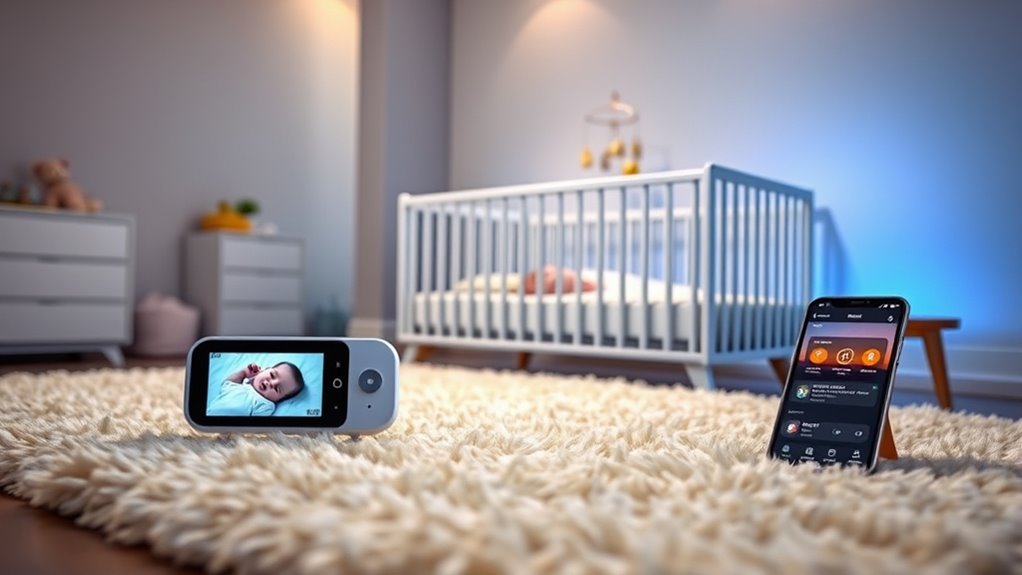

Smart baby monitors range from camera-and-app systems to kits with a dedicated parent screen or a wearable sensor. My best overall pick is the VTech VM901, which pairs a 1080p Wi-Fi camera with a 5-inch screen for families who want app access without relying on a phone alone. For two-camera coverage, the VTech VM901-2 adds split-screen viewing, while the Nanit Floor Stand system suits parents who want a more connected camera setup. The central tradeoff is convenience versus dependence on Wi-Fi, apps, and optional services; display size, mounting, and monitoring style also vary. Read on for the full breakdown and help matching a monitor to your home and routine.

Prime made for students and young adults
- Fast, free delivery for dorm and study essentials
- Prime Video and Amazon Music included
- Member-only deals
Key Takeaways
- A hybrid setup stands out: The VTech VM901 combines Wi-Fi viewing with a 5-inch parent screen, giving it a practical balance that app-only systems may not provide.
- Two-camera kits solve a different problem than higher resolution: The VTech VM901-2 and Dr.Care VistaView two-camera set focus on viewing more than one sleep space, while other models prioritize a single camera or different display options.
- Nanit options vary by installation and viewing setup: Floor Stand, Wall Mount, and Floor Stand with an 8-inch display fit different nursery layouts and preferences; buyers should choose the physical setup they can use safely.
- Wearable monitoring is a separate category of choice: Owlet Dream Sock differs from camera-first products because it adds a wearable component rather than simply changing the camera or screen.
- Mounting and connection needs can outweigh resolution: Clip, wall, and stand configurations affect placement, while Wi-Fi and dedicated displays shape how easily caregivers can check in.
| VTech VM901 Smart WiFi Baby Monitor with 1080p Camera and 5-Inch Screen |  | Best Overall | Model: VM901 | Camera resolution: 1080p | Parent unit screen: 5-inch HD | VIEW ON AMAZON | See Our Full Breakdown |
| VTech Smart WiFi Baby Monitor (VM901-2) – 2 Cameras, 1080p Split Screen, 5″ HD Parent Unit, Pan‑Tilt‑Zoom, Night Vision |  | Best for Two Rooms | Camera count: 2 | Camera resolution: 1080p | Parent unit screen: 5-inch HD | VIEW ON AMAZON | See Our Full Breakdown |
| Dr.Care VistaView 5″ Smart WiFi Baby Monitor with 2 Cameras, 1080P Display |  | Best for Recording and Detailed Alerts | Camera count: 2 | Camera resolution: 2K | Split-screen resolution: 1080p | VIEW ON AMAZON | See Our Full Breakdown |
| Nanit Smart Baby Video Monitor with Camera and Floor Stand, 1080p Wi-Fi |  | Best for Sleep Insights | Video resolution: 1080p HD | Connectivity: Wi-Fi | Night vision: Infrared | VIEW ON AMAZON | See Our Full Breakdown |
| Owlet Dream Sock Smart Baby Monitor |  | Best Wearable Vital-Sign Monitor | Intended age: 1–18 months | Intended weight: 6–30 pounds | Monitored readings: Pulse rate and oxygen levels | VIEW ON AMAZON | See Our Full Breakdown |
| Owlet Dream Sight Smart Baby Monitor with 2K HD Wi-Fi Camera |  | Best for Owlet Ecosystem Users | Video resolution: 2K HD | Night vision: Yes | Zoom: 4x | VIEW ON AMAZON | See Our Full Breakdown |
| Momcozy Smart WiFi Baby Monitor with 5-Inch 1080p Camera and Wall Mount |  | Best for Shared Family Access | Display: 5-inch | Camera resolution: 1080p | Connectivity: 2.4 GHz Wi-Fi or dedicated BM04 parent unit | VIEW ON AMAZON | See Our Full Breakdown |
| ARENTI Baby Monitor C3 Kit with 3MP PTZ Camera and 5-Inch Wireless Display |  | Best for Local Recording and Camera Control | Camera resolution: 3 MP | Display size: 5 inches | Pan range: 355° | VIEW ON AMAZON | See Our Full Breakdown |
| Nanit Smart Baby Video Monitor with Camera and Wall Mount, 1080p Wi-Fi |  | Best for Subscription-Free Core Monitoring | Video resolution: 1080p HD | Connectivity: Wi-Fi; local network viewing supported | Audio: Two-way audio | VIEW ON AMAZON | See Our Full Breakdown |
| Dr.Care VistaView 5-Inch 1080p Smart Wi-Fi Baby Monitor with Camera and Clip Mount |  | Best for Flexible Parent-Unit Monitoring | Display: 5 inches | Camera resolution: 1080p | Camera rotation: 300° | VIEW ON AMAZON | See Our Full Breakdown |
| VTech Smart WiFi Baby Monitor with 2K Camera and 5.5-Inch Screen |  | Best for Detailed Video | Camera resolution: 2K | Parent unit screen: 5.5-inch HD | Zoom: 24x | VIEW ON AMAZON | See Our Full Breakdown |
| Nanit Smart Baby Video Monitor System with Floor Stand and 8-Inch Display |  | Best for Nursery Insights | Video resolution: 1080p HD | Display: 8-inch touchscreen | Setup options: Floor stand or wall mount | VIEW ON AMAZON | See Our Full Breakdown |
| 1080p Wi-Fi Baby Monitor with Camera, Audio, and 4-Inch Screen |  | Best for Flexible Connection Options | Camera video resolution: 720p; supports up to 1080p display | Included display: 4-inch IPS screen | Connectivity: Wi-Fi app and FHSS no-Wi-Fi connection | VIEW ON AMAZON | See Our Full Breakdown |
| smart baby monitor | Connectivity | Night vision | Camera resolution |
|---|---|---|---|
| VTech VM901 Smart WiFi Baby Mo | Wi-Fi and free MyVTech Baby app | Automatic | 1080p |
| VTech Smart WiFi Baby Monitor | Wi-Fi | Automatic | 1080p |
| Dr.Care VistaView 5" Smart WiF | Wi-Fi | — | 2K |
| Nanit Smart Baby Video Monitor | Wi-Fi | Infrared | — |
| Owlet Dream Sock Smart Baby Mo | Bluetooth and 2.4 GHz Wi-Fi | — | — |
| Owlet Dream Sight Smart Baby M | Dual-band Wi-Fi (2.4 GHz and 5 GHz), Bluetooth | Yes | — |
| Momcozy Smart WiFi Baby Monito | 2.4 GHz Wi-Fi or dedicated BM04 parent unit | — | 1080p |
| ARENTI Baby Monitor C3 Kit wit | — | 8 × 940 nm infrared lights | 3 MP |
| Nanit Smart Baby Video Monitor | Wi-Fi; local network viewing supported | Infrared | — |
| Dr.Care VistaView 5-Inch 1080p | — | — | 1080p |
| VTech Smart WiFi Baby Monitor | Wi-Fi and MyVTech Baby Plus app | Automatic | 2K |
| Nanit Smart Baby Video Monitor | — | Infrared | — |
| 1080p Wi-Fi Baby Monitor with | Wi-Fi app and FHSS no-Wi-Fi connection | — | — |
More Details on Our Top Picks
VTech VM901 Smart WiFi Baby Monitor with 1080p Camera and 5-Inch Screen
I’d put the VTech VM901 first for families who want a smart monitor without giving up a dedicated parent screen. Its 5-inch display works at home, while the MyVTech Baby app adds remote viewing when Wi-Fi is available. That dual-viewing setup makes it more flexible than app-only choices such as the Nanit Smart Baby Video Monitor with Camera and Floor Stand. The camera’s 1080p video, automatic night vision, and remote pan-tilt-zoom help you check a wider area without entering the nursery; motion and temperature alerts plus two-way talk round out the everyday tools. The tradeoff is that remote checks depend on a working connection, and temperature alerts can flag routine room fluctuations. I’d choose it over the dual-camera VM901-2 when one camera is enough and a simpler setup matters more than split-screen monitoring.
Pros:- Dedicated 5-inch parent screen and free app support home and remote viewing.
- 1080p video with automatic night vision gives clear day-and-night checks.
- Remote pan, tilt, and zoom help cover more of the nursery.
- Motion and temperature alerts and two-way talk add useful monitoring and soothing tools.
Cons:- Remote app viewing depends on an adequate Wi-Fi signal.
- Temperature alerts may notify caregivers about ordinary room temperature changes.
Best for: Caregivers who want both a dedicated screen for home use and app-based remote viewing from one camera.
Not ideal for: Families monitoring two rooms at once or anyone who needs app viewing to work without a reliable Wi-Fi connection.
- Model:VM901
- Camera resolution:1080p
- Parent unit screen:5-inch HD
- Connectivity:Wi-Fi and free MyVTech Baby app
- Camera movement:Pan, tilt, and zoom
- Night vision:Automatic
- Alerts:Motion and temperature
- Two-way talk:Yes
Our verdict“Choose the VM901 if you want one camera, a dedicated parent screen, and app access without moving to a more specialized sleep-tracking system.”
VTech Smart WiFi Baby Monitor (VM901-2) – 2 Cameras, 1080p Split Screen, 5″ HD Parent Unit, Pan‑Tilt‑Zoom, Night Vision
The VTech VM901-2 earns its place for households that need to watch two spaces, not simply get a sharper view of one crib. Its two 1080p cameras show both rooms at once on the 5-inch parent unit or through the MyVTech Baby app, while each camera has independent pan-tilt-zoom. That split-screen approach is more immediately useful for siblings in separate rooms than the single-camera VTech VM901, which otherwise offers similar core monitoring tools. Automatic night vision, temperature alerts, and two-way talk keep the setup practical for routine checks, and app sharing lets multiple caregivers access the feed. The tradeoffs are a parent unit that may be bulky on a crowded bedside table and reliance on stable Wi-Fi for remote viewing. I’d skip the second camera if one room is all you need.
Pros:- Two cameras provide split-screen viewing of separate rooms.
- Each camera has independent pan, tilt, and zoom control.
- The 5-inch HD parent unit and free app offer more than one way to check in.
- Multiple caregivers can share app access, with automatic night vision and two-way talk included.
Cons:- The parent unit may take up substantial bedside space.
- Remote app viewing requires stable Wi-Fi.
- The dual-camera setup may be more than needed for families monitoring one room.
Best for: Families with two children or two sleep spaces who want simultaneous views on a parent unit and shared app access.
Not ideal for: Caregivers monitoring a single room, or those with limited bedside space or unreliable Wi-Fi for remote checks.
- Camera count:2
- Camera resolution:1080p
- Parent unit screen:5-inch HD
- Split-screen viewing:Yes, on parent unit and app
- Connectivity:Wi-Fi
- App:Free MyVTech Baby app
- Camera movement:Independent pan, tilt, and zoom per camera
- Alerts and audio:Temperature alerts and two-way talk
- Night vision:Automatic
Our verdict“Pick the VM901-2 over the single-camera VM901 when simultaneous views of two rooms are worth the larger setup.”
Dr.Care VistaView 5″ Smart WiFi Baby Monitor with 2 Cameras, 1080P Display
I’d choose the Dr.Care VistaView when dual-room coverage is only part of the brief and a family also wants recording and a wider set of alerts. Its dual 2K cameras feed a 1080p split-screen display, and notifications cover motion, crying, temperature, and humidity. That gives it more alert variety and recording options than the VTech VM901-2, which focuses on split-screen viewing, talk, and temperature alerts. Pan-tilt-zoom, lullabies, two-way talk, and a rechargeable 5000mAh battery broaden the feature set; an SD card supports local storage, while cloud storage is also offered. The added capabilities bring setup complexity, and recording needs an SD card or cloud plan rather than being ready without extra storage. Battery life can also vary with use, so I’d favor it for feature-focused caregivers, not anyone seeking the simplest monitor.
Pros:- Dual 2K cameras support detailed viewing with 1080p split-screen output.
- Alerts cover motion, crying, temperature, and humidity.
- Recording, cloud storage, and support for an SD card provide storage choices.
- Rechargeable 5000mAh battery and up to 10 hours of stated battery life support portable use.
Cons:- Recording requires an SD card or cloud storage plan.
- Setup may be more involved than with the VTech VM901-2.
- Battery life may vary depending on how the monitor is used.
Best for: Caregivers who want two-camera coverage, several kinds of alerts, and the option to record footage or share it.
Not ideal for: Buyers who want a straightforward plug-and-view monitor or recording without arranging an SD card or cloud storage.
- Camera count:2
- Camera resolution:2K
- Split-screen resolution:1080p
- Display size:5 inches
- Battery:Rechargeable 5000mAh; up to 10 hours
- Range:1279 feet
- Storage:Supports up to 128GB SD card; card not included
- Connectivity:Wi-Fi
- Monitoring features:Motion, crying, temperature, and humidity alerts; pan, tilt, and zoom
Our verdict“Choose the VistaView if you want dual cameras plus recording and broader alerts, and are comfortable with a more involved setup.”
Nanit Smart Baby Video Monitor with Camera and Floor Stand, 1080p Wi-Fi
The Nanit Smart Baby Video Monitor is the sleep-focused pick in this group. Alongside 1080p video, infrared night vision, and two-way audio, it tracks sleep and nursery conditions, adding context beyond the live view offered by the VTech VM901. Motion and sound alerts, access controls for multiple caregivers, and Alexa and Google Home compatibility make it a fit for households that want their monitor connected to a broader smart-home setup. The supplied floor stand gives it a different installation route from a basic camera arrangement, and wall mounting is also supported. Its main compromise is that some sleep features require an Insights trial or membership; the richer tracking experience is not all included indefinitely. It also depends on Wi-Fi and the Nanit app for remote monitoring, so it is less suitable for families who prioritize a standalone parent unit.
Pros:- Sleep tracking and insights go beyond the live-video focus of the VTech VM901.
- 1080p video and infrared night vision support day-and-night viewing.
- Temperature, humidity, motion, and sound monitoring add nursery context.
- Floor stand and wall-mount options, multi-caregiver access, and Alexa and Google Home support offer flexibility.
Cons:- Some sleep features require an Insights trial or membership.
- Remote monitoring depends on Wi-Fi and the Nanit app.
- The listed setup does not include a dedicated parent unit.
Best for: Caregivers who want sleep tracking and nursery condition insights alongside app-based video and smart-home compatibility.
Not ideal for: Families who want a dedicated parent-screen monitor, app-independent viewing, or all sleep features without a membership.
- Video resolution:1080p HD
- Connectivity:Wi-Fi
- Night vision:Infrared
- Audio:Two-way audio
- Smart-home compatibility:Alexa and Google Home
- Monitoring features:Sleep tracking, motion and sound detection, temperature and humidity tracking
- Mounting:Floor stand or wall mount
- Security:256-bit AES encryption and two-factor authentication
Our verdict“Choose Nanit if sleep insights and smart-home integration matter more to you than having a standalone parent screen.”
Owlet Dream Sock Smart Baby Monitor
The Owlet Dream Sock takes a different approach from the camera-led monitors here: it tracks pulse rate and oxygen levels and sends alerts when readings leave preset zones. That makes it a specialized add-on for caregivers who want wearable readings and sleep trends, rather than a substitute for seeing or hearing a baby. Compared with the Nanit Smart Baby Video Monitor, which pairs video with sleep and nursery insights, the Dream Sock focuses on readings from a fabric sock and alerts through both a base station and phone. Its stated fit is limited to healthy infants aged 1–18 months weighing 6–30 pounds, and it is available for use only in the United States. The 2.4 GHz Wi-Fi requirement narrows compatibility, while battery life of up to 16 hours means it needs regular charging. I’d avoid treating it as a general-purpose video monitor.
Pros:- Tracks pulse rate and oxygen levels with alerts on the base station and phone.
- Sleep trends and wake windows add information beyond a basic camera feed.
- Up to 16 hours of stated battery life supports extended use between charges.
- Uses 256-bit encryption and elliptic curve authentication for data security.
Cons:- Designed only for healthy infants aged 1–18 months and weighing 6–30 pounds.
- Available for use only in the United States.
- Requires 2.4 GHz Wi-Fi and does not provide the camera video offered by Nanit or VTech monitors.
Best for: U.S. caregivers of healthy infants within the stated age and weight range who specifically want wearable pulse-rate and oxygen-level alerts.
Not ideal for: Families seeking camera video, caregivers outside the United States, or anyone whose infant falls outside the stated age and weight limits.
- Intended age:1–18 months
- Intended weight:6–30 pounds
- Monitored readings:Pulse rate and oxygen levels
- Battery life:Up to 16 hours
- Connectivity:Bluetooth and 2.4 GHz Wi-Fi
- Wi-Fi compatibility:2.4 GHz only
- Alerts:Base station and phone alerts when readings leave preset zones
- Data security:256-bit encryption and elliptic curve authentication
- Regional compatibility:United States only
Our verdict“Pick the Dream Sock only if wearable readings are your priority and your infant and Wi-Fi setup fit its stated limits.”
Owlet Dream Sight Smart Baby Monitor with 2K HD Wi-Fi Camera
The Owlet Dream Sight is the clearest fit for families who want high-resolution video and a path to connected health tracking. Its 2K feed, night vision, and 4x zoom help make small movements easier to check, while customizable crying, sound, and motion alerts let parents tune notifications to their routines. Temperature and humidity tracking add useful nursery context, and the camera can pair with the Owlet Dream Sock for sleep insights. Compared with the Nanit Smart Baby Video Monitor, this model offers higher stated video resolution and Dream Sock compatibility, while Nanit provides local Wi-Fi viewing during internet outages. The tradeoff is that Dream Sight relies on Wi-Fi for streaming and app features, and some insights require an Owlet360 upgrade. I’d choose it for Owlet households, not for buyers seeking a monitor that works independently of Wi-Fi.
Pros:- 2K video, night vision, and 4x zoom provide detailed crib views.
- Customizable sound, motion, and crying alerts support tailored notifications.
- Temperature and humidity tracking add nursery-condition information.
- Dream Sock compatibility connects camera monitoring with Owlet health tracking.
Cons:- Streaming and app features require Wi-Fi connectivity.
- Some features and insights require an Owlet360 upgrade.
Best for: Families already using or planning to add the Owlet Dream Sock who want detailed video and connected sleep insights.
Not ideal for: Parents who need streaming without Wi-Fi or want all health and sleep insights without an upgrade.
- Video resolution:2K HD
- Night vision:Yes
- Zoom:4x
- Connectivity:Dual-band Wi-Fi (2.4 GHz and 5 GHz), Bluetooth
- Alerts:Sound, motion, and crying
- Environmental monitoring:Temperature and humidity
- Encryption:256-bit
- App:Owlet Dream App
- Dream Sock compatibility:Yes
Our verdict“Choose Dream Sight if you want a high-detail Wi-Fi camera that can join the Owlet Dream Sock ecosystem.”
Momcozy Smart WiFi Baby Monitor with 5-Inch 1080p Camera and Wall Mount
Momcozy’s strongest distinction is flexible viewing for parents and a large circle of caregivers: use the dedicated 5-inch parent unit at home or open the app, with video access shareable among up to 20 family members. Motion and safe-zone alerts, plus continuous or motion-activated recording, suit households that want more than a live view. Compared with the Dr.Care VistaView 5-Inch 1080p Smart Wi-Fi Baby Monitor, Momcozy stands out for its stated 20-person sharing capacity, while Dr.Care lists environmental alerts, lullabies, and a removable battery. Momcozy’s 2.4 GHz-only Wi-Fi pairing may limit setup flexibility on networks that use other bands. App motion alerts are available only in the app, and night vision may not clearly illuminate the baby beyond 5 m from the crib. This is a practical fit for shared caregiving, but less compelling when long-range night vision is a priority.
Pros:- Dedicated parent unit and app provide two ways to view the camera.
- Video access can be shared with up to 20 family members.
- Motion and safe-zone alerts flag activity around the monitored area.
- Continuous and motion-activated recording offer different video-capture options.
Cons:- Wi-Fi pairing supports only 2.4 GHz networks.
- App motion alerts are available only through the app.
- Night vision may not clearly illuminate the baby beyond 5 m from the crib.
Best for: Households where several relatives or caregivers need app access alongside a parent who prefers a dedicated screen.
Not ideal for: Families with only 5 GHz Wi-Fi available or nurseries where the camera must clearly illuminate beyond 5 m from the crib.
- Display:5-inch
- Camera resolution:1080p
- Connectivity:2.4 GHz Wi-Fi or dedicated BM04 parent unit
- App sharing:Up to 20 family members
- Recording:Continuous or motion-activated
- Recommended camera height:At least 0.6 m (24 inches) above the baby
- Maximum horizontal distance from crib:5 m (16 feet)
- Certification:FCC
Our verdict“Pick Momcozy if many caregivers need access and you want both a dedicated screen and app viewing.”
ARENTI Baby Monitor C3 Kit with 3MP PTZ Camera and 5-Inch Wireless Display
The ARENTI C3 is built around hands-on camera control and local storage, rather than a high-resolution Wi-Fi-first experience. Its 3MP camera remotely pans across 355 degrees, tilts, and offers up to 6× digital zoom, so caregivers can adjust the view from the included 5-inch display. Cry and movement alerts, feeding reminders, two-way audio, and app access cover routine nursery checks. Compared with the Owlet Dream Sight, ARENTI adds a dedicated wireless display and supports local storage up to 256 GB, while Owlet offers 2K video and Dream Sock compatibility. The tradeoff is a 20 fps frame rate and a memory card that must be supplied separately. The listed IP30 rating also means this is not a monitor to treat as water-resistant. I’d favor it when remote repositioning and local recording matter more than health-tracking integration.
Pros:- Remote 355° pan and -15° to 78° tilt help reposition the view without entering the nursery.
- Up to 6× digital zoom supports closer checks of the crib.
- Dedicated 5-inch display is paired with app access and two-way audio.
- Local storage supports memory cards up to 256 GB.
Cons:- A memory card is required for local recording and is not included.
- Video runs at 20 fps, a modest frame rate for moving scenes.
- The IP30 rating does not support treating the camera as water-resistant.
Best for: Caregivers who want a dedicated display, remote pan-tilt-zoom control, and the option to record locally.
Not ideal for: Parents who want 2K video, a supplied memory card, or a camera suitable for wet environments.
- Camera resolution:3 MP
- Display size:5 inches
- Pan range:355°
- Tilt range:-15° to 78°
- Zoom:Up to 6× digital
- Night vision:8 × 940 nm infrared lights
- Wireless technology:2.4 GHz FHSS
- Maximum local storage:256 GB
- Video frame rate:20 fps
Our verdict“Choose ARENTI if camera repositioning and local recording matter more to you than top-tier video resolution or Owlet health features.”
Nanit Smart Baby Video Monitor with Camera and Wall Mount, 1080p Wi-Fi
Nanit earns its place for parents who want app-based monitoring without paying for basic live viewing and alerts. The 1080p camera pairs infrared night vision with two-way audio and customizable sound, motion, temperature, and humidity alerts. Its core monitoring features work without a subscription, and local network viewing can keep the feed available during an internet outage—an advantage over the Wi-Fi-dependent Owlet Dream Sight. Nanit also adds sleep tracking and coaching, but the advanced sleep insights, video history, and automatic milestone captures sit behind a paid subscription after the three-month Insights Sleep Plan trial. That makes the ongoing feature boundary worth weighing before choosing it. The wall mount gives this version a fixed installation approach; buyers who need a freestanding setup should compare it with the Nanit floor-stand model in this roundup. I’d pick it for app-first households that value local viewing and can treat paid insights as optional.
Pros:- Core live-streaming and alert features work without a subscription.
- Local Wi-Fi viewing is supported during internet outages.
- Customizable alerts cover sound, motion, temperature, and humidity.
- 256-bit AES encryption and two-factor authentication add account protections.
Cons:- Advanced sleep insights, video history, and automatic milestone captures require a paid subscription.
- The three-month Insights Sleep Plan trial does not make those advanced features ongoing.
- This version uses a wall mount rather than the freestanding floor stand offered by another Nanit model.
Best for: App-first parents who want live monitoring and customizable alerts without a subscription, with local network viewing as a backup.
Not ideal for: Families who want ongoing sleep insights, video history, or automatic milestone captures without a paid plan.
- Video resolution:1080p HD
- Connectivity:Wi-Fi; local network viewing supported
- Audio:Two-way audio
- Night vision:Infrared
- Alerts:Motion, sound, room temperature, and humidity
- Mounting options:Wall mount or floor stand
- Security:256-bit AES encryption and two-factor authentication
- Free trial:3 months of Nanit Insights Sleep Plan
Our verdict“Choose this Nanit if you want subscription-free core app monitoring and can skip or separately pay for advanced sleep features.”
Dr.Care VistaView 5-Inch 1080p Smart Wi-Fi Baby Monitor with Camera and Clip Mount
Dr.Care VistaView makes a strong case for parents who want a dedicated screen with useful offline-leaning options, rather than relying on an app alone. The 5-inch parent unit works with a 1080p camera, split-screen viewing, two-way talk, lullabies, and alerts for motion, sound, temperature, and humidity. Its removable 5000mAh battery is rated for up to 11 hours of streaming or 15 hours in VOX mode, giving caregivers more freedom to move around than a camera-only setup. Compared with the Momcozy Smart WiFi Baby Monitor, Dr.Care adds a removable battery and environmental alerts; Momcozy instead supports video sharing with up to 20 family members. Dr.Care’s compromises include an SD card sold separately and cloud recording as an optional service. I’d choose it for parent-unit flexibility, but not if a large shared-app network is the main priority.
Pros:- 5-inch parent unit provides a dedicated viewing option alongside Wi-Fi features.
- Removable 5000mAh battery is rated for up to 11 hours of streaming or 15 hours in VOX mode.
- Motion, sound, temperature, and humidity alerts cover activity and room conditions.
- Supports local SD-card recording as well as optional cloud recording.
Cons:- SD card is not included.
- Cloud recording is optional rather than part of the stated included setup.
- Its 1080p resolution is lower than the 2K video offered by Owlet Dream Sight.
Best for: Caregivers who want a rechargeable parent unit, nursery-condition alerts, and local recording as an option.
Not ideal for: Families who need app access shared with a large group or expect SD-card recording to work without buying a card separately.
- Display:5 inches
- Camera resolution:1080p
- Camera rotation:300°
- Camera tilt:65°
- Zoom:2x/4x
- Battery:5000mAh removable
- Battery life:Up to 11 hours streaming; up to 15 hours in VOX mode
- Signal range:Up to 1279 feet
- Storage:Supports SD cards up to 128GB; card not included
Our verdict“Pick Dr.Care VistaView if a rechargeable parent unit and broad nursery alerts matter more than extensive family sharing or 2K video.”
VTech Smart WiFi Baby Monitor with 2K Camera and 5.5-Inch Screen
This VTech is the strongest fit for parents who want sharper camera detail without giving up a dedicated screen. Its 2K camera, wide-angle view, pan and tilt, and 24x zoom offer more ways to check the crib than the 1080p Nanit Smart Baby Video Monitor System with Floor Stand and 8-Inch Display. The 5.5-inch parent screen also lets you check in without opening an app, while MyVTech Baby Plus adds remote viewing and movement and sound alerts when you are away from home. A multicolor night light, lullabies, and two-way talk add soothing options. The tradeoff is that remote access depends on an internet connection, and the product details do not state battery life or range. Unlike Nanit, it lists no sleep tracking or nursery temperature and humidity monitoring.
Pros:- 2K video with wide-angle viewing, pan and tilt, and 24x zoom
- 5.5-inch HD parent unit supports screen-based monitoring
- App provides remote viewing plus movement and sound alerts
- Night light, lullabies, and two-way talk add soothing functions
Cons:- Remote app access requires an internet connection
- Battery life and connection range are not specified
- Does not list Nanit-style sleep tracking or temperature and humidity sensors
Best for: Parents who want high-detail video, a large dedicated screen, and app access for occasional checks away from home.
Not ideal for: Families who need remote viewing during internet outages or want built-in sleep, temperature, and humidity tracking.
- Camera resolution:2K
- Parent unit screen:5.5-inch HD
- Zoom:24x
- Connectivity:Wi-Fi and MyVTech Baby Plus app
- Night vision:Automatic
- Camera view:Wide-angle, pan, and tilt
- Alerts:Movement and sound
- Soothing features:Multicolor night light, lullabies, and two-way talk
Our verdict“Choose this VTech if camera detail and a substantial parent screen matter more than offline app access or sleep analytics.”
Nanit Smart Baby Video Monitor System with Floor Stand and 8-Inch Display
The Nanit system is the most analytics-focused option in this group, pairing sleep and positioning tracking with temperature and humidity readings. Its 1080p stream reaches both the Nanit app and the included 8-inch touchscreen, so caregivers can choose a phone or a dedicated display. Local network viewing during internet outages gives it a practical advantage over the VTech Smart WiFi Baby Monitor with 2K Camera and 5.5-Inch Screen, whose remote app access requires internet. Nanit also includes infrared night vision, two-way audio, and floor-stand or wall-mount setup. The tradeoffs are a display battery life of just 3–6 hours and an internet requirement for initial camera setup. Advanced sleep insights, video history, and milestone captures require a subscription, while the VTech offers higher stated camera resolution.
Pros:- Includes an 8-inch touchscreen as well as app viewing
- Tracks sleep and baby positioning and monitors temperature and humidity
- Local network viewing is available during internet outages
- Floor stand or wall-mount setup provides placement flexibility
Cons:- Advanced sleep insights, video history, and milestone captures require a subscription
- Display battery life is limited to 3–6 hours
- Initial camera setup requires internet access
Best for: Parents who want a dedicated large display alongside sleep and positioning tracking, nursery climate readings, and caregiver access.
Not ideal for: Buyers who want advanced sleep records without a subscription, long untethered display use, or camera setup without internet.
- Video resolution:1080p HD
- Display:8-inch touchscreen
- Setup options:Floor stand or wall mount
- Night vision:Infrared
- Sensors and tracking:Sleep and positioning tracking; temperature and humidity monitoring
- Offline viewing:Local network viewing during internet outages
- Display battery life:3–6 hours
- Smart home compatibility:Alexa and Google Home
- Subscription features:Advanced sleep insights, video history, and milestone captures
Our verdict“Pick Nanit if nursery insights and an extra-large included display outweigh subscription features and short display battery life.”
1080p Wi-Fi Baby Monitor with Camera, Audio, and 4-Inch Screen
This monitor suits parents who want a dedicated screen and phone app but also value a no-Wi-Fi viewing option. Its FHSS connection provides a way to monitor without relying on Wi-Fi, while app use requires 2.4 GHz Wi-Fi. Remote pan and tilt, VOX cry detection, temperature alerts, two-way talk, and preset lullabies cover useful everyday checks. The advertised 1080p display can be misleading: the listed camera video resolution is 720p, so buyers seeking sharper source footage should look at the VTech Smart WiFi Baby Monitor with 2K Camera and 5.5-Inch Screen. This model’s 4-inch screen is more compact, and its screen battery life reaches up to 14 hours. However, no mounting stand is included, and the 68° lens field of view is narrower than a wide-angle setup.
Pros:- Offers both smartphone app viewing and an FHSS no-Wi-Fi connection
- Up to 14 hours of screen use per battery charge
- Remote pan and tilt, cry detection, and temperature alerts
- Two-way talk and preset lullabies support basic soothing
Cons:- Camera video is 720p despite support for up to 1080p display
- App connectivity is limited to 2.4 GHz Wi-Fi
- No mounting stand is included
Best for: Parents who want a compact included screen, app monitoring on 2.4 GHz Wi-Fi, and an FHSS option for viewing without Wi-Fi.
Not ideal for: Buyers who prioritize true high-resolution camera footage, a wide field of view, or a monitor ready to mount out of the box.
- Camera video resolution:720p; supports up to 1080p display
- Included display:4-inch IPS screen
- Connectivity:Wi-Fi app and FHSS no-Wi-Fi connection
- Wi-Fi band:2.4 GHz
- Pan and tilt:340° pan/tilt
- Night vision range:8 meters
- Screen battery life:Up to 14 hours
- Alerts:VOX cry detection and temperature alerts
- Connection range:Up to 1,000 ft
Our verdict“Choose this model if connection flexibility and long screen battery life matter more than camera resolution or included mounting hardware.”

How We Picked
I compared these 13 smart baby monitors by the decisions that affect day-to-day use: whether each product includes a dedicated parent display, how it connects, whether it supports more than one camera, and what mounting or monitoring approach it uses. I also considered how clearly each model serves a distinct household need, from a compact screen-based kit to a wearable sensor or a camera system with a larger display. Product names and listed specifications guide this comparison; I do not treat a higher resolution alone as proof of better monitoring.
The order favors useful flexibility and a clear fit for common needs. The VTech VM901 leads for combining app connectivity and a dedicated screen; the VM901-2 ranks highly for families needing two-camera coverage. Nanit and Owlet options follow for buyers who specifically want their distinct stand, wall, larger-display, or wearable approaches. More specialized or less fully specified options rank lower because their names indicate a narrower setup or provide fewer details for judging fit. No monitor is a substitute for safe-sleep practices, and app-dependent features may vary by service plan or network conditions.
Factors to Consider When Choosing Smart Baby Monitors
Before choosing a model, decide how you want to check on your baby and what your room setup allows. A higher-resolution camera may not help if the signal is unreliable where you sleep, and a second camera may be more useful than extra pixels when you need to watch two sleep spaces. These factors can help you avoid paying for a setup that does not match your routine.
Choose Between a Parent Screen and Phone-First Viewing
A dedicated parent unit lets a caregiver check the camera without opening an app or keeping a phone available. That can be useful overnight or when a phone is being used for another task. A Wi-Fi app, by contrast, can make remote viewing and sharing with another caregiver easier, but it depends on the home network, account access, and the app’s current features. Hybrid models offer both paths, though they add another device to charge and keep track of. Avoid choosing on app access alone if your nursery has weak Wi-Fi or you want a screen that works independently of a phone. Check what functions remain available if internet access drops.
Match Camera Count to the Rooms You Need to Watch
Two cameras matter when you need to monitor separate sleep spaces, such as siblings in different rooms, or want more than one camera angle. They do not automatically provide better coverage if both cameras point at the same cot, and split-screen layouts may make each view smaller. A single camera with pan, tilt, or zoom may suit one room better than a multi-camera kit. Check how camera switching works and whether the parent unit can show both views at once. Also plan for power outlets and mounting locations before buying a multi-camera setup. This prevents discovering that a second camera cannot be positioned where you need it.
Treat Wearable Sensors as a Different Monitoring Choice
A wearable monitor adds a sensor worn by the baby, which is a different commitment from watching video or listening for sounds. Think about whether your household is comfortable fitting, charging, and maintaining a wearable as part of the routine. A camera can show the sleep space, while a wearable may provide sensor-based information; neither approach should be treated as a replacement for safe-sleep guidance or medical advice. Read the manufacturer’s instructions and confirm what the product actually measures before relying on any alert. If you want straightforward visual checks, a camera-first monitor may be a better fit. If you are considering a wearable because of a health concern, discuss monitoring choices with your child’s clinician.
Plan Mounting Around the Nursery, Not the Product Photo
Floor stands, wall mounts, and clip mounts solve different placement problems. A stand may be easier to reposition, while a wall mount can keep equipment off furniture; a clip mount can suit a suitable nearby surface. Each option still needs a secure location, a clear view, and careful cable management away from the sleep area. Measure the distance and angle before buying, and check whether the mount is intended for your furniture or wall type. Do not improvise a mount or leave cords within a baby’s reach. A camera with impressive resolution is of limited use if the only available position gives an obstructed view.
Prioritize Reliable Connection Over Spec-Sheet Resolution
Resolution affects image detail, but it does not guarantee a stable stream or make nighttime viewing clear in every room. Wireless performance depends on the camera’s location, the router, household interference, and whether the monitor can use a dedicated parent unit. A higher-resolution model may also put more demands on a network when viewed remotely. Check the product’s connection requirements and test coverage from the rooms where caregivers will actually watch. If the nursery is far from the router, a local display or improved network coverage may matter more than a jump from 1080p to 2K. Consider night vision and camera placement alongside resolution rather than treating pixel count as the deciding feature.
Check Ongoing Features Before Paying for a Connected System
Some smart-monitor capabilities may depend on an app account, subscription, or service availability, so distinguish included functions from optional extras before deciding. Make a short list of what you will use often, such as remote access, caregiver sharing, saved video, or notifications, and verify which items require ongoing fees. Also check update support, privacy settings, account controls, and how easy it is to remove access for a former caregiver. A product with many connected features can add setup and maintenance work that a simpler camera-and-screen kit avoids. If you only need live viewing, avoid choosing a system based on features you do not plan to use. Keep account passwords unique and review camera permissions regularly.
Frequently Asked Questions
Is a smart baby monitor with a parent screen better than one that relies on an app?
Neither setup suits every household. A parent screen can be checked without opening a phone app and may offer a direct viewing option when internet access is unavailable, depending on the model. App-based viewing can be more convenient for remote access or sharing with another caregiver, but it depends on network quality and account access. A hybrid option such as the VTech VM901 gives buyers both a dedicated screen and Wi-Fi access, though it adds another device to charge. Check the specific model’s offline functions before treating a parent unit as a guarantee of uninterrupted monitoring.
Do I need a two-camera baby monitor if I have twins or more than one child?
A two-camera kit can simplify checks when children sleep in separate spaces, and the VTech VM901-2 and Dr.Care VistaView two-camera option are designed around that need. The useful detail is how the system presents both views: split-screen, camera switching, and the size of each view can change how easy it is to spot movement. If both babies sleep in one room, a single camera may cover the space, depending on its angle and placement. Check whether extra cameras are included or sold separately and confirm the kit supports the viewing arrangement you want. More cameras also mean more places to mount and power equipment.
Should I choose the Owlet Dream Sock or a camera-based monitor?
The Owlet Dream Sock is a wearable-monitoring choice, while camera-first options focus on video and audio from the sleep space. Decide whether you want a wearable component and are prepared to follow its fit, charging, and care instructions. A camera can let you see the room and baby, but it does not provide the same type of sensor information. Neither product should replace safe-sleep practices or clinical advice, and alerts should be understood according to the manufacturer’s instructions. If a health concern is driving the decision, ask your child’s clinician what monitoring, if any, is appropriate.
Is a 2K baby monitor worth choosing over a 1080p model?
Higher resolution can show more image detail when the camera, screen, and connection support it, but the difference may matter less than stable viewing and useful placement. This roundup includes VTech and Owlet camera options with different resolution claims, alongside several 1080p models. Compare the full setup: screen size, night vision, Wi-Fi behavior, and whether a dedicated display is included. A strong connection and a clear camera angle may improve everyday viewing more than a resolution increase. Choose 2K when detail is a priority and the rest of the system fits your home, rather than treating resolution as a stand-alone measure of quality.
How can I choose a safe camera mount and cable setup?
Start with the room layout and the camera’s intended mounting method, then follow the manufacturer’s installation instructions. Wall, floor-stand, and clip-mount products offer different placement options, but no mount should be used on a surface it was not designed to hold. Keep cords and equipment out of the baby’s reach and away from the sleep space, and check that the camera cannot fall into the cot. A flexible mount is not automatically a safer or better mount; secure attachment and appropriate distance matter more. Recheck the setup as the nursery changes and as the child becomes more mobile.
Conclusion
For the best overall balance, I would start with the VTech VM901 because its Wi-Fi camera and dedicated 5-inch screen serve both app and screen-first households. The best fit for multiple sleep spaces is the VTech VM901-2, while the standard VTech VM901 or a simpler screen-based option is a sensible place for beginners to start. For a premium connected setup, compare Nanit’s Floor Stand and 8-inch display system based on your preferred installation and viewing style; choose the Wall Mount version when that placement better fits the nursery. The best specific-needs choice depends on what you want to monitor: consider Owlet Dream Sock for a wearable approach, or a two-camera kit for separate rooms. Match the connection, mount, and monitoring style to your routine before prioritizing resolution or extra features.
Fall Picks
fall essentials
As an affiliate, we earn on qualifying purchases.