For labs that require precise and reliable temperature monitoring, a wireless system offers flexibility and real-time data access. The Elitech RCW-360Pro stands out as the best overall choice, thanks to its cellular and Wi-Fi connectivity, making it suitable for diverse lab environments. The UTREL30 Dual Sensor System excels for vaccine storage, offering dual sensors for critical temperature zones. Meanwhile, the YoLink Wireless Thermometer packs affordability and ease of setup, perfect for smaller labs or those new to wireless monitoring. The main tradeoffs include balancing cost against advanced features and connectivity options. Keep reading for a detailed breakdown to help you find the right fit for your lab’s specific needs.

Prime made for students and young adults
- Fast, free delivery for dorm and study essentials
- Prime Video and Amazon Music included
- Member-only deals
Key Takeaways
- The top picks balance connectivity options—Wi-Fi, cellular, or dual sensors—based on lab setup and data reliability needs.
- Ease of use and setup vary; simpler systems often sacrifice advanced alert features but are better for beginners.
- Build quality and sensor accuracy are consistent differentiators, especially for critical storage like vaccines or low-temperature freezers.
- Cost ranges significantly, with premium options offering more integrations and data management features, but not always necessary for smaller labs.
- Battery life and data logging capabilities are crucial for maintaining continuous monitoring, especially in off-grid or power-sensitive environments.
| Elitech RCW-360Pro Cellular & Wi-Fi Remote Temperature Humidity Data Logger |  | Best Overall for Remote Environmental Monitoring | Connectivity: Cellular (LTE 4G) and Wi-Fi | Data Storage: 100,000 points offline storage | Probes: Interchangeable types (sold separately) | VIEW ON AMAZON | See Our Full Breakdown |
| UTREL30 Dual Sensor Wireless Vaccine Temperature Monitoring System |  | Best for Critical Vaccine Storage with Dual External Sensors | Temperature Range: -90°C to 40°C | Sensors: 2 external sensors | Power: AC powered with AAA batteries backup | VIEW ON AMAZON | See Our Full Breakdown |
| YoLink Smart Wireless Thermometer Hygrometer 3-Pack | 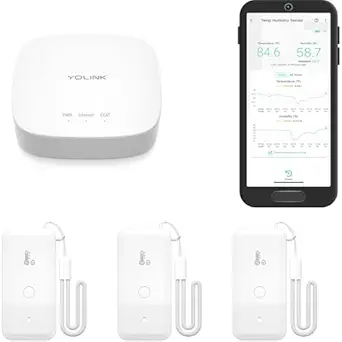 | Best for Long-Range, Multi-Environment Monitoring | Temperature Range: -4°F to 129°F | Humidity Range: 0% to 100% | Temperature Accuracy: ±0.36°F | VIEW ON AMAZON | See Our Full Breakdown |
| YoLink Smart Wireless Temperature & Humidity Sensor (3-Pack) |  | Best for Versatile, Long-Range Monitoring in Multiple Environments | Number of Sensors: 3 | Connectivity: LoRa | Power Source: 2 AAA batteries | VIEW ON AMAZON | See Our Full Breakdown |
| Cellular Temperature Monitor, Power Outage Alarm & Humidity Sensor |  | Best for Continuous Power and Outage Alerts in Remote Locations | Connectivity Technology: Cellular | Power Source: Rechargeable Lithium Ion battery | Upper Temperature Range: 120 °F | VIEW ON AMAZON | See Our Full Breakdown |
| Temp Stick Remote WiFi Temperature & Humidity Sensor with Data Logging |  | Best Overall for Versatile Indoor Monitoring | Connectivity: WiFi 2.4 GHz only | Battery Life: 1-2 years | Power: 2xAA batteries | VIEW ON AMAZON | See Our Full Breakdown |
| Wireless Vaccine Temperature Monitoring System |  | Best for Ultra-Low Temperature Lab Storage | Temperature Range: -90°C to 40°C | Includes: UTREL30-WIFI Data Logger, External Sensor, Wall Mount | Connectivity: Wi-Fi | VIEW ON AMAZON | See Our Full Breakdown |
| MOCREO ST10 Ultra Low Wireless Freezer Thermometer -328°F to 392°F with Alerts and Data Logging |  | Best for Cryogenic and High-Accuracy Freezer Monitoring | Temperature Range: -328°F to 392°F | Accuracy: ±1.8°F | Probe Type: RTD | VIEW ON AMAZON | See Our Full Breakdown |
| MOCREO WiFi Remote Thermometer with Freezer Alarm and Long-Range Sensors |  | Best for Outdoor and Long-Range Temperature Monitoring | Temperature Range: -4°F to 131°F | Accuracy: ±0.9°F | Wireless Range: up to 1/3 mile | VIEW ON AMAZON | See Our Full Breakdown |
| pp-Code WiFi Temperature and Humidity Sensor, Thermometer with Alerts |  | Best for Compact Indoor Environments | Connectivity: WiFi 2.4G | Monitoring: Temperature and Humidity | Alerts: Customizable thresholds | VIEW ON AMAZON | See Our Full Breakdown |
| wireless temperature monitoring system for lab | Connectivity | Temperature Range | Battery Life |
|---|---|---|---|
| Elitech RCW-360Pro Cellular & | Cellular (LTE 4G) and Wi-Fi | — | — |
| UTREL30 Dual Sensor Wireless V | — | -90°C to 40°C | — |
| YoLink Smart Wireless Thermome | LoRa-based | -4°F to 129°F | Up to 5 years |
| YoLink Smart Wireless Temperat | LoRa | — | Over 2 years |
| Cellular Temperature Monitor | — | — | — |
| Temp Stick Remote WiFi Tempera | WiFi 2.4 GHz only | — | 1-2 years |
| Wireless Vaccine Temperature M | Wi-Fi | -90°C to 40°C | — |
| MOCREO ST10 Ultra Low Wireless | WiFi 2.4GHz (Hub required) | -328°F to 392°F | Up to 2 years |
| MOCREO WiFi Remote Thermometer | — | -4°F to 131°F | up to 2 years |
| pp-Code WiFi Temperature and H | WiFi 2.4G | — | — |
More Details on Our Top Picks
Elitech RCW-360Pro Cellular & Wi-Fi Remote Temperature Humidity Data Logger
This model stands out for its combination of cellular and Wi-Fi connectivity, making it ideal for monitoring sensitive environments like labs or cold chain logistics from virtually anywhere. Compared with the YoLink sensors, it offers real-time alerts via multiple channels, including SMS and email, with a large offline storage capacity for data security. However, the probes are sold separately, adding to initial costs, and setup can be complex for users unfamiliar with cellular systems. Its dual connectivity and extensive alert options make it a flexible choice for environments where constant oversight is critical, but it requires a cellular network and additional setup effort.
Pros:- Real-time monitoring with multi-channel alerts (app, email, SMS)
- Large offline data storage for security and compliance
- Interchangeable probes for versatile temperature/humidity monitoring
- Accessible remotely via app and web dashboard
Cons:- Probes sold separately, increasing initial costs
- Requires cellular network for full remote access
- Setup can be complex for less tech-savvy users
Best for: Labs or businesses needing comprehensive remote monitoring with customizable alerts and offline data storage
Not ideal for: Small laboratories or users seeking a simple, plug-and-play solution without cellular setup complexities
- Connectivity:Cellular (LTE 4G) and Wi-Fi
- Data Storage:100,000 points offline storage
- Probes:Interchangeable types (sold separately)
- Display:Large LCD screen
- Temperature Units:Celsius and Fahrenheit
- Alarm Types:Sound, light, app, email, SMS
Our verdict“This system is best suited for labs needing reliable, customizable remote environmental data with extensive alerting capabilities, despite its more involved setup.”
UTREL30 Dual Sensor Wireless Vaccine Temperature Monitoring System
This system excels at monitoring vaccine refrigerators and freezers, with its dual external sensors covering a broad temperature range from -90°C to 40°C. Compared to the YoLink sensors, it offers more specialized data collection and audible alarms for immediate alerts. Its reliance on AC power limits its use in remote locations, and battery backup may require maintenance over time. Designed specifically for vaccine storage, it provides reliable, automatic data logging, but isn’t suitable for environments where power sources are inconsistent or where long-term battery independence is needed.
Pros:- Wireless data upload to online platform for easy access
- Supports multiple external sensors for comprehensive coverage
- Audible alarm and LED signals for real-time alerts
- Designed specifically for vaccine cold chain compliance
Cons:- Requires AC power connection, limiting placement flexibility
- Battery backup may need replacement over time
- No Wi-Fi connectivity, only wireless via dedicated sensors
Best for: Healthcare facilities or vaccine storage units requiring precise, continuous temperature monitoring with reliable alarms
Not ideal for: Remote outdoor environments or locations lacking consistent AC power, due to its dependence on mains power
- Temperature Range:-90°C to 40°C
- Sensors:2 external sensors
- Power:AC powered with AAA batteries backup
- Data Storage:16,129 samples
- Includes:UTREL30-WIFI data logger, sensors, wall mount, calibration
- Alarm:Audible and LED signals
Our verdict“Ideal for vaccine storage environments needing dependable, automatic temperature logging with immediate alerting, though limited by power source constraints.”
YoLink Smart Wireless Thermometer Hygrometer 3-Pack
This three-sensor pack leverages LoRa technology to deliver long-range wireless monitoring up to a quarter mile in open air, making it well-suited for greenhouses, pet cages, or outdoor labs. The sensors provide high-precision temperature and humidity readings with a battery life of up to five years, surpassing many Wi-Fi-based options in longevity. Compared to the YoLink temperature/humidity sensor 3-pack, this set is more versatile with automation options via Alexa and IFTTT. However, the need for a hub and limited SMS messages per month may restrict use for some users seeking more extensive communication channels.
Pros:- Long-range wireless connectivity up to 1/4 mile outdoors
- Battery life of up to 5 years reduces maintenance
- High-precision temperature (±0.36°F) and humidity measurements
- Supports automation via Alexa and IFTTT
Cons:- Limited SMS alerts—only 5 messages per device per month
- Requires a hub for operation, adding complexity
- Humidity alerts cannot be voice-queried via Alexa
Best for: Research labs or agricultural settings requiring long-range, low-maintenance environmental monitoring with automation integration
Not ideal for: Indoor labs or short-range monitoring needs, where Wi-Fi options are more straightforward and do not require a hub
- Temperature Range:-4°F to 129°F
- Humidity Range:0% to 100%
- Temperature Accuracy:±0.36°F
- Connectivity:LoRa-based
- Battery Life:Up to 5 years
- Includes:1 Hub, 3 Sensors
Our verdict“Best for outdoor or large-area environments needing long-distance monitoring with automation, but less suitable for indoor or simple setups without a hub.”
YoLink Smart Wireless Temperature & Humidity Sensor (3-Pack)
This set offers a flexible solution for monitoring temperature and humidity across various settings such as greenhouses, pet cages, and refrigerators. With LoRa connectivity, it provides extensive range without burdening Wi-Fi networks, and supports multiple alert types, including SMS, email, and app notifications. Compared to the YoLink 3-pack, this sensor emphasizes versatility and long battery life (over 2 years). However, it requires a hub for full functionality, and the humidity alerting features do not support voice queries. Its long-range capabilities make it suitable for remote monitoring but add setup complexity.
Pros:- Long-range LoRa connectivity suitable for remote locations
- Includes batteries with over 2 years of operation
- Supports multiple alert options including SMS, email, and app
- Suitable for various environments like greenhouses and pet cages
Cons:- Humidty monitoring not voice query compatible
- Requires a hub for full operation
- Limited SMS messages per device per month
Best for: Facilities needing long-range environmental sensors in outdoor or large indoor spaces that want flexibility and multiple alert options
Not ideal for: Small indoor labs or environments where Wi-Fi is preferred over LoRa technology due to setup simplicity
- Number of Sensors:3
- Connectivity:LoRa
- Power Source:2 AAA batteries
- Battery Life:Over 2 years
- Humidity Support:Yes
- Hub Required:Yes
Our verdict“Excellent for long-distance, multi-environment monitoring where power efficiency and alert flexibility are priorities, despite the need for a hub.”
Cellular Temperature Monitor, Power Outage Alarm & Humidity Sensor
This cellular-based sensor simplifies remote monitoring with its integrated cellular connection, providing 24/7 updates on temperature, humidity, and power status, with two years of included service. Compared to Wi-Fi or LoRa options, it offers straightforward setup and reliable alerts for environments prone to power outages or where cellular coverage is robust. However, it requires a subscription renewal after two years and has limited battery life for long-term standalone use. It’s especially suitable for homes, RVs, or pet environments where cellular coverage is available and simple installation is preferred.
Pros:- Includes two years of cellular service with no hidden fees
- Real-time alerts for temperature, humidity, and power outages
- Rechargeable battery for continuous monitoring during outages
- Easy setup via mobile app
Cons:- Requires subscription renewal after two years
- Limited battery life for extended standalone use
- Dependent on cellular network coverage
Best for: RVs, homes, or remote sites needing reliable, cellular-based environmental and power monitoring with minimal setup
Not ideal for: Locations with poor cellular coverage or users seeking long-term battery-powered solutions without ongoing subscription costs
- Connectivity Technology:Cellular
- Power Source:Rechargeable Lithium Ion battery
- Upper Temperature Range:120 °F
- Reusability:Rechargeable
- Duration:2 years
- Color:White
Our verdict“Best for users wanting hassle-free cellular monitoring with power outage alerts, but beware of ongoing subscription costs and coverage limitations.”
Temp Stick Remote WiFi Temperature & Humidity Sensor with Data Logging
The Temp Stick stands out for its simplicity, long battery life, and reliable WiFi connectivity, making it a solid choice for monitoring labs where ease of setup and ongoing alerts matter. It excels over products like the pp-Code Sensor in offering unlimited text and email alerts without subscription fees, though it is limited to 2.4 GHz WiFi and doesn’t support enterprise networks. Its data logging supports up to one month offline, suitable for routine checks rather than continuous high-frequency data. Compared to the MOCREO ST10, it’s less specialized for ultra-low temperatures but is more user-friendly for general lab environments. The major tradeoff is its WiFi limitation, which could be a concern in complex network setups. Overall, this pick makes the most sense for labs seeking straightforward remote alerts and long-term data logging without overly complex configuration.
Pros:- Unlimited email and text alerts without subscription fees
- Battery life of 1-2 years minimizes maintenance
- Supports automation with Alexa and IFTTT
Cons:- Limited to 2.4 GHz WiFi networks, restricting some enterprise setups
- Not suitable for environments requiring ultra-low temperature monitoring
Best for: Small to medium labs needing reliable, easy-to-implement WiFi monitoring with no subscription fees
Not ideal for: Labs requiring high-frequency data logging or operation on 5 GHz networks
- Connectivity:WiFi 2.4 GHz only
- Battery Life:1-2 years
- Power:2xAA batteries
- Supports:Alexa, IFTTT
- Data Logging:Up to one month offline storage
- Made in:USA
Our verdict“A versatile, user-friendly choice for labs prioritizing reliable alerts and long-term data logging without complex network needs.”
Wireless Vaccine Temperature Monitoring System
The Wireless Vaccine Temperature Monitoring System excels in extremely cold environments, offering accurate measurement across -90°C to 40°C, ideal for vaccine storage and cryogenic freezers. Its wide temperature range surpasses many alternatives like the MOCREO ST10, which focuses more on general freezer temperatures. The system uploads data automatically to LogTag Online, enabling remote access, but this requires a subscription, adding ongoing costs. While setup can be complex, the system’s accuracy and cloud integration make it invaluable for labs needing precise control over ultra-low temps. The external sensor probe ensures flexibility but demands careful handling. This option makes the most sense for labs prioritizing ultra-low temperature monitoring with remote data access, despite higher setup complexity and subscription costs.
Pros:- Extremely accurate temperature measurement over a broad range
- Automatic data upload to cloud for remote monitoring
- Includes alarms and calibration certificate
Cons:- Requires a subscription plan for full functionality
- Setup may be complex for less experienced users
Best for: Laboratories storing vaccines or cryogenic samples requiring precise, ultra-low temperature tracking
Not ideal for: Labs seeking a simple, subscription-free monitoring system for general refrigeration needs
- Temperature Range:-90°C to 40°C
- Includes:UTREL30-WIFI Data Logger, External Sensor, Wall Mount
- Connectivity:Wi-Fi
- Subscription Requirement:Yes, for LogTagOnline
- Data Logging:Unlimited
- Made in:Not specified
Our verdict“Perfect for labs needing ultra-low temperature precision and remote data access, with the tradeoff of higher complexity and ongoing costs.”
MOCREO ST10 Ultra Low Wireless Freezer Thermometer -328°F to 392°F with Alerts and Data Logging
The MOCREO ST10 stands out for its extreme temperature range and high accuracy, making it ideal for cryogenic storage and high-end freezer environments. It supports remote alerts via email and app, with data logging for up to 2 years, similar to the Wireless Vaccine System. Unlike the vaccine-specific system, the ST10’s focus on high precision and RTD probe provides more detailed temperature readings, but it requires a MOCREO Hub for operation, adding a layer of setup complexity. Its rechargeable battery offers up to 2 years of use, minimizing maintenance. The external probe, while precise, demands careful handling in sensitive environments. This model fits well for labs where ultra-low, high-accuracy temperature monitoring is essential, but it may be overkill for general refrigeration.
Pros:- Extremely accurate across a wide temperature range
- Supports extensive data logging and export
- Rechargeable battery lasts up to 2 years
Cons:- Requires a MOCREO Hub for operation, increasing initial setup
- Limited to WiFi 2.4GHz, restricting some network environments
Best for: Labs needing precise, ultra-low temperature measurement in cryogenic storage or research labs
Not ideal for: Labs seeking a plug-and-play solution without additional hubs or for general temperature ranges
- Temperature Range:-328°F to 392°F
- Accuracy:±1.8°F
- Probe Type:RTD
- Connectivity:WiFi 2.4GHz (Hub required)
- Battery Life:Up to 2 years
- Data Storage:2 years
Our verdict“Ideal for highly precise, ultra-low temperature monitoring where accuracy and long-term data are priorities, despite needing additional hardware.”
MOCREO WiFi Remote Thermometer with Freezer Alarm and Long-Range Sensors
The MOCREO WiFi Remote Thermometer offers unmatched wireless range, supporting sensors up to 1/3 mile away, making it perfect for outdoor storage, greenhouses, or RVs. Its high-accuracy measurement of ±0.9°F excels in environments where precise, long-distance monitoring is needed, outperforming shorter-range solutions like the Temp Stick in range. It features customizable alerts via app and email, with a robust IP66 waterproof rating for outdoor use. Despite its impressive range, placement outside metal enclosures can interfere with signals, and it depends on WiFi or Ethernet, which might limit flexibility in some outdoor settings. If long-range, high-accuracy monitoring is a priority, this device is a clear choice, but it demands careful placement and network setup.
Pros:- Wireless range up to 1/3 mile (1640 ft)
- High-accuracy measurement with ±0.9°F
- Supports multiple alert types and waterproof IP66 rating
Cons:- Placement outside metal enclosures may interfere with signal
- Requires WiFi or Ethernet connection, limiting flexibility
Best for: Outdoor storage, greenhouses, or RV owners needing long-range, reliable temperature alerts
Not ideal for: Indoor-only labs or environments with significant metal interference that could disrupt signals
- Temperature Range:-4°F to 131°F
- Accuracy:±0.9°F
- Wireless Range:up to 1/3 mile
- Waterproof Rating:IP66
- Battery Life:up to 2 years
- Sensor Compatibility:BLE, LoRa
Our verdict“A top choice for outdoor or remote environments where long-range, precise temperature monitoring is needed, with some considerations for placement and network setup.”
pp-Code WiFi Temperature and Humidity Sensor, Thermometer with Alerts
The pp-Code Sensor offers a compact, easy-to-set-up solution for indoor environments like labs, server rooms, and greenhouses. Its WiFi connectivity allows remote access, and customizable alerts help prevent damage or environmental issues. Compared with the Temp Stick, it provides combined temperature and humidity monitoring, which can be crucial in sensitive lab conditions. Its sleek design makes it easy to place discreetly, but it’s limited to indoor use, and the lack of battery life details suggests it may require continuous power, adding to maintenance. The absence of external sensors or more advanced network options means it’s best suited for straightforward indoor applications where simplicity matters more than extended range or ruggedness.
Pros:- Remote monitoring via WiFi from anywhere
- Customizable alerts for environmental thresholds
- Compact, easy to install and use
Cons:- Limited to indoor environments, not weatherproof
- No information on battery life or power source
Best for: Indoor labs, greenhouses, or server rooms requiring combined temperature and humidity monitoring
Not ideal for: Outdoor environments or labs needing high-precision or long-range sensors
- Connectivity:WiFi 2.4G
- Monitoring:Temperature and Humidity
- Alerts:Customizable thresholds
- Design:Sleek, portable
- API:Available for log access
- Range:Indoor only
Our verdict“A streamlined, space-efficient choice for indoor temperature and humidity tracking, best suited for straightforward environments.”

How We Picked
The products in this roundup were selected based on their performance, connectivity options, ease of installation, build quality, and value for money. We prioritized systems that are designed specifically for laboratory environments, with features like data logging, alert customization, and reliable wireless communication. Devices with multi-sensor capabilities and robust alert systems scored higher, as they address common lab monitoring challenges. The ranking reflects a balance between affordability and feature set, ensuring options suitable for different lab sizes and budgets. We also considered user feedback and industry reputation to identify products that are trusted and proven in real-world lab settings.| wireless temperature monitoring system for lab | Temperature Range |
|---|---|
| Elitech RCW-360Pro Cellular & | — |
| UTREL30 Dual Sensor Wireless V | -90°C to 40°C |
| YoLink Smart Wireless Thermome | -4°F to 129°F |
| YoLink Smart Wireless Temperat | — |
| Cellular Temperature Monitor | — |
| Temp Stick Remote WiFi Tempera | — |
| Wireless Vaccine Temperature M | -90°C to 40°C |
| MOCREO ST10 Ultra Low Wireless | -328°F to 392°F |
| MOCREO WiFi Remote Thermometer | -4°F to 131°F |
| pp-Code WiFi Temperature and H | — |
Factors to Consider When Choosing Wireless Temperature Monitoring System For Labs
Choosing the right wireless temperature monitoring system for a lab involves more than just selecting the most feature-rich device. It’s essential to evaluate how each system integrates into your existing workflows, its reliability, and how it handles critical alerts. The following factors will help you make a well-informed decision that minimizes common pitfalls and maximizes your investment.Connectivity Options and Network Compatibility
Consider whether your lab’s infrastructure supports Wi-Fi, cellular, or hybrid connectivity. Wi-Fi systems are usually easier to set up but depend on a stable network, while cellular options offer greater reliability in environments with poor Wi-Fi coverage. Dual or multi-network systems can provide added security, ensuring continuous monitoring even if one network fails. Think about your current network setup and future scalability before choosing a system.
Sensor Accuracy and Range
Accurate sensors are vital for critical storage like vaccines or pharmaceuticals. Look for systems with proven calibration and low drift over time. Also, evaluate the temperature range and sensor placement flexibility—long-range sensors or multiple probes can prevent blind spots. Remember, a less accurate sensor might be cheaper but could compromise compliance and safety in sensitive environments.
Ease of Use and Setup
Some systems require technical expertise to install and configure, while others are plug-and-play. For busy labs or those with limited technical support, intuitive interfaces and clear setup instructions are worth paying for. Keep in mind that overly complex systems may lead to user errors, while simpler options might lack advanced alert options. Balance these factors based on your team’s technical comfort and monitoring needs.
Alerting Features and Data Logging
Effective alerting—via SMS, email, or app notifications—can prevent costly spoilage or compliance issues. Check whether alerts are customizable and if they include detailed logs for audit purposes. Data logging capabilities also matter, especially if your lab needs historical records for regulatory inspections. Systems with automatic data backup and export options add extra security, but often come at a higher price.
Cost and Long-term Value
Cost varies widely, from affordable starter kits to high-end enterprise systems. Cheaper options might lack key features like multi-sensor support or cellular backup, increasing the risk of blind spots. Conversely, premium systems offer extensive analytics and integrations but may be overkill for smaller labs. Consider your monitoring requirements and budget, focusing on features that genuinely improve safety and compliance rather than just adding bells and whistles.
Frequently Asked Questions
Can I use a wireless temperature monitoring system in a freezer or ultra-low temperature environment?
Yes, many wireless systems are designed to operate effectively in cold storage environments, including freezers and ultra-low temperature units. Look for sensors with a wide temperature range and proven durability in low temperatures—like the MOCREO ST10, which can go down to -328°F. Ensure the system’s signal can penetrate metal enclosures and that the device is rated for the specific temperature range you require. Proper placement and sensor calibration are key to maintaining accuracy in these settings.
How reliable are cellular versus Wi-Fi systems for lab monitoring?
Cellular systems generally provide greater reliability in environments where Wi-Fi signals are weak or unstable, as they operate independently of local networks. However, they depend on cellular coverage, which may vary by location. Wi-Fi systems are easier to install and manage but require a stable network connection, which can be disrupted by network issues or interference. For critical environments, combining both options or choosing dual-enabled systems offers the best assurance of uninterrupted monitoring.
What features should I prioritize for monitoring vaccine refrigerators?
Vaccine storage requires precise temperature control and reliable alerting. Prioritize systems with dual sensors for redundancy, real-time alerts via multiple channels, and data logging for compliance. Look for devices with a proven track record in cold chain management, such as those with long battery life and remote access. Ensuring the sensors are highly accurate and calibrated is vital, as even small deviations can affect vaccine efficacy.
Are all wireless systems compatible with existing lab management software?
Not all wireless monitoring systems integrate directly with lab management platforms. Check whether the device offers APIs or data export options compatible with your existing software. Some premium systems include built-in integrations, making data analysis and compliance reporting easier. If integration is important, verify compatibility before purchasing, as non-compatible systems may require manual data handling, increasing the risk of errors.
How do I maintain and troubleshoot a wireless temperature monitoring system?
Regular maintenance involves checking sensor calibration, replacing batteries, and ensuring network connections are stable. Most systems provide troubleshooting guides for connectivity issues or false alerts. Keeping firmware and software updated is essential for security and performance. For ongoing reliability, establish a routine inspection schedule and keep spare batteries or sensors on hand to minimize downtime. Proper documentation of system configurations also simplifies troubleshooting when issues arise.
Conclusion
For labs seeking a comprehensive, reliable monitoring system, the Elitech RCW-360Pro offers unmatched versatility with cellular and Wi-Fi options, making it ideal for diverse environments. Smaller or less technical teams may prefer the YoLink Wireless Thermometer for its simplicity and affordability. For critical vaccine storage, systems like the UTREL30 Dual Sensor or MOCREO ST10 provide the accuracy and redundancy necessary. Budget-conscious labs should focus on systems with core features like alerting and data logging, while facilities with high compliance needs benefit from premium options with extensive integrations. Your choice should align with your specific monitoring demands, infrastructure, and budget constraints.
Fall Picks
fall essentials
As an affiliate, we earn on qualifying purchases.