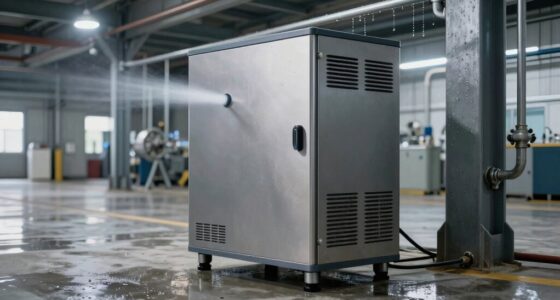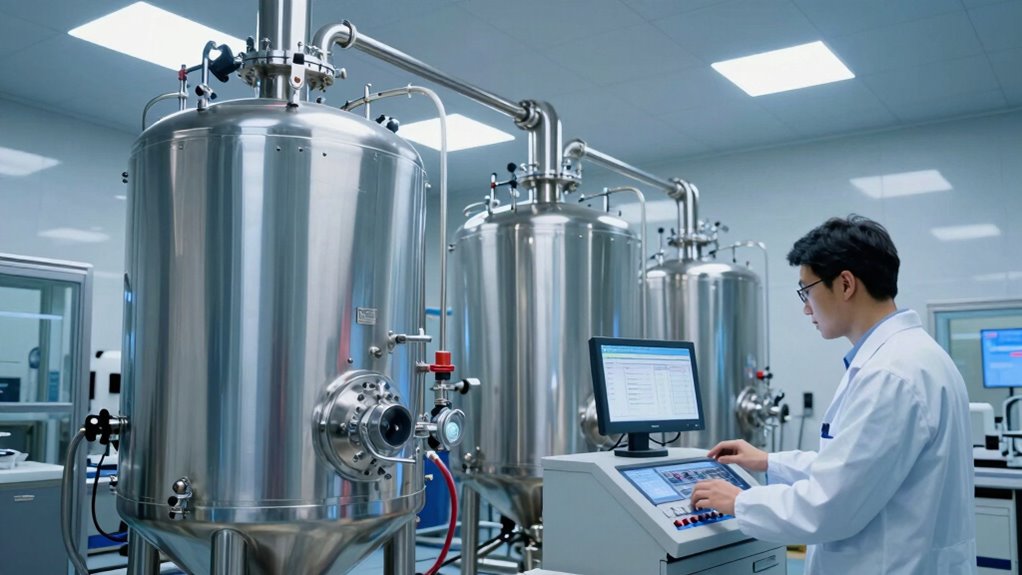

Fermentation is revolutionizing how you produce complex molecules by making biomanufacturing faster, more efficient, and adaptable. With advances in genetic engineering and process optimization, you can now develop microbial strains that deliver higher yields and withstand diverse environments. Integrating bioprocess innovations helps expand capacity while lowering costs. These changes mean quicker product development and a more sustainable supply chain. Keep exploring to discover how these breakthroughs are shaping the future of industrial biotech.

Prime made for students and young adults
- Fast, free delivery for dorm and study essentials
- Prime Video and Amazon Music included
- Member-only deals
Key Takeaways
- Fermentation enables scalable, sustainable production of complex molecules, reducing reliance on traditional chemical synthesis.
- Genetic engineering enhances microbial strains for higher yields and resilience, boosting overall capacity.
- Process optimization ensures consistent quality and efficiency during large-scale fermentation operations.
- Bioprocessing innovations improve yields and reduce costs, supporting rapid capacity expansion.
- Modular and flexible fermentation methods accelerate product development, meeting growing demand in personalized medicine.
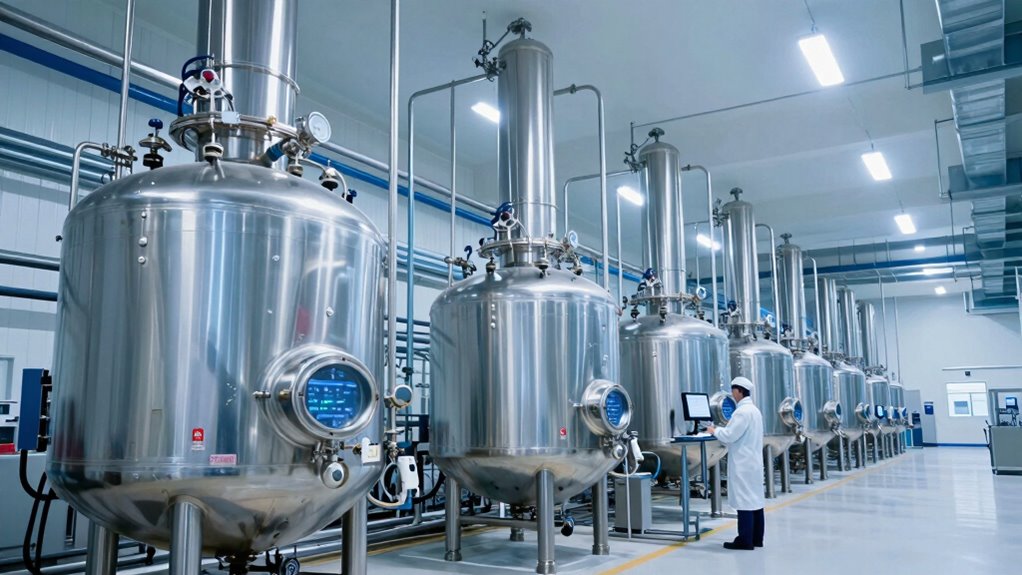
Have you ever wondered how much biotech industry capacity is available to meet the growing demand for innovative therapies and solutions? It’s a pressing question as the need for sustainable and efficient molecule production accelerates. At the heart of this transformation is fermentation, a process that’s become central to industrial biotech. This approach leverages living organisms to produce complex molecules, reducing reliance on traditional chemical synthesis. But what truly fuels this shift is the strategic use of genetic engineering and process optimization. Genetic engineering allows scientists to fine-tune microorganisms, making them more efficient at producing desired compounds. By editing their DNA, you can enhance pathways that generate valuable molecules, increasing yields and reducing production time. This precision engineering not only boosts capacity but also helps in creating strains that are more resilient, adaptable, and capable of operating under a variety of industrial conditions.
Genetic engineering enhances microbial efficiency, boosting capacity and creating resilient, adaptable strains for sustainable biotech production.
Process optimization further amplifies this capacity. You can streamline fermentation workflows to maximize output while minimizing waste. Through careful control of variables like temperature, pH, and nutrient flow, you *guarantee* that microorganisms work at peak efficiency. Advanced bioprocessing techniques also enable scale-up from lab to industrial production without losing consistency or quality. This means you can meet rising demand without the typical bottlenecks associated with traditional manufacturing. The combination of genetic engineering and process optimization allows for rapid iteration and continuous improvement, creating a flexible biotech capacity that can respond swiftly to market needs. Additionally, integrating bioprocessing innovations can further improve yields and reduce costs, making capacity expansion more feasible. Enhancing microbial performance is a key focus in this area, as it directly impacts capacity and resilience. Moreover, genetic modifications can be used to develop microbial strains tailored for specific production environments, further expanding capacity and robustness in production processes. As these techniques evolve, the overall biotech capacity continues to grow, enabling faster and more efficient molecule supply.
Furthermore, the modular nature of fermentation-based production gives you a distinct advantage. You can re-engineer existing processes to produce different molecules, making your capacity adaptable to various therapies—from biologics to specialty chemicals. This flexibility is *essential* in a landscape where personalized medicine and novel therapies are emerging quickly. By investing in these advanced techniques, you’re not only increasing your capacity but also *guaranteeing* it’s sustainable and scalable. The ability to produce complex molecules more efficiently means faster development timelines, lower costs, and a healthier pipeline of innovative products. Additionally, advancements in fermentation are enabling the development of more resilient microbial strains, further expanding capacity and robustness in production processes.
In essence, the growth of fermentation technologies driven by genetic engineering and process optimization is reshaping how you think about molecule supply. It’s transforming industrial biotech from a niche approach into a powerhouse capable of meeting the global demand for life-changing therapies. As you leverage these advancements, you’re positioning yourself at the forefront of a new era—one where capacity is not just about volume but about agility, precision, and sustainability.
industrial fermentation bioreactors
As an affiliate, we earn on qualifying purchases.
As an affiliate, we earn on qualifying purchases.
Frequently Asked Questions
How Does Fermentation Compare to Traditional Chemical Synthesis in Cost?
Fermentation typically offers a lower cost comparison to traditional chemical synthesis, especially for complex molecules. You’ll find that fermentation benefits from economic factors like renewable raw materials and less energy consumption, reducing overall expenses. While initial investments can be high, ongoing costs tend to be lower due to scalable biological processes. Overall, fermentation often proves more cost-effective, particularly for producing specialty and bio-based molecules, making it an attractive alternative to chemical synthesis.
What Are the Main Challenges in Scaling Fermentation Technologies?
They say “A chain is only as strong as its weakest link,” and that’s true in fermentation. You face challenges like optimizing genetic pathways and scaling up processes efficiently. Genetic optimization helps improve yields, but it’s complex and time-consuming. Process automation can streamline operations, yet integrating new tech at large scales remains tricky. Overcoming these hurdles requires innovation, patience, and precise control to grow fermentation’s role in molecule supply.
How Sustainable Is Fermentation-Based Molecule Production?
Fermentation-based molecule production is quite sustainable when you prioritize eco-friendly practices and use renewable resources. You can reduce environmental impact by optimizing processes to lower energy consumption and waste. By sourcing raw materials from renewable feedstocks, you lessen reliance on fossil fuels. While challenges remain, adopting sustainable methods makes fermentation a greener alternative, helping you produce molecules more responsibly and contribute to a circular economy.
Which Industries Benefit Most From Fermentation Advancements?
Imagine a bustling factory where tiny microbial artisans craft molecules with precision. You’ll see industries like pharmaceuticals, agriculture, and textiles reaping the benefits of fermentation advancements. Bioreactor optimization streamlines production, while microbial engineering open new possibilities. These innovations accelerate molecule supply, reduce costs, and enhance sustainability, making your favorite products more accessible. As fermentation evolves, it’s transforming industries into vibrant ecosystems of innovation and efficiency.
What Future Innovations Could Further Transform Biotech Capacity?
You could see future innovations like advanced synthetic pathways and genetic engineering revolutionizing biotech capacity further. By refining synthetic pathways, you’ll enable more efficient molecule production, reducing costs and environmental impact. Genetic engineering will allow you to customize microorganisms for specific outputs, increasing yields and diversity of products. These breakthroughs could lead to more sustainable, scalable manufacturing processes, transforming industries like pharmaceuticals, biofuels, and specialty chemicals even more profoundly.
Conclusion
As you witness fermentation’s rise in industrial biotech, it’s clear this revolution is more than just a wave—it’s a tidal shift transforming molecule supply. Imagine a future where sustainable, cost-effective solutions are no longer dreams but realities, powered by this incredible technology. Don’t stand on the shore watching the tide come in—dive in and embrace the profound impact fermentation is making. After all, in this new era, the possibilities are as boundless as the science itself.
Fall Picks
fall essentials
As an affiliate, we earn on qualifying purchases.