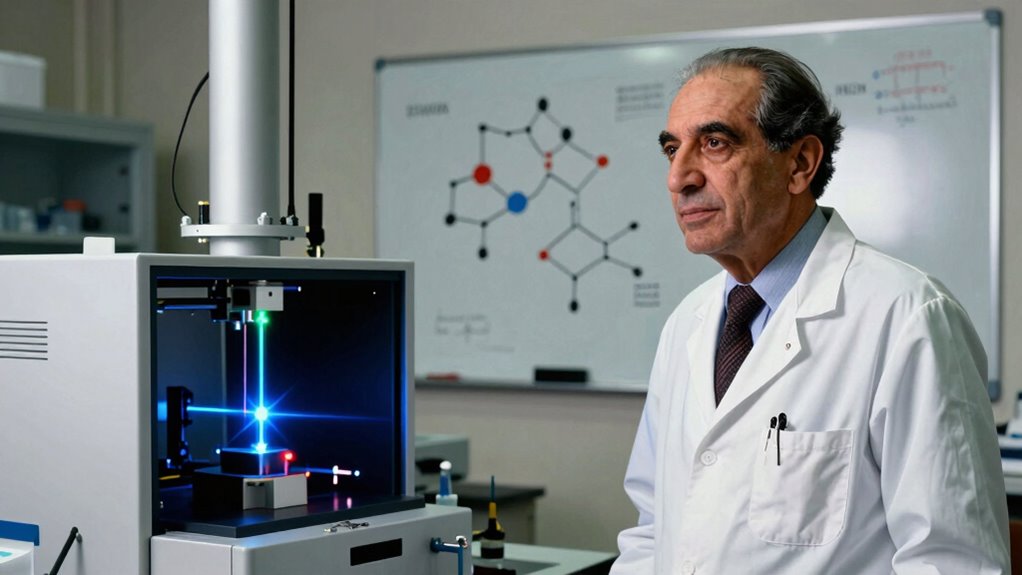

Ahmed Zewail revolutionized chemistry by pioneering femtochemistry, allowing you to observe molecules in action within trillionths of a second. His development of ultrashort laser pulses acted as high-speed cameras, capturing bond-breaking and forming in real time. This breakthrough transformed how scientists understand molecular dynamics, bridging theory and experiment. If you’re curious about how he changed our view of chemical reactions and what’s next in this fascinating field, there’s more to discover ahead.

Prime made for students and young adults
- Fast, free delivery for dorm and study essentials
- Prime Video and Amazon Music included
- Member-only deals
Key Takeaways
- Ahmed Zewail pioneered femtochemistry by developing ultrashort laser pulses to observe chemical reactions in real time.
- His work enabled the visualization of bond breaking and forming at the atomic and molecular levels.
- Zewail’s advancements bridged the gap between theoretical models and experimental observations in chemistry.
- His innovations in laser spectroscopy provided the temporal resolution necessary to study ultrafast molecular dynamics.
- Zewail’s contributions revolutionized understanding of chemical reaction mechanisms and earned him the Nobel Prize in Chemistry.
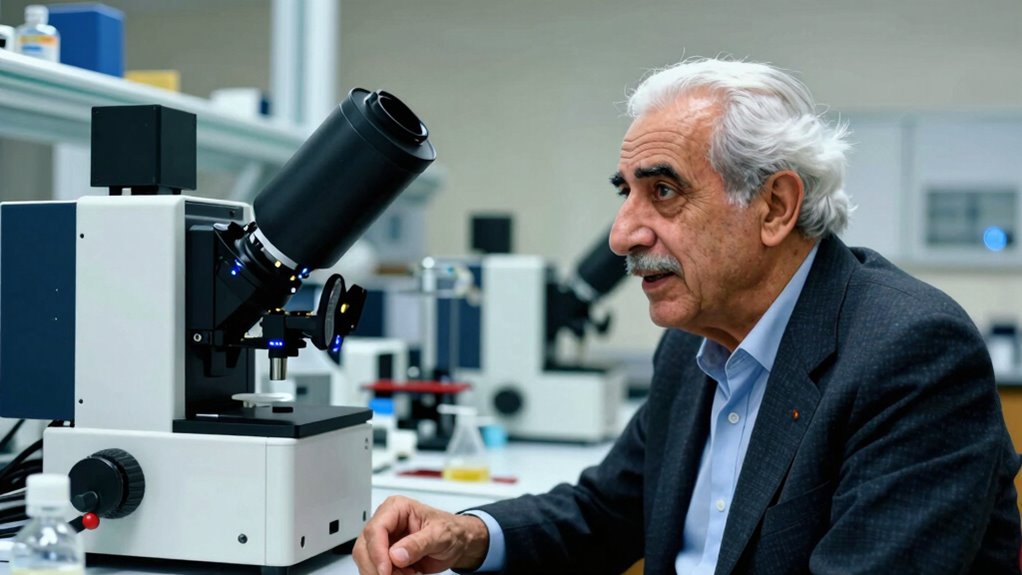
Ahmed Zewail revolutionized our understanding of chemical reactions by pioneering femtochemistry, a field that captures the fleeting moments when molecules break and form bonds. Through this groundbreaking work, you learn how scientists can observe and analyze chemical processes occurring on incredibly short timescales—trillionths of a second. This achievement opened new doors to studying molecular dynamics in real time, transforming theoretical concepts into observable phenomena. You see that Zewail’s approach relies heavily on advanced laser spectroscopy techniques, which enable scientists to generate ultrashort laser pulses. These pulses act like high-speed cameras, freezing molecular motions and revealing the precise sequence of events during a reaction. With this technology, you’re able to visualize how bonds stretch, break, and reform in real time, providing a detailed picture that was previously impossible to obtain.
In femtochemistry, the focus is on understanding the dynamics of molecules as they shift through various states during a reaction. You recognize that molecular dynamics simulations complement laser spectroscopy by offering theoretical insights into these rapid processes. These simulations help interpret experimental data, showing how molecules vibrate, rotate, and interact at the atomic level. Zewail’s work bridged the gap between theory and experiment, allowing you to witness the actual choreography of atoms as they respond to energy inputs. Laser spectroscopy, in particular, plays a crucial role because it provides the temporal resolution necessary to track ultrafast events. When you study these interactions, you appreciate how laser pulses can be finely tuned to match the timescale of molecular motions, enabling precise temporal snapshots. Additionally, the development of ultrashort laser pulses has been essential in advancing femtochemistry, making it possible to observe these rapid phenomena directly. This technological innovation has also spurred the development of new analytical tools that continue to expand our capabilities in molecular research. Moreover, the integration of advanced laser techniques has led to significant breakthroughs in related fields, such as biochemistry and materials science.
As you explore deeper, you understand that Zewail’s innovations paved the way for new research avenues in chemistry, biology, and materials science. You see that by capturing molecular dynamics in real time, scientists can better understand reaction mechanisms, design more efficient catalysts, and develop targeted pharmaceuticals. The ability to observe molecules in action allows you to appreciate the complexity and elegance of chemical processes at an atomic level. Ultimately, Zewail’s pioneering work in femtochemistry and the integration of laser spectroscopy have revolutionized how we explore the molecular world, giving you a window into the swift, intricate ballet of atoms that underpins all chemical transformations.
ultrashort laser pulse spectrometer
As an affiliate, we earn on qualifying purchases.
As an affiliate, we earn on qualifying purchases.
Frequently Asked Questions
What Inspired Ahmed Zewail to Pursue Femtochemistry?
You’re curious about what inspired Ahmed Zewail to pursue femtochemistry. His fascination with understanding chemical reactions at an atomic level drove him. He was motivated by the desire for innovative techniques that could capture real-time, experimental breakthroughs in molecular dynamics. By pushing technological boundaries, he aimed to see the fleeting moments of reactions, ultimately transforming chemistry into a more precise and dynamic science.
How Did Zewail’s Background Influence His Scientific Career?
You might not realize it, but Zewail’s background deeply shaped his scientific path. Growing up in a culture that values education and family support, he found encouragement to pursue his curiosity. Coincidentally, his family’s unwavering backing gave him the confidence to explore groundbreaking ideas. These cultural influences and support system fueled his passion, helping him push the boundaries of science and ultimately revolutionize femtochemistry.
What Challenges Did Zewail Face in Developing Femtochemistry?
You face significant challenges in developing femtochemistry, especially technological limitations that restrict measuring ultra-fast chemical reactions. Funding obstacles also hinder progress, making it hard to access advanced equipment and conduct extensive research. Despite these hurdles, your perseverance and innovative use of available technology enable breakthroughs. Overcoming these obstacles requires resourcefulness and determination, ultimately helping you push the boundaries of understanding chemical dynamics at an unprecedented timescale.
How Has Femtochemistry Impacted Other Scientific Fields?
Femtochemistry has profoundly impacted fields like quantum mechanics and molecular dynamics by allowing you to observe chemical reactions in real-time at the femtosecond scale. This breakthrough helps you understand atomic-level interactions and energy transfers more accurately. As a result, you can develop better models, improve drug design, and innovate new materials, pushing the boundaries of science and technology with insights that were previously impossible to achieve.
What Awards Did Zewail Receive for His Contributions?
You might not know, but Ahmed Zewail received the Nobel Prize in Chemistry in 1999 for his groundbreaking work in femtochemistry, which revolutionized how we comprehend chemical reactions. His scientific recognition extends beyond the Nobel, earning numerous awards and honors worldwide. Zewail’s achievements highlight his significant contribution to science, inspiring generations to explore the ultrafast world of molecules and their fleeting states.
Conclusion
You now see how Ahmed Zewail revolutionized chemistry with femtochemistry, capturing reactions in femtoseconds. His groundbreaking work opened new doors for understanding molecular processes. Just as the early bird catches the worm, Zewail’s pioneering spirit reminds us that innovation often comes from daring to look closer and faster. Keep pushing boundaries, and you’ll find that even the tiniest moments can lead to the biggest discoveries.
Fall Picks
fall essentials
As an affiliate, we earn on qualifying purchases.