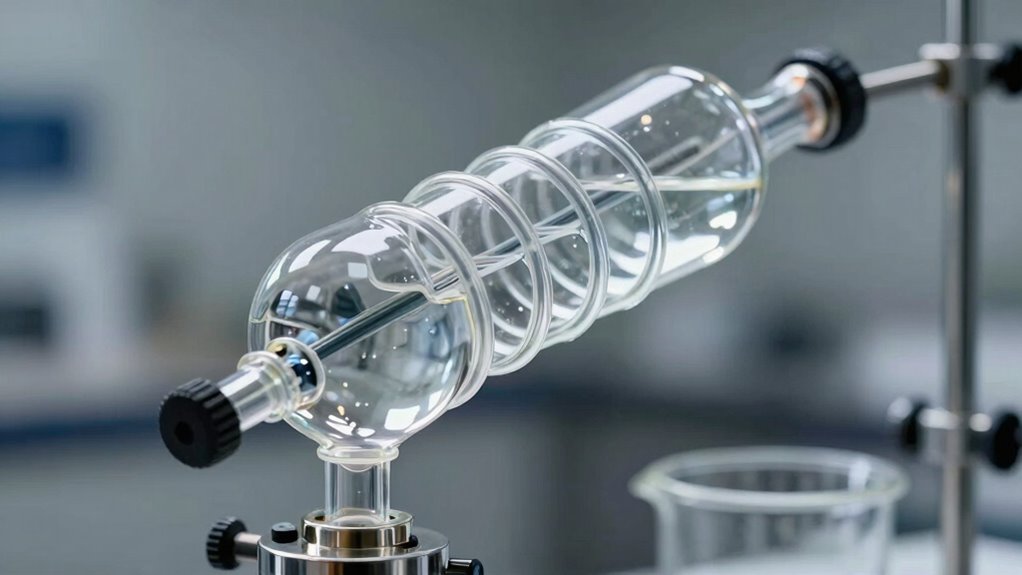

Short path distillation is best suited for small-scale, high-purity separations of heat-sensitive substances like cannabis or essential oils. It’s effective when you need precise temperature control to isolate specific compounds without thermal degradation. However, it’s not ideal for large quantities or when components have similar boiling points. If you want to understand how to optimize this process or explore its limitations, there’s more to discover about its applications and best practices.
Key Takeaways
- Ideal for small-scale, high-purity separations of heat-sensitive compounds like cannabis and essential oils.
- Less effective for large-volume processing or mixtures with closely boiling components.
- Requires precise temperature control and skilled operation for optimal results.
- Suitable when thermal degradation must be minimized, ensuring product integrity.
- Not recommended for bulk or rapid processing, where other distillation methods are more efficient.
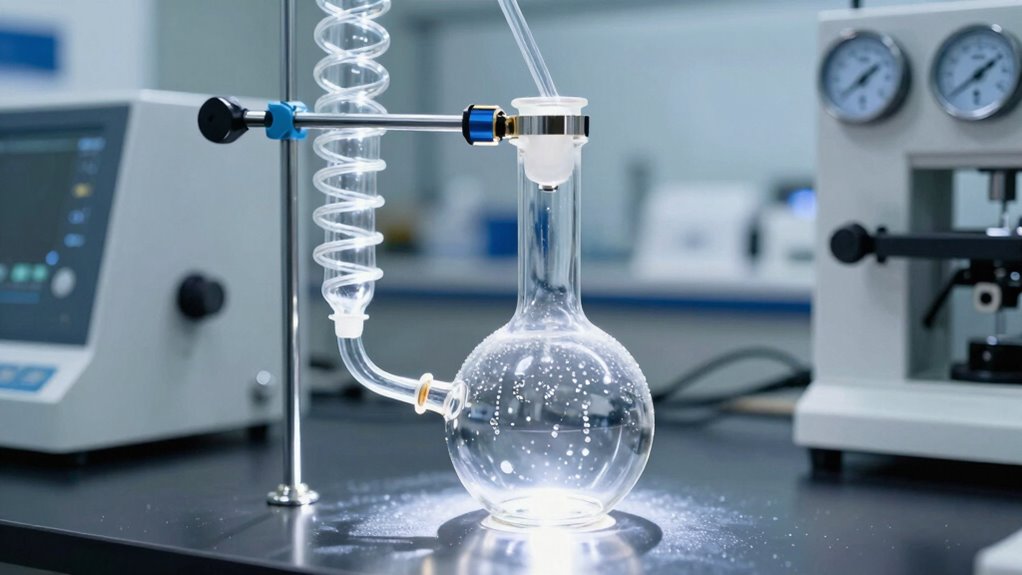
Have you ever wondered how high-purity cannabis or essential oils are efficiently isolated? The answer often lies in short path distillation, a technique prized for its ability to produce exceptional chemical purity. When you’re aiming to separate complex mixtures into their most refined components, maintaining precise temperature control becomes critical. Short path distillation allows you to do just that, thanks to its design that minimizes heat exposure and reduces the risk of thermal decomposition. This process involves a heated, closed-loop system where the vapor travels a short distance before condensation, enabling rapid separation and high purity of the target compounds.
In this method, temperature control is paramount. You need to carefully regulate the heat to ensure that only the desired molecules vaporize at specific temperatures, leaving behind unwanted impurities. This precise control helps you achieve a cleaner separation, which is essential when working with sensitive substances like cannabinoids or aromatic oils. The short path setup minimizes the amount of material exposed to heat, reducing the chance of thermal degradation and preserving the integrity of the compounds. This makes it particularly suitable for isolating high-value, heat-sensitive substances where purity is non-negotiable. Additionally, the effectiveness of this technique relies heavily on precise temperature control, ensuring optimal separation and product quality. Proper equipment maintenance is also vital to prevent contamination and ensure consistent results. Furthermore, understanding the properties of target compounds can help optimize the distillation process for better efficiency. Recognizing the limitations of small-scale distillation can also guide you in choosing the right method for larger productions. Moreover, selecting appropriate distillation apparatus is crucial for achieving the best results and maintaining safety standards.
However, short path distillation isn’t a universal solution. Its strength lies in refining small quantities of heat-sensitive materials with high purity, but it’s less effective for large-scale separations. If you’re dealing with bulk quantities or mixtures with closely boiling components, other distillation methods, like wiped film or batch distillation, may be more appropriate. Short path distillation also requires precise control equipment and skilled operation to optimize temperature settings and prevent loss of product or contamination. It’s not the best choice if you need rapid, high-volume processing or if the compounds you’re separating have similar boiling points, which can make effective separation challenging.

LYJIANGXIN 2L Short Path Distillation Kit, Short Path Distillation Apparatus, with Heating Mantle, Cold Trap, Lab Glassware, Short Path Distillation Process Equipment, for Science Teaching
- Material: Borosilicate glass for durability
- Heating System: Fast, safe heating with jacket
- Insulation: High-temperature fiberglass lining
As an affiliate, we earn on qualifying purchases.
As an affiliate, we earn on qualifying purchases.
Frequently Asked Questions
What Are the Safety Precautions for Short Path Distillation?
You should always wear proper safety equipment, like gloves, goggles, and lab coats, to protect yourself during short path distillation. Guarantee proper hazard mitigation by working in a well-ventilated area and using a fume hood if necessary. Regularly inspect your glassware for cracks and leaks, and never operate the equipment unattended. Following these precautions minimizes risks and keeps you safe throughout the process.
How Does Temperature Affect Distillation Efficiency?
You should understand that temperature considerably impacts distillation efficiency by influencing distillation kinetics. By optimizing the temperature, you guarantee that the vaporization process occurs efficiently, minimizing impurities and maximizing yield. Too high a temperature can cause decomposition, while too low slows distillation. Proper temperature optimization balances these factors, improving overall efficiency. Monitoring and controlling temperature carefully allows you to enhance the separation process and achieve better product purity.
Can Short Path Distillation Be Scaled for Industrial Use?
Yes, short path distillation can be scaled for industrial use, but you need to carefully consider industrial scalability and cost considerations. Larger equipment and optimized processes are essential to maintain efficiency at a bigger scale. While initial investment may be high, the precision and purity achieved make it worthwhile for high-value products. Just make certain your setup balances throughput with cost-effectiveness, and you’ll successfully adapt it for industrial applications.
What Are Common Contaminants Removed During Distillation?
During distillation, you remove common contaminants like solvent residues and particulate matter, ensuring a purer product. Some might worry about the effectiveness, but distillation efficiently separates these impurities based on boiling points. This process helps eliminate unwanted solvents and tiny solids, improving product quality. So, if you’re aiming for cleaner extracts, distillation is a reliable method to remove these contaminants and enhance purity.
How Does Vacuum Level Influence Separation Quality?
You’ll find that vacuum pressure directly impacts separation clarity during distillation. When you reduce vacuum pressure, you lower the boiling points of components, allowing for more precise separation at lower temperatures. This minimizes thermal degradation and guarantees contaminants are effectively removed. By maintaining ideal vacuum levels, you enhance separation quality, achieving a purer product. So, controlling vacuum pressure is essential for improving separation clarity and overall distillation efficiency.
Conclusion
Just like the alchemists’ quest for purest gold, short path distillation offers a refined path to purity, but only where precision and clarity matter most. It’s a tool that whispers secrets of separation, yet isn’t a one-size-fits-all solution. Recognize its place in your process, and you’ll harness its power without falling into the trap of overreach. In this dance of molecules, remember: mastery lies in knowing when to lead and when to follow.