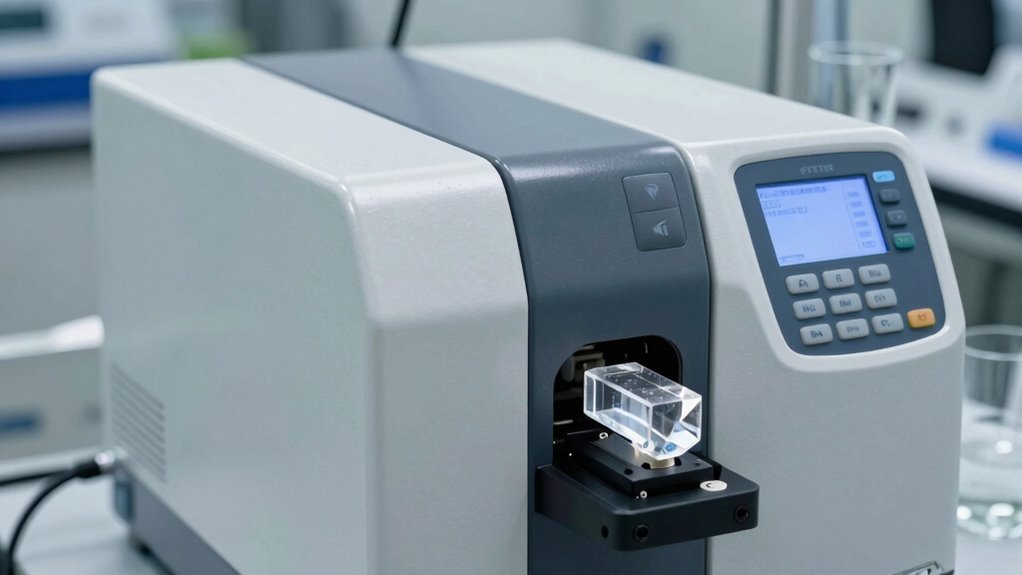

If you’re looking for a quick, non-destructive way to analyze solids, powders, or liquids that are hard to prepare, ATR is your best option. It simplifies sample handling by allowing you to place samples directly on the crystal, saving you time and reducing contamination. Its durability and consistent results make it ideal for routine analysis. Keep exploring to discover more about how ATR can boost your FTIR spectroscopy workflows.

Prime made for students and young adults
- Fast, free delivery for dorm and study essentials
- Prime Video and Amazon Music included
- Member-only deals
Key Takeaways
- ATR simplifies analysis of solids, powders, and liquids that are difficult to prepare as thin films or pellets.
- It enables rapid, routine measurements with minimal sample handling, ideal for quick screening.
- Durable ATR accessories ensure consistent performance during frequent use and routine operations.
- Suitable for qualitative and semi-quantitative analysis, especially surface and functional group identification.
- Provides high reproducibility by direct contact with the crystal, reducing sample variability.
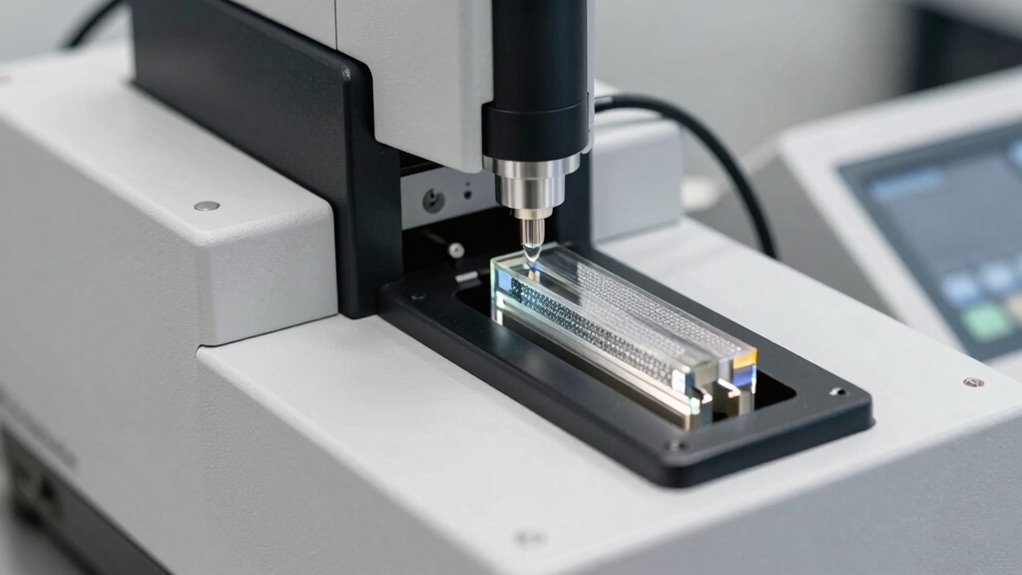
Fourier Transform Infrared (FTIR) spectrometers are powerful tools for identifying and analyzing materials, but choosing the right accessory can substantially impact your results. When it comes to selecting the best option, Attenuated Total Reflectance (ATR) accessories often stand out, especially depending on your sample preparation needs and the spectral resolution you require. ATR is particularly advantageous when you want minimal sample handling or need quick, reliable measurements.
Sample preparation plays an essential role in obtaining high-quality spectra. If you’re working with solids, powders, or liquids that are difficult to dissolve or prepare as thin films, ATR simplifies the process. You simply place the sample directly onto the crystal surface, eliminating the need for extensive grinding, pellet formation, or solvent-based preparations. This not only saves time but also reduces potential contamination or sample loss. For biological tissues, polymers, or other complex materials, ATR allows you to analyze samples in their native state, preserving their integrity and ensuring consistent results. Additionally, ATR’s ease of use makes it a popular choice for rapid screening and routine analysis.
Furthermore, ATR accessories often feature a robust design, which enhances durability during frequent use in laboratory environments, ensuring consistent performance over time. Spectral resolution is another critical factor. ATR accessories typically provide sufficient resolution for most qualitative and semi-quantitative analyses, making them suitable for identifying functional groups, characterizing surfaces, or monitoring chemical changes. If your work demands ultra-high resolution, such as differentiating closely overlapping peaks, traditional transmission modes might be preferable. However, for routine analysis, ATR generally delivers clear, sharp spectra that facilitate quick interpretation.
Choosing ATR also minimizes the need for extensive sample preparation, which can often introduce variability or contamination, thereby affecting spectral resolution. Because the sample is in direct contact with the crystal, the measurement is more reproducible and less prone to errors caused by sample thickness or uneven distribution. This consistency is especially beneficial when analyzing multiple samples or conducting quality control.
FTIR spectrometer with ATR accessory
As an affiliate, we earn on qualifying purchases.
As an affiliate, we earn on qualifying purchases.
Frequently Asked Questions
How Does ATR FTIR Compare to Traditional Reflection Methods?
You’ll find ATR FTIR offers better spectral resolution and faster measurement speed compared to traditional reflection methods. It requires less sample preparation and provides more consistent contact, resulting in more accurate results. While traditional reflection might be suitable for reflective surfaces, ATR excels with solids, liquids, and thin films. Overall, ATR FTIR is more versatile, efficient, and user-friendly, making it the preferred choice for many analytical applications.
Can ATR FTIR Analyze Thick or Highly Absorbing Samples?
You can analyze thick or highly absorbing samples with ATR FTIR, but spectral resolution might decrease due to limited penetration depth. ATR is highly sample compatible because it handles various surface types without extensive preparation. However, for very thick or strongly absorbing materials, traditional transmission methods may provide better spectral detail, as ATR’s shallow penetration can limit the amount of information obtained from deeply embedded features.
What Maintenance Is Required for ATR Accessories?
A stitch in time saves nine, so proper maintenance keeps your ATR accessories in top shape. You should regularly check accessory durability and follow cleaning protocols to prevent contamination and guarantee accurate results. Keep the crystal clean with appropriate solvents, and inspect it for scratches or damage. Regular calibration and careful handling extend the lifespan of your ATR accessories, making sure your spectrometer remains reliable and precise.
Are There Limitations to Sample Types for ATR FTIR?
You should be aware that ATR FTIR has limitations with certain sample types. Highly oily or greasy samples can be difficult because they may not form proper contact with the crystal, affecting sample compatibility. Additionally, some soft or fragile samples risk damaging the crystal, impacting instrument durability. To guarantee accurate results and protect your equipment, choose samples that are compatible with ATR’s contact requirements and handle fragile materials carefully.
How Does Sample Preparation Differ for ATR Versus Other FTIR Methods?
You handle samples differently with ATR versus other FTIR methods. With ATR, you typically need minimal sample preparation—just clean and dry the surface, then place it directly on the crystal. In contrast, other FTIR techniques might require grinding, pellet pressing, or thin-film preparation to guarantee proper transmission. ATR’s straightforward sample handling saves time, making it ideal for quick, in-situ analysis without complex preparation protocols.
Conclusion
So, when should you choose ATR over traditional FTIR spectrometers? The answer isn’t always straightforward. While ATR offers quick, direct analysis of solids and liquids, there’s a hidden edge that might surprise you—one that could change your entire approach to spectroscopy. Are you ready to discover which method truly fits your needs and reveal the secrets hidden in your samples? The choice isn’t just technical; it could be the key to your next breakthrough.
Halloween Picks
halloween
As an affiliate, we earn on qualifying purchases.