

Covalent Organic Frameworks (COFs) are porous, crystalline materials with highly tunable electronic properties that set them apart from MOFs. You can modify their conjugated structures to control conductivity, charge mobility, and optical features for applications like sensors and energy storage. Embedding guest molecules can further enhance their performance. If you explore more, you’ll discover how these versatile frameworks are shaping the future of materials science, offering exciting opportunities beyond MOFs.

Prime made for students and young adults
- Fast, free delivery for dorm and study essentials
- Prime Video and Amazon Music included
- Member-only deals
Key Takeaways
- COFs are crystalline, porous materials built from covalently linked organic molecules, similar to MOFs but composed entirely of light elements.
- They offer tunable electronic properties through conjugated frameworks, enabling applications in electronics and sensing.
- Unlike MOFs, COFs have stronger covalent bonds, providing enhanced stability and customizable porosity.
- COFs can incorporate guest molecules to further modify their electronic and functional properties.
- Computational modeling accelerates the design of COFs with targeted features, complementing experimental synthesis efforts.
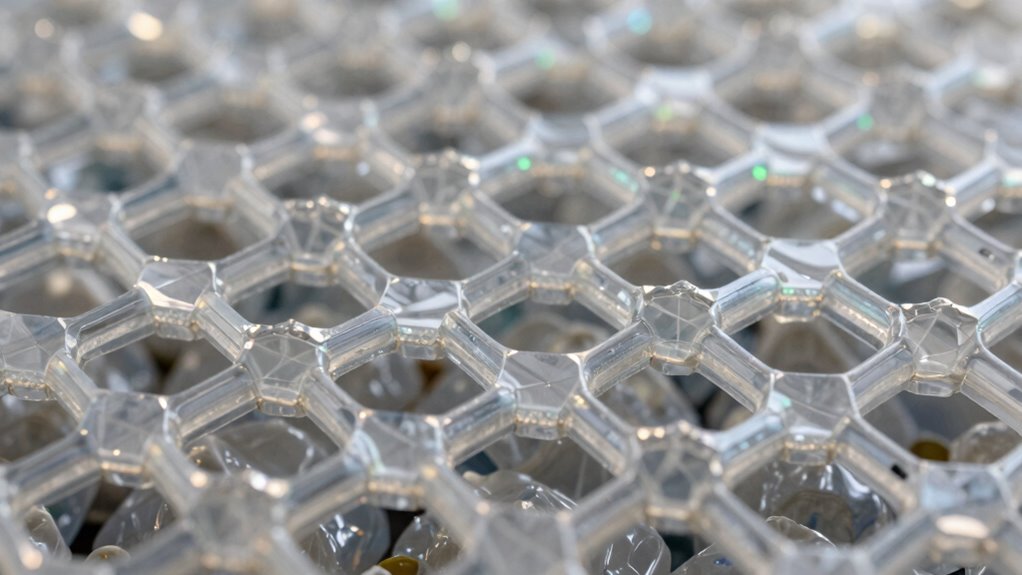
Understanding the electronic properties of COFs is essential if you want to harness their full potential. Unlike many other porous materials, COFs can exhibit remarkable electronic behavior, thanks to their conjugated structures and tunable linkers. When you modify the building blocks, you can influence properties like charge mobility, conductivity, and optical absorption. This tunability means you can design COFs for specific electronic or optoelectronic applications, such as sensors, organic semiconductors, or energy storage devices. The ability to control these properties at the molecular level gives you a powerful toolset for developing next-generation materials.
Furthermore, the combination of guest synthesis and electronic property tuning opens up new avenues in material science. You can, for instance, embed conductive guest molecules into a COF’s pores to create composite materials with enhanced electrical conductivity. Alternatively, by choosing guest molecules that interact strongly with the framework, you can develop highly selective sensors that respond to specific analytes. The interplay between guest synthesis and electronic properties isn’t just theoretical; it has practical implications, allowing you to craft materials that are both highly functional and customizable.
A key advantage of COFs over other porous materials is their conjugated structures, which enable their electronic properties to be precisely tailored through molecular design. In essence, COFs offer a unique platform where you can manipulate both their internal structure and electronic characteristics to suit your needs. Their ability to host guest molecules while maintaining or enhancing electronic functionality makes them stand out as a promising alternative or complement to metal-organic frameworks (MOFs). As research advances, you’ll find more innovative ways to leverage these features, pushing the boundaries of what porous, crystalline materials can achieve. Advances in computational modeling are also playing a crucial role in predicting and optimizing these properties efficiently.
As an affiliate, we earn on qualifying purchases.
Frequently Asked Questions
How Do COFS Compare to Traditional Porous Materials?
You’ll find that covalent organic frameworks (COFs) offer better structural stability than many traditional porous materials, thanks to their strong covalent bonds. Their synthesis methods are more versatile, often involving bottom-up design and organic reactions, which allow for precise control over pore size and functionality. Unlike some traditional materials, COFs can be tailored for specific applications, making them a promising alternative in areas like gas storage, sensing, and catalysis.
What Are the Latest Applications of COFS?
You’ll be amazed how COFs are revolutionizing technology with their nanostructure tuning and functional versatility. These materials are now leading breakthroughs in gas storage, catalysis, and sensor development, transforming industries overnight. Their customizable frameworks let you fine-tune properties for specific applications, making them invaluable in environmental cleanup, drug delivery, and energy storage. COFs are truly pushing the boundaries of what’s possible in materials science, and you’ll want to keep an eye on their rapid advancements.
Are COFS Scalable for Industrial Use?
You’ll find that covalent organic frameworks (COFs) face scalability challenges when it comes to industrial integration. Producing large quantities while maintaining their precise structure is tricky, but researchers are making progress. Advances in synthesis methods are helping overcome these hurdles, making COFs more viable for industrial applications. So, while not fully scalable yet, ongoing innovations suggest that large-scale production could become feasible in the future.
How Environmentally Friendly Are COFS to Produce?
You might find it surprising, but COFs can be quite eco-friendly to produce. When you opt for green synthesis methods, such as using less toxic solvents and milder conditions, the ecological impact decreases considerably. This approach minimizes waste and energy consumption, making COFs more sustainable. Overall, with careful choice of materials and processes, you can reduce environmental harm while creating these innovative frameworks.
Can COFS Be Customized for Specific Functions?
Yes, you can customize COFs for specific functions thanks to their high structural tunability and functionalization potential. By selecting different building blocks and linkers, you can tailor pore sizes, chemical functionalities, and stability to suit applications like sensing, catalysis, or gas storage. This flexibility makes COFs versatile, allowing you to design materials precisely aligned with your needs while maintaining their inherent structural robustness.
Conclusion
As you explore covalent organic frameworks, you’re discovering a revolutionary class of materials poised to transform technology as we know it. These “cousins” of MOFs aren’t just innovative—they’re groundbreaking, holding the potential to reshape industries and solve pressing global challenges. Embrace the future of materials science with these extraordinary frameworks; they’re more than just molecules—they’re the key to opening a brighter, smarter world. Get ready, because this is just the beginning of a remarkable journey!
Evergreen bestsellers Picks
bestsellers
As an affiliate, we earn on qualifying purchases.