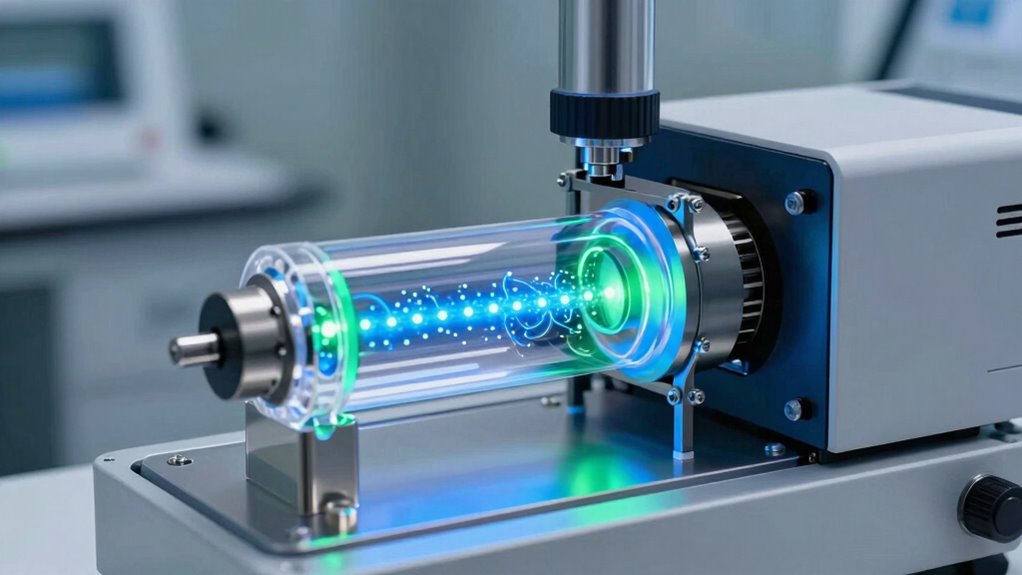

Ion mobility spectrometry (IMS) is a fast method that helps you identify chemicals by measuring how ions move through a gas when an electric field is applied. It separates molecules based on their size and shape, making it ideal for quickly detecting substances like drugs, explosives, or pollutants. IMS is portable and works with little sample prep, so you can get results fast. If you explore further, you’ll discover how this technique is constantly improving and used in many fields.

Prime made for students and young adults
- Fast, free delivery for dorm and study essentials
- Prime Video and Amazon Music included
- Member-only deals
Key Takeaways
- Ion Mobility Spectrometry (IMS) separates charged particles based on how fast they drift through a gas under an electric field.
- IMS quickly identifies substances by measuring how ions move, often in milliseconds.
- It is often combined with other methods like mass spectrometry or gas chromatography for better analysis.
- IMS is portable and used for on-site detection of explosives, drugs, toxins, or pollutants.
- Advances in IMS improve its ability to distinguish similar ions and analyze complex samples more accurately.
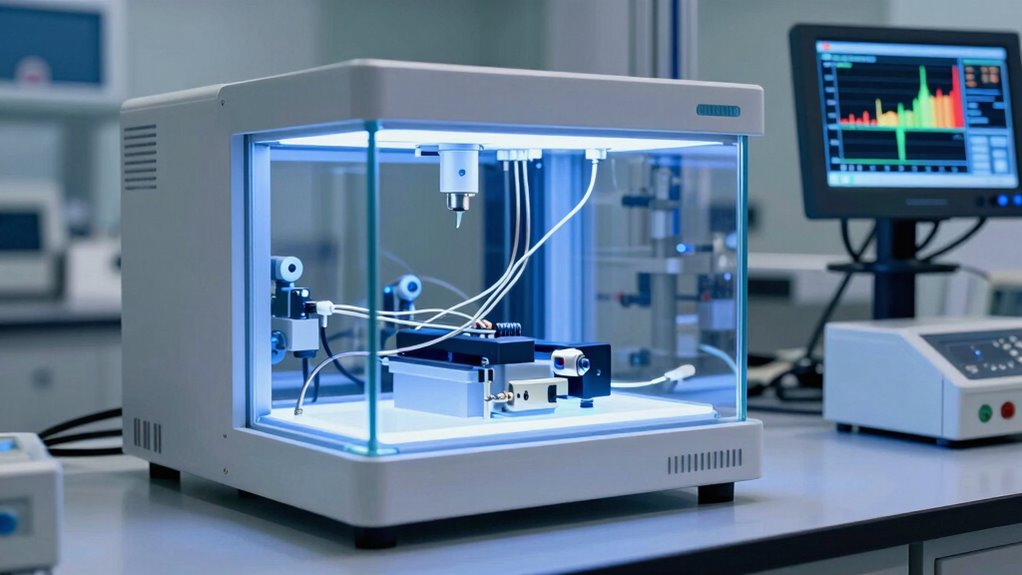
You might wonder how IMS compares to other methods like mass spectrometry or gas chromatography. IMS is often combined with mass spectrometry, creating a hybrid system that gives you both separation and detailed identification. Mass spectrometry measures the mass-to-charge ratio of ions, providing precise molecular information, while IMS quickly separates ions based on their physical properties. This combination enhances your ability to analyze complex samples, such as biological fluids, environmental samples, or chemical mixtures. Gas chromatography, on the other hand, separates compounds in a mixture based on their volatility before they even reach the IMS detector. When you use gas chromatography with IMS, you first separate the mixture into its components, then identify each one based on how it moves in the IMS drift tube. This layered approach improves accuracy and resolution, especially when dealing with very similar compounds. Additionally, ion mobility separation allows for rapid analysis that can be tailored to specific applications, making IMS highly versatile. Moreover, advancements in instrumentation continue to expand IMS’s capabilities, allowing for more precise and reliable results in diverse fields. Factors such as electric field strength can also be adjusted to optimize ion mobility, further enhancing analytical performance. The mobility of ions in the drift tube can be influenced by factors such as electric field strength, temperature, and gas composition, which can be optimized for different analytical goals. Recent innovations, such as high-resolution IMS, are improving the ability to distinguish very similar ions, broadening IMS applications even further. In practical terms, IMS is valued for its speed—sometimes providing results in milliseconds—and its portability, making it ideal for field testing or on-site analysis. You can use it to detect explosives, drugs, toxins, or pollutants quickly, often with minimal sample preparation. Since IMS can be integrated with other analytical techniques like mass spectrometry and gas chromatography, you get an all-encompassing picture of your sample’s composition. This synergy allows you to identify unknown substances, confirm the presence of specific chemicals, or monitor changes over time with high sensitivity. Because it’s capable of analyzing ions directly in the gas phase, IMS reduces the need for extensive sample processing, saving you time and effort.
portable ion mobility spectrometer
As an affiliate, we earn on qualifying purchases.
As an affiliate, we earn on qualifying purchases.
Frequently Asked Questions
How Does Ion Mobility Spectrometry Differ From Mass Spectrometry?
You find that ion mobility spectrometry separates ions based on how quickly they move through a gas, focusing on ion separation by size and shape. In contrast, mass spectrometry sorts ions by their mass-to-charge ratio. Ion mobility provides rapid, real-time data analysis of ion behavior, while mass spectrometry offers detailed mass information. Together, they give you an all-encompassing understanding of complex samples, enhancing your analytical capabilities.
What Are Common Applications of Ion Mobility Spectrometry?
You’ll find ion mobility spectrometry commonly used in drug detection and explosive analysis. It helps identify trace amounts of substances quickly and accurately by separating ions based on their movement in a gas. Airports, security agencies, and forensic labs rely on it for rapid screening of luggage, cargo, or evidence. Its portability and speed make it ideal for on-the-spot detection of dangerous or illegal materials.
How Sensitive Is Ion Mobility Spectrometry in Detecting Substances?
You’ll find ion mobility spectrometry highly sensitive, capable of detecting substances at very low concentrations. Its detection limits are remarkably fine, identifying trace amounts in complex samples. To achieve this, thorough sample preparation is crucial—removing interferences, concentrating samples, and optimizing conditions. This combination of sensitive detection and meticulous sample prep ensures you can reliably detect even tiny quantities of substances, making IMS a powerful tool for rapid, accurate analysis.
Can Ion Mobility Spectrometry Identify Unknown Compounds?
Yes, ion mobility spectrometry can help identify unknown compounds, but it faces analytical challenges. You’ll need to compare the detected ion’s mobility with known databases or perform additional tests to confirm the compound’s identity. While it’s useful for unknown compound detection, you should be aware that complex mixtures or similar substances might complicate identification. So, combining it with other techniques often yields the best results.
What Are the Limitations of Ion Mobility Spectrometry?
You should know that ion mobility spectrometry has limitations, such as sensitivity to sample preparation and instrument calibration. In fact, studies show that improper sample prep can cause false positives or missed detections in 30% of cases. These issues can lead to inaccurate results, especially with complex mixtures. To avoid this, you need to carefully prepare samples and regularly calibrate your instrument, ensuring reliable and precise analysis.
Conclusion
As you explore deeper into ion mobility spectrometry, you’ll realize it’s more than just a tool—it’s a gateway to uncovering hidden secrets. Its precision and speed make it invaluable, but the true potential remains shrouded in mystery, waiting to be accessed. What breakthroughs could it lead to? Only time will tell. Keep exploring, and you might just be on the brink of revealing discoveries that could change everything.
Fall Picks
fall essentials
As an affiliate, we earn on qualifying purchases.