
When you use portable particle counters in cleanrooms, understanding what the counts mean is vital for maintaining compliance and safety. These devices measure airborne particles against strict standards, with thresholds indicating environmental quality. Proper calibration guarantees your readings are accurate over time, helping you identify when contamination levels exceed permitted limits. Environmental factors like humidity and temperature can influence results, so interpreting data accurately relies on knowing these influences. Keep exploring to discover how calibration and standards help you verify your cleanroom stays safe and compliant.
Key Takeaways
- Particle counts indicate the level of airborne contaminants, with standards defining acceptable limits for specific environments.
- Proper calibration ensures particle measurements accurately reflect real cleanliness levels in cleanrooms.
- Exceeding cleanroom particle count standards signals potential contamination risks requiring corrective action.
- Particle size ranges monitored are critical; different industries require specific size thresholds for compliance.
- Regular calibration and understanding measurement standards are essential for interpreting cleanroom particle data reliably.
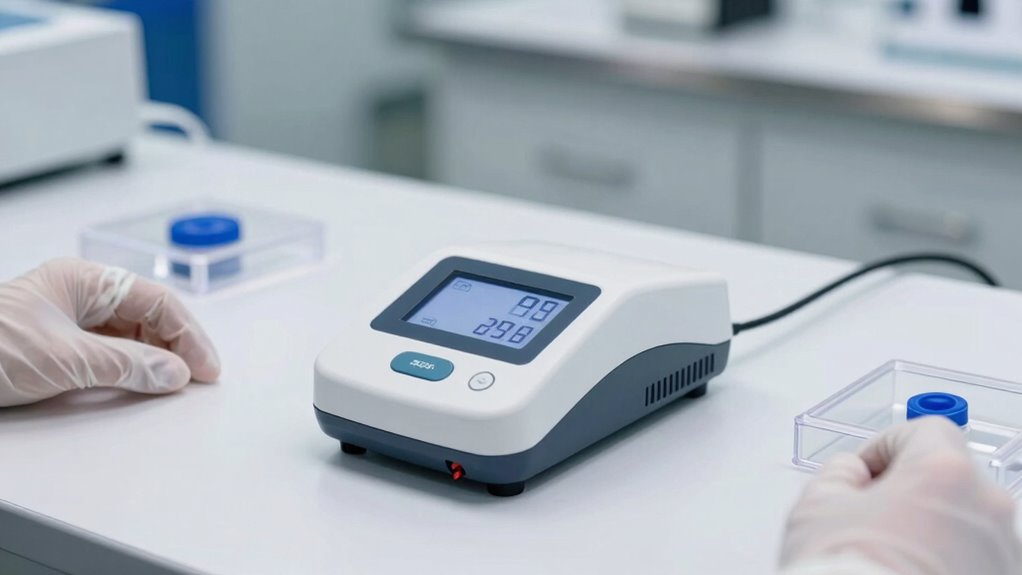
To guarantee your particle counter provides accurate readings, you need to pay attention to calibration procedures. Proper calibration aligns your device’s measurements with recognized standards, ensuring reliable data. Regular calibration is essential because factors like temperature, humidity, and device age can influence readings over time. When you follow strict calibration procedures, you minimize measurement inaccuracies, which is especially important in environments where even tiny deviations can compromise product quality or safety. Calibration typically involves using a standard aerosol or test aerosol generator, which produces particles of known size and concentration. You’ll compare your device’s readings against these known values and adjust accordingly. Some portable counters have auto-calibration features, but manual calibration using certified standards remains the most precise method. calibration procedures help maintain your device’s accuracy over time, ensuring consistent and trustworthy data collection. Maintaining proper calibration also involves understanding particle measurement standards, which are critical for interpreting cleanroom data accurately. Understanding what cleanroom counts really mean hinges on your ability to interpret particle data correctly. Cleanroom standards, often expressed as specific particle counts per cubic meter, serve as benchmarks for acceptable levels of airborne contaminants. When your device detects particle counts exceeding these standards, it signals that the environment might be compromised, prompting you to investigate and address potential issues. You must also consider the size of particles being measured because different environments have different requirements for particle size ranges. For example, a pharmaceutical cleanroom might require monitoring for particles as small as 0.3 micrometers, making precise measurement critical. Additionally, knowing how environmental factors like humidity and temperature affect particle detection can help improve measurement accuracy. Understanding environmental influences can further optimize your calibration and measurement practices. Moreover, staying informed about measurement accuracy helps ensure your data remains reliable for critical decision-making.

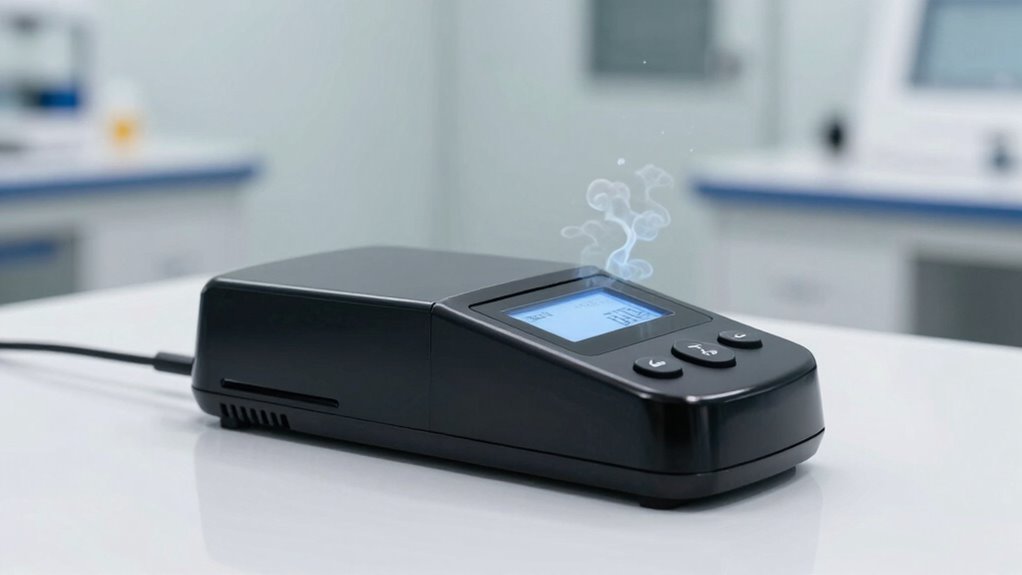
Temtop PMD331 Professional Particle Counter, 7-Channel Handheld Laser Dust Monitor (0.3-10μm), ISO 21501-4 Certified for Cleanroom, Laboratory & HVAC, 2M+ Data Logger with RS485 Modbus
- ISO 21501-4 Certified Accuracy: High-precision calibration for cleanroom use
- 7-Channel Particle Monitoring: Simultaneous detection of seven particle sizes
- Advanced Mie-Scattering Technology: Provides instant air quality insights
As an affiliate, we earn on qualifying purchases.
As an affiliate, we earn on qualifying purchases.
Frequently Asked Questions
How Often Should Portable Particle Counters Be Calibrated?
You should calibrate your portable particle counters at least every 6 to 12 months, depending on manufacturer recommendations and your facility’s regulatory requirements. Regular calibration guarantees accurate readings and maintains compliance. Incorporate calibration into your maintenance procedures, and consider more frequent checks if the device experiences heavy use or harsh environments. Proper calibration frequency helps you trust your cleanroom data and avoid costly compliance issues.
What Is the Maximum Particle Size Detection Capability?
Think of your particle counter like a detective with a keen eye—its detection thresholds for particle size analysis typically reach down to 0.3 microns, catching even the tiniest suspects. This means it can detect particles as small as 0.3 microns in size, making it highly effective for cleanroom monitoring. Knowing these limits helps you guarantee your environment meets strict contamination standards and maintains product quality.
Are Portable Counters Suitable for All Cleanroom Classifications?
Portable counters are suitable for many cleanroom classifications, but their portable accuracy varies depending on the device and cleanroom standards. For highly sensitive environments like ISO Class 1 or 2, you might need more sophisticated, stationary equipment to meet strict standards. However, for less critical areas, portable counters offer reliable, flexible monitoring, helping you verify your cleanroom maintains the appropriate cleanliness levels without compromising on accuracy or convenience.
How Long Does a Typical Battery Last During Testing?
A typical portable particle counter’s battery lasts about 4 to 8 hours during testing, depending on battery maintenance and power consumption. You can extend battery life by turning off the device when not in use and avoiding unnecessary functions. Regularly checking and maintaining the battery helps guarantee peak performance. Keep an eye on power consumption, as high settings or continuous operation can drain the battery faster, reducing testing time.
Can Portable Counters Record Data Automatically?
Yes, portable counters can record data automatically through data logging features. This allows you to store particle count data over time without manual input. To guarantee accuracy, you should regularly perform calibration, typically based on the device’s calibration frequency recommendations. Automated data logging simplifies compliance and tracking, making it easier to analyze trends, maintain cleanroom standards, and prepare reports efficiently.
Conclusion
In brief, understanding what cleanroom counts really mean can profoundly impact your work environment. Did you know that even a single particle can compromise a cleanroom’s standards? That’s why using portable particle counters is essential—they give you real-time data, helping you maintain strict cleanliness levels. By staying vigilant and monitoring consistently, you guarantee product quality and safety. Remember, in cleanroom environments, every particle counts—literally.