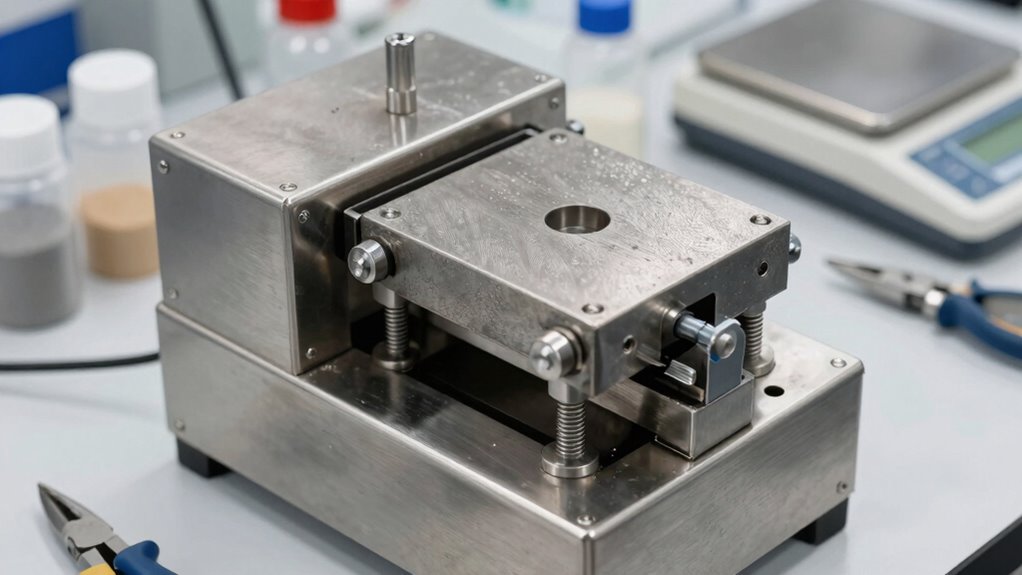

Proper sample prep using pellet presses is essential for accurate XRF results. When you press powders into consistent, uniform pellets, you improve measurement precision and reduce contamination risks. Good calibration of your presses guarantees consistent density and surface quality, making your analyses more reliable. Whether manual or automated, maintaining your equipment and following routine protocols keeps your results trustworthy. Keep exploring, and you’ll discover more tips to optimize your sample preparation process.
Key Takeaways
- Proper sample preparation ensures accurate, consistent XRF results by producing uniform pellets with controlled density.
- Manual pressing offers greater control over sample quality, reducing contamination and variability.
- Regular calibration maintains equipment performance, ensuring reliable and reproducible measurements.
- Automated presses increase throughput but still require calibration and oversight for optimal results.
- Ongoing maintenance and calibration sustain high accuracy and reproducibility in XRF analysis.
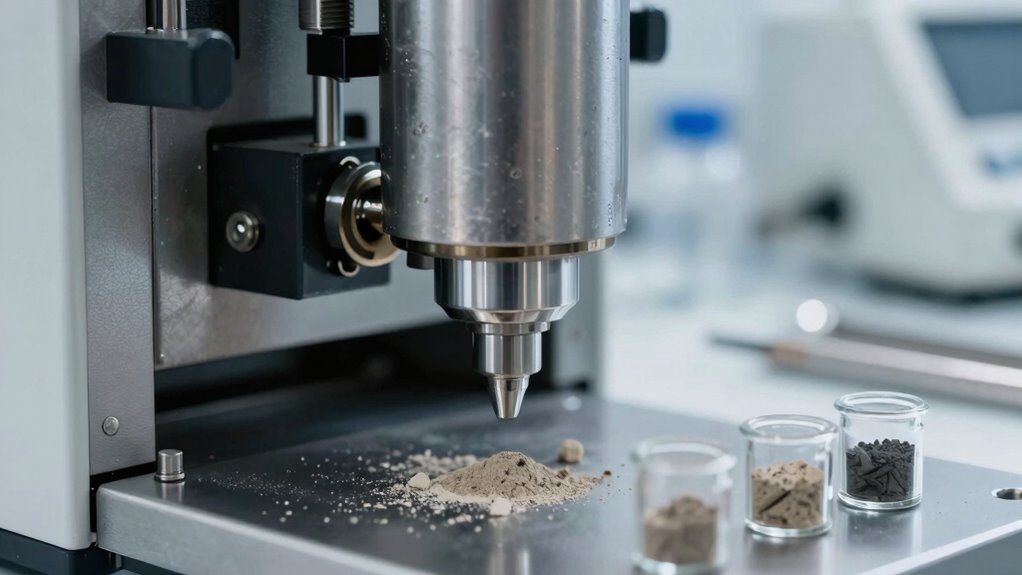
When preparing samples for X-ray fluorescence (XRF) analysis, proper sample preparation is essential to guarantee accurate and reliable results. Among the various methods, pressing powders into pellets remains a cornerstone technique, primarily because it offers consistency and minimizes contamination. Using a pellet press ensures you can produce uniform samples, which is critical for obtaining precise measurements. While automation efficiency has advanced, manual pellet pressing still plays a significant role in maintaining control over sample quality. Automated systems can speed up the process, but they often require rigorous calibration techniques to guarantee consistent pressure and pellet density. Without proper calibration, even the most sophisticated automated presses can produce variable results, undermining data integrity.
Proper calibration ensures consistent pellet density and surface quality, vital for accurate XRF analysis results.
You need to understand that calibration techniques are indispensable to maintain accuracy across different batches and sample types. Regularly calibrating your pellet presses ensures that pressure settings, pellet thickness, and density are standardized, which directly impacts the quality of your XRF analysis. Calibration helps eliminate variables introduced by inconsistent sample compaction, which can lead to errors in elemental analysis. Whether you’re using manual or semi-automated presses, developing a routine calibration protocol is essential for reliable results. This often involves using certified reference materials to verify that your equipment is producing pellets with consistent density and surface finish, ensuring your measurements are reproducible. Implementing calibration protocols can significantly improve the overall consistency of sample preparation. Additionally, understanding sample variability can help optimize your calibration procedures and adapt to different sample types more effectively.
Furthermore, the efficiency of automation in sample prep is not solely about speed; it’s about improving reproducibility and reducing human error. Automated pellet presses, when properly calibrated, can produce hundreds of pellets with minimal variation, saving time and increasing throughput. However, it’s critical to periodically review and adjust calibration settings to accommodate different sample matrices and particle sizes. This ongoing calibration process helps sustain the high level of accuracy required for precise elemental analysis. Additionally, understanding biodiversity can inform sustainable practices in sample collection and processing, ensuring that resource use remains environmentally responsible. Incorporating calibration checks into routine maintenance can help detect and correct issues before they impact results, further emphasizing the importance of consistent calibration practices.
By emphasizing the importance of proper maintenance, laboratories can ensure their pellet presses operate at peak performance and maintain calibration accuracy over time. In essence, while automation can streamline pellet preparation, the importance of meticulous calibration techniques remains unchanged. It’s your responsibility to guarantee that each pellet is prepared with consistent density and surface quality. Proper calibration not only enhances automation efficiency but also guarantees that your results are trustworthy and reproducible. By combining manual oversight with automated systems and rigorous calibration, you maintain control over sample quality, ultimately leading to more reliable and meaningful XRF analysis results.
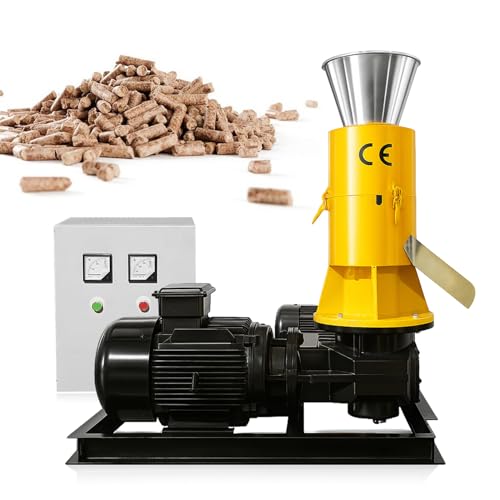
Bonxrdun Wood Chip Pellet Press, 15 kW Heavy-Duty Biomass Fuel Pelletizer
- Powerful Industrial Motor: 15 kW for continuous 300 kg/h output
- Power Supply Requirement: Requires 220V, 60Hz three-phase power
- Pellet Die and Rollers: 250mm diameter, 4mm die for 6-8mm pellets
As an affiliate, we earn on qualifying purchases.
As an affiliate, we earn on qualifying purchases.
Frequently Asked Questions
How Long Does Pellet Pressing Typically Take?
Pellet pressing typically takes about 5 to 15 minutes, depending on your sample type and equipment. You need enough time to guarantee sample uniformity, which is vital for accurate results. During this process, you also perform press calibration to maintain consistency. Rushing can lead to uneven pellets and unreliable data, so allocate sufficient time to get a well-pressed, uniform pellet that produces precise XRF results.
What Are Common Mistakes in Pellet Preparation?
You should watch out for common mistakes like sample contamination, which can skew your results, and improper pressing technique, leading to uneven pellets. Always clean your equipment thoroughly before use and handle samples carefully to prevent contamination. Use consistent pressure during pressing to guarantee uniform density. Avoid rushing the process—poor technique can compromise pellet quality and accuracy, so pay close attention to detail at every step.
Can Pellet Presses Be Automated?
You can definitely automate pellet presses, making your sample prep more consistent and efficient. With automation integration, you streamline the process, reducing manual errors and speeding up throughput. Incorporating quality control techniques guarantees each pellet meets precise standards, so your results stay reliable. Embracing automation allows you to focus on analysis and interpretation, knowing your sample preparation process is both controlled and optimized for accuracy.
How Do Pellet Thickness Variations Affect Results?
Thickness variations can considerably impact your XRF results by affecting sample uniformity. If the pellet isn’t consistently thick, it skews the measurement accuracy, leading to unreliable data. To avoid this, you should perform thickness calibration regularly, ensuring your pellets maintain uniform thickness. Consistent pellet thickness helps produce more accurate, reproducible results, making your sample prep process more reliable and your analysis more trustworthy.
What Maintenance Is Required for Pellet Presses?
You need to regularly perform calibration procedures on your pellet press to guarantee accurate results. Check for wear and tear on the punches, molds, and hydraulic components, replacing parts as needed. Keep the press clean and lubricated to prevent buildup that can affect performance. Periodic inspection and maintenance will extend the press’s lifespan and maintain consistent pellet quality, making your XRF results more reliable and precise over time.
Conclusion
Remember, proper sample prep is vital for accurate XRF results—skipping steps can lead to errors and unreliable data. Did you know that poorly prepared samples can cause up to a 20% deviation in readings? That’s a significant margin, emphasizing why pellet presses and meticulous prep still rule the results. Don’t cut corners; investing time in sample prep guarantees you get precise, trustworthy analysis every time. Your results depend on it!