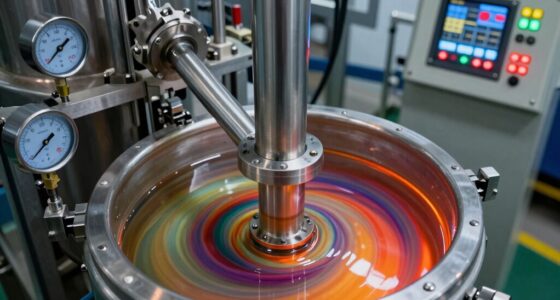
Nucleation happens when molecules gather and overcome an energy barrier to form tiny clusters called nuclei, which are the starting points for crystals or droplets. This process requires molecules to stick together despite repulsive forces and the energy cost of creating new interfaces. Once a cluster reaches a critical size, it becomes stable and can grow more easily. If you’re curious about how molecular interactions influence this process, there’s more to explore.
Listen free for 30 days with Audible
Thousands of audiobooks and originals — cancel anytime.
As an affiliate, we earn on qualifying purchases.
Key Takeaways
- Nucleation begins when molecules cluster to form a tiny, stable nucleus that initiates crystal growth.
- Overcoming an energy barrier is essential for stable nucleus formation, influenced by temperature and saturation.
- Stronger molecular attractions lower the energy needed, making nucleation easier under favorable conditions.
- Once a nucleus reaches a critical size, it becomes stable and promotes further crystal growth.
- Environmental factors and molecular forces jointly control the timing and likelihood of crystal nucleation.

Have you ever wondered how tiny droplets of water form out of vapor or how crystals begin to develop? It all starts with the process of nucleation, a fascinating phenomenon where the initial phase change or formation of a new structure occurs. At the core of nucleation are molecular interactions—the forces between individual molecules that determine whether they stay apart or come together. When vapor cools or becomes supersaturated, molecules start to cluster, but this isn’t a straightforward process. Instead, it depends heavily on overcoming energy barriers that resist the formation of stable clusters.
Imagine molecules in a vapor state floating freely. For nucleation to take place, these molecules need to come together and form a tiny, stable cluster, often called a nucleus. But forming this nucleus isn’t effortless. It requires energy to overcome the natural repulsion or disorder among molecules, which is known as an energy barrier. This barrier exists because creating a new phase, like a droplet of water or a crystal, involves both the formation of an interface and the stabilization of the new phase. The interface between the cluster and its surrounding vapor has an associated energy cost, making small clusters unstable and prone to breakup unless they reach a critical size. Molecular interactions play a crucial role in lowering this energy barrier and enabling nucleation under certain conditions.
Forming a stable nucleus requires energy to overcome the cost of creating an interface and stabilizing the new phase.
When enough molecules cluster to surpass this critical size, the energy barrier is effectively overcome, and the cluster becomes stable enough to grow. This is where molecular interactions play a crucial role. Stronger attractive forces between molecules lower the energy barrier, making nucleation easier. Conversely, weaker interactions mean you need a higher degree of supersaturation or cooling to push molecules together. Once a stable nucleus forms, additional molecules tend to attach more readily, and the process accelerates, leading to the formation of larger droplets or crystals. The thermodynamics of phase change also influence how readily nucleation occurs, depending on environmental conditions. Recognizing the role of molecular forces can help predict and control nucleation in various scientific and industrial processes.
Furthermore, understanding the energy barrier involved in nucleation can assist in controlling processes such as cloud formation or material manufacturing, where precise manipulation of nucleation is crucial. In essence, nucleation is a delicate balance of molecular interactions and energy barriers. It’s a process driven by the thermodynamics of phase change, where molecules must overcome the energy cost of forming an interface to create a stable new phase. Understanding this balance helps explain why nucleation can be so unpredictable—sometimes it happens quickly, and other times it takes a long time, depending on the conditions and the strength of the molecular interactions. So, next time you see dew on a leaf or crystals forming on a windowpane, you’re witnessing the intricate dance of molecules overcoming energy barriers to kickstart the birth of something new.
As an affiliate, we earn on qualifying purchases.
Frequently Asked Questions
How Does Temperature Influence Nucleation Rates?
Temperature effects play a vital role in nucleation rates, influencing how quickly crystals form. When you increase temperature, it often raises the energy barrier, slowing nucleation kinetics because particles need more energy to overcome this barrier. Conversely, lowering the temperature reduces this energy requirement, accelerating nucleation. So, controlling temperature allows you to manage nucleation rates, either speeding up or slowing down crystal formation depending on your desired outcome.
Can Nucleation Occur Without External Disturbances?
Yes, nucleation can occur without external disturbances through spontaneous formation, known as homogeneous nucleation. In this process, crystals initiate purely from fluctuations within the supersaturated or supercooled environment, without any impurities or surfaces acting as catalysts. You might find that at specific conditions, such as high supersaturation or supercooling, homogeneous nucleation becomes more likely, allowing crystals to form spontaneously even in a perfectly undisturbed environment.
What Role Do Impurities Play in Nucleation?
Impurities can dramatically influence nucleation, acting as powerful catalysts or deterrents. Their impurity effects are monumental—they create tiny imperfections that serve as nucleation sites, where crystals can more easily form. Without impurities, nucleation would be a much slower, less efficient process. So, you can think of impurities as the secret spark that ignites crystal growth, making the difference between a smooth or chaotic crystallization process.
Is Nucleation the Same in Liquids and Solids?
Nucleation isn’t the same in liquids and solids because the processes differ. In liquids, crystal formation begins at nucleation sites where molecules gather and form small clusters, often influenced by impurities or temperature. In solids, nucleation involves the rearrangement of atoms or molecules within the crystal lattice, usually triggered by stress or defects. While both involve nucleation sites, the mechanisms and conditions vary considerably between the two states.
How Can Nucleation Be Controlled in Industrial Processes?
Think of controlling nucleation like a conductor guiding an orchestra; you can influence when and where crystals form. By adjusting temperature, supersaturation, or adding nucleation inhibitors, you control nucleation sites and crystal morphology. This precise tuning prevents unwanted large crystals and promotes uniform growth, ensuring products meet quality standards. Your mastery over these parameters allows you to shape crystal formation, much like sculpting a masterpiece from raw material.
Conclusion
So, next time you marvel at a sparkling crystal or wonder how a simple droplet turns to ice, remember—nucleation is secretly the show’s star. It’s the tiny, invisible kickstart that sparks grand transformations, yet we often overlook it. Ironically, the tiniest seed of change holds the power to shape entire structures. So, don’t underestimate those small beginnings—they might just be the most essential part of the story you never noticed.
Fall yard work Picks
leaf blowers
As an affiliate, we earn on qualifying purchases.