
Rotary evaporators achieve smooth evaporation by carefully controlling temperature and adjusting the surface area through rotation. By maintaining temperatures below boiling points, you prevent overheating and protect heat-sensitive compounds. The rotation creates a thin film, speeding up vaporization and improving efficiency. Proper system calibration ensures safety and consistent results. Understanding the role of boiling points helps enhance the process. Keep exploring to discover more about how these factors work together for ideal solvent removal.

Get school and study supplies delivered free — and shop member deals
- Fast, free delivery on millions of items
- Access to Prime Big Deal Days deals on October 6–7
- Prime Video, Amazon Music and more included
Key Takeaways
- Rotary evaporators use controlled temperature settings below boiling points to prevent thermal degradation of sensitive compounds.
- The rotation creates a thin film, increasing surface area and promoting efficient vaporization at specific boiling points.
- Maintaining precise temperature regulation ensures smooth evaporation without overheating or delays.
- Calibration of the system optimizes conditions based on the mixture’s boiling points, enhancing process efficiency.
- Understanding boiling points helps prevent hazards and ensures effective solvent removal during evaporation.
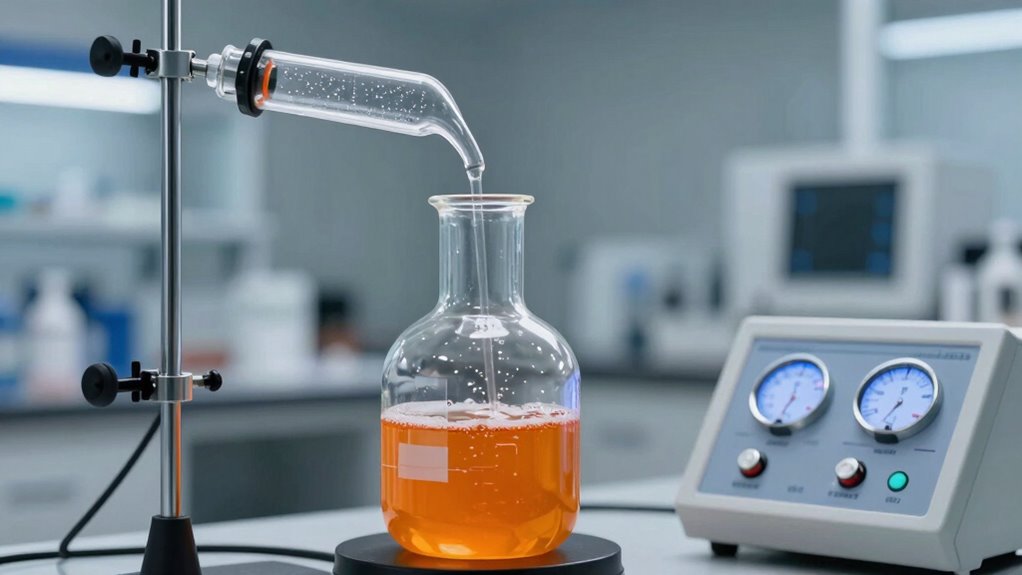
Have you ever wondered how scientists efficiently remove solvents from mixtures? The answer lies in a device called a rotary evaporator, a vital tool that simplifies the process of solvent recovery. When working with mixtures that contain volatile compounds, you want a method that’s both gentle and effective. That’s where rotary evaporators excel, offering a controlled environment to evaporate solvents without decomposing delicate substances. The key to this efficiency is temperature regulation, which allows you to set precise heat levels that match the boiling points of specific solvents. By carefully regulating temperature, you minimize overheating and prevent the loss of valuable compounds, guaranteeing a clean separation every time.
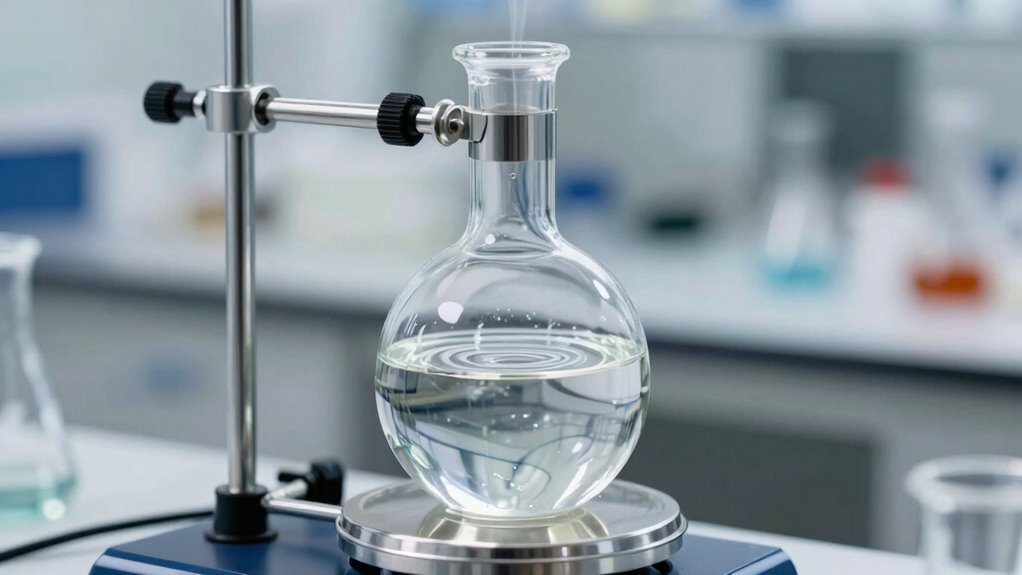
In operation, a rotary evaporator spins the flask containing your mixture, increasing the surface area of the liquid and promoting faster evaporation. As the mixture rotates, it creates a thin film along the interior wall of the flask, which exposes more of the solvent to heat and air, accelerating vaporization. The device’s temperature regulation system maintains a set temperature, often below the solvent’s boiling point, so evaporation occurs smoothly without risking thermal degradation of sensitive ingredients. This careful control is essential, especially when working with heat-sensitive compounds, because it guarantees the process remains gentle and preserves the integrity of your sample. Additionally, temperature regulation is crucial for maintaining the efficiency and safety of the evaporation process. Proper system calibration ensures consistent performance and reliable results, especially during prolonged or repeated use. Understanding how boiling points influence evaporation helps optimize the process and avoid unnecessary delays or hazards. Moreover, understanding the phase change from liquid to vapor is fundamental to controlling the evaporation process effectively. Proper awareness of chemical properties can also assist in selecting the appropriate conditions for each solvent, ensuring safety and efficiency.
rotary evaporator with temperature control
As an affiliate, we earn on qualifying purchases.
As an affiliate, we earn on qualifying purchases.
Frequently Asked Questions
How Do Rotary Evaporators Differ From Traditional Distillation Methods?
Rotary evaporators differ from traditional distillation by offering higher evaporation efficiency and better solvent recovery. You’ll notice that they gently rotate the flask, increasing surface area and allowing for faster, more uniform evaporation at lower temperatures. This reduces thermal degradation of sensitive compounds, making the process safer and more efficient. Unlike conventional methods, rotary evaporators provide precise control over temperature and pressure, enhancing both solvent recovery and overall evaporation performance.
What Safety Precautions Are Necessary When Operating a Rotary Evaporator?
You must prioritize safety when operating a rotary evaporator. Always wear protective gear to shield yourself from chemical hazards, which can be more dangerous than a wild animal! Regularly calibrate the equipment to guarantee precise temperature and vacuum control, preventing accidents. Never bypass safety features or rush the process. Staying vigilant keeps you safe from potential explosions, spills, or exposure—making your evaporation process smooth, safe, and successful.
Can Rotary Evaporators Be Used for Heat-Sensitive Compounds?
Yes, rotary evaporators are ideal for heat-sensitive compounds because of precise temperature control. You can adjust the boiling point to gently evaporate solvents without degrading delicate substances. This careful temperature management allows efficient solvent recovery while protecting sensitive materials. By maintaining ideal conditions, you guarantee smooth evaporation, maximize yield, and preserve the integrity of your compounds throughout the process.
What Maintenance Does a Rotary Evaporator Require Over Time?
You need to perform regular maintenance on your rotary evaporator, including lubrication routines to keep moving parts functioning smoothly. Seal inspections are also essential to prevent leaks and maintain vacuum integrity. Check seals periodically for wear or damage, and replace them as needed. Additionally, clean glass components and guarantee the motor and bearings are well-lubricated. Proper maintenance extends your evaporator’s lifespan and ensures peak, smooth evaporation performance.
Are Rotary Evaporators Suitable for Large-Scale Industrial Applications?
Rotary evaporators aren’t ideal for large-scale industrial applications due to scaling challenges and energy efficiency concerns. You might find them effective for lab-sized tasks, but as you scale up, they struggle with maintaining consistent performance and managing heat transfer efficiently. For industrial needs, you should consider specialized equipment designed for high-volume processing, which offers better scalability, energy efficiency, and consistent results across larger batches.
Conclusion
Imagine you’re boiling water on a stove, trying to catch every vapor before it escapes. That’s exactly what a rotary evaporator does—it gently and efficiently captures vapors, turning them back into liquid. Just like a skilled chef retains every drop of flavor, this device guarantees nothing goes to waste. With over 80% efficiency in some setups, it’s the unsung hero behind smooth, precise evaporation—making your lab work feel like a well-choreographed dance.
Fall Picks
fall essentials
As an affiliate, we earn on qualifying purchases.